


China has finalized a clandestine plan to invade Taiwan in 2020 by launching missile attacks, blocking the nation’s air and sea space, and carrying out amphibious landings, Washington-based think tank Project 2049 Institute research fellow Ian Easton said.
Easton, a former student at National Chengchi University, made the “revelation” in his new book, The Chinese Invasion Threat, released on Tuesday.
The two sides of the Taiwan Strait have been two different nations since 1949, and most analysts believe that as long as Taiwan does not declare de jure independence, the “status quo” across the Strait would be maintained, Easton said.
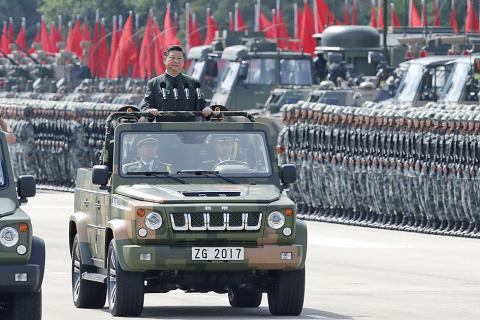
Photo: AP
However, conflict could still arise no matter what Taiwan or the US does to prevent it given the unstable situation in the Taiwan Strait, just like a levee that has been under enormous pressure and ultimately breaks, he said, adding that Washington should focus on formulating new thinking that would accentuate that Taiwan is a sovereign and free nation.
The US’ arms sales to Taiwan was the biggest factor helping Taiwan to be involved in international politics, but it is unwise for Taiwan and the US to continue increasing arms sales in bilateral relations, Easton said.
US military officials holding a two-star rank or above should make regular visits to Taiwan so that Washington could make useful assessments in the event of a crisis, he said, adding that the two sides should conduct bilateral port-of-call stops, hold joint military drills and engage in defense industry exchanges to streamline efforts in providing humanitarian aid and disaster relief, and in counterterrorism and cyberwarfare.
It would be difficult for the US to maintain a military edge over China in the long term, unless it includes Taiwan in its strategic planning, Easton said, adding that it would likewise be impossible for Taiwan to ensure its security without maintaining the US’ support.
Taiwan’s counterattack capabilities pose a threat to the Chinese People’s Liberation Army (PLA), but it should expand its arsenal of long-range and shoulder-launched missiles, drones, fighter jets and cannons, and deploy weapons with lower lethality in areas closest to China, he said.
Easton also highlighted the need for Taiwan to understand the complexity of PLA tactics for launching an assault in its outlying Penghu, Kinmen and Lienchiang islands and for it to boost its abilities to engage in electronic warfare.
The US and China are engaged in a long and tense strategic race in the Asia-Pacific region, in which the US would quickly lose its advantage over China if Beijing’s growing prominence in the region is not curbed, Easton said.
Presidential Office spokesman Sidney Lin (林鶴明) yesterday said the office had no comment on Easton’s assertions that China would invade in 2020, nor does it have any comments on the reliability of his sources.
The Ministry of National Defense has been closely monitoring movements of the Chinese military, Lin said.
“The public can rest assured that the nation’s safety is guaranteed” he said.
Chinese Nationalist Party (KMT) Legislator Ma Wen-jun (馬文君) said the threat of the PLA “liberating” Taiwan by force is ever-present, but added that Beijing’s setting of a time frame for annexing the nation through an armed assault could signal that China’s agenda has changed.
Democratic Progressive Party Legislator Lo Chih-cheng (羅致政) raised doubts over the time frame Easton asserted, saying that he did not think it is very precise.
China might be ready militarily to invade Taiwan in 2020, but that would not necessarily mean that it would also be “politically ready,” Lo said.
China also needs to assess its chances of launching a successful invasion and the consequences of an attack, which are reasons that there could be variables to a possible invasion, he said.

‘NO SECURITY RISK’: The Railway Bureau reassured the public that the technicians’ activities were limited to technical guidance and did not involve sensitive systems The Railway Bureau yesterday said it had invited eight Chinese technicians to assist with an airport MRT construction project. The bureau issued the confirmation after an Internet user said Chinese nationals had entered the construction zone of Taiwan Taoyuan International Airport’s Terminal 3 project. They asked why “individuals from an enemy state” were allowed access to such a major national infrastructure project, which raised serious concerns over Taiwan’s industrial safety, sensitive systems and information security. The bureau’s Northern Region Engineering Branch Office said subcontractor Taiwan Handle Industrial Co (台灣手把工業) of the Taoyuan airport MRT’s “Contract No. CU05 Project A14 Station Civil, MEP &

A US uncrewed surface vessel (USV) encountered multiple Chinese warships during an autonomous transit of the Taiwan Strait, US defense company Seasats said in a statement on Wednesday. Seasats announced that a Lightfish USV had completed the first autonomous transit of the Taiwan Strait. Over five days, the USV traversed the entire length of the Strait while constantly monitoring surface vessel traffic, the company said. The Lightfish encountered multiple Chinese warships, one of which was a Chinese People’s Liberation Army Navy (PLAN) Type 056 corvette, it said. The Chinese vessels were operating “well within Taiwan’s exclusive economic zone without transmitting their identity via the
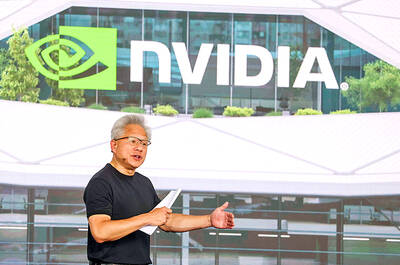
‘BOOMING’: ’ The number of partners we have here is incredible. You can see from their stock prices. They’re doing so well, they’re so happy,’ Jensen Huang said Nvidia Corp’s spending in Taiwan has ballooned to about US$150 billion a year, 10 times the US$10 billion to US$15 billion the company spent five years ago, Nvidia chief executive officer Jensen Huang (黃仁勳) said yesterday, suggesting Taiwan’s strategic importance in the global artificial intelligence (AI) supply chain. “Taiwan is the epicenter of the AI revolution. This is where the chips come, packaging comes. This is where the systems are made. This is where AI supercomputers were created,” Huang said at a meeting for the company’s employees in Beitou-Shilin Technology Park (北投士林科技園區) in Taipei, the planned site of Nvidia’s Taipei headquarters. “Taiwan
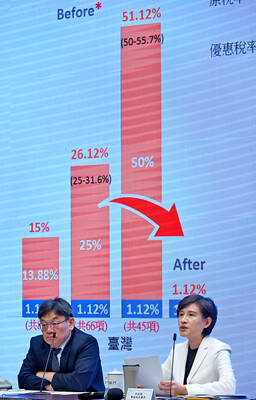
GREATER REACH? Auto parts and wood products would face tariffs of up to 15%, matching those targeting the EU, Japan and South Korea, Vice Premier said The US has announced that preferential tariff treatment for Taiwan’s non-semiconductor Section 232 goods would take effect retroactively from May 1, the Executive Yuan said yesterday. The US government yesterday posted a notice on the Federal Register’s public inspection Web site previewing tariff concessions for Taiwan under a memorandum of understanding (MOU) on Taiwan-US investment after two months of negotiations. The MOU signed on Jan. 15 stipulated three major preferential tariff arrangements: a 15 percent “reciprocal” tariff rate for Taiwan without stacking most-favored nation (MFN) rates; preferential Section 232 treatment for semiconductors and related products; and preferential Section 232 treatment for non-semiconductor


 RSS
RSS