


Sharp Corp might seek a strategic collaboration with Japan Display Inc (JDI) to build a sizeable alliance against South Korean display suppliers Samsung Electronics Co and LG Electronics Inc, Sharp president Tai Jeng-wu (戴正吳) said yesterday.
“We can work together, but there is one condition: Sharp must lead the alliance,” Tai told a news conference in Taipei.
Tai said Sharp has not yet officially approached JDI regarding the proposal, due to concerns of possible antitrust violations.
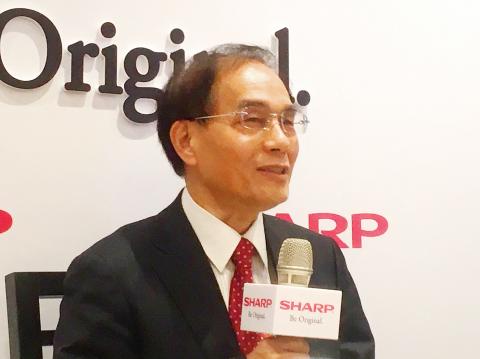
Photo: Chen Jou-chen, Taipei Times
However, there are ways for Sharp to avoid breaking the law, he said.
“Otherwise, how could [South Korean chipmaker] SK Hynix [Inc] join the bid to acquire Toshiba’s memorychip business?” Tai asked.
Tai said he views Samsung and LG as experienced sumo wrestlers who weigh more than 200kg, whereas Sharp only weighs slightly more than 150kg.
“Sharp cannot spend hundreds of billions of yen to fight against Samsung or LG alone, as we will definitely lose the game,” he said.
Tai said that firms in Japan’s display supply chain — including material and equipment suppliers — should form a “big Japanese league” to increase their competitiveness.
When asked if Sharp is to follow in Hon Hai Precision Industry Co’s (鴻海精密) footsteps and build plants in the US, Tai said Sharp is evaluating the feasibility of investing in the nation and hopes it could help expand the firm’s overseas revenue contribution from 68 percent to 80 percent.
“North America is such a big market. We will definitely go if the investment opportunity benefits Sharp,” he said.
However, the company does not plan to acquire Vizio Inc, the US’ second-largest television manufacturer, Tai said.
“I am promoting Sharp’s brand in the US, but we will not buy other brands,” he said.
Tai’s remarks came amid rumors that Sharp is interested in buying Vizio with help from Hon Hai, after Leshi Internet Information and Technology Corp’s (LeEco, 樂視) US$2 billion acquisition of Vizio collapsed.
As part of efforts to boost Sharp’s overseas revenue, Tai on Aug. 1 took over as the firm’s head of global sales to closely oversee sales performance abroad and in Taiwan, he said.
Sharp aims to increase its market share in Taiwan to 40 percent as soon as possible, Tai said, without disclosing the current share or a time frame.
The company is to allocate more marketing resources in Taiwan, including inking an endorsement agreement with Taiwanese singer and actor Crowd Lu (盧廣仲) to promote Sharp TVs, Tai said.

South Korea has adjusted its electronic arrival card system to no longer list Taiwan as a part of China, a move that the Ministry of Foreign Affairs said would help facilitate exchanges between the two sides. South Korea previously listed “Taiwan” as “Taiwan (China)” in the drop-down menus of its online arrival card system, where people had to fill out where they came from and their next destination. The ministry had requested South Korea make a revision and said it would change South Korea’s name on Taiwan’s online immigration system from “Republic of Korea” to “Korea (South),” should the issue not be

Tainan, Taipei and New Taipei City recorded the highest fines nationwide for illegal accommodations in the first quarter of this year, with fines issued in the three cities each exceeding NT$7 million (US$220,639), Tourism Administration data showed. Among them, Taipei had the highest number of illegal short-term rental units, with 410. There were 3,280 legally registered hotels nationwide in the first quarter, down by 14 properties, or 0.43 percent, from a year earlier, likely indicating operators exiting the market, the agency said. However, the number of unregistered properties rose to 1,174, including 314 illegal hotels and 860 illegal short-term rental
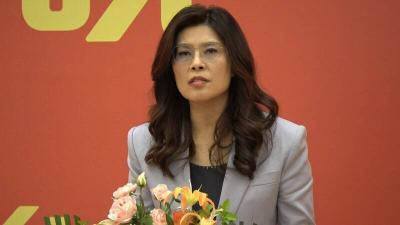
Both sides of the Taiwan Strait share a political foundation based on the “1992 consensus” and opposition to Taiwanese independence, Chinese Nationalist Party (KMT) Chairwoman Cheng Li-wun (鄭麗文) today said during her meeting with Chinese President Xi Jinping (習近平). Both sides of the Strait should plan and build institutionalized and sustainable mechanisms for dialogue and cooperation based on that foundation to make peaceful development across the Strait irreversible, she said. Peace is a shared moral value across the Strait, and both sides should move beyond political confrontation to seek institutionalized solutions to prevent war, she said. Mutually beneficial cross-strait relations are what the
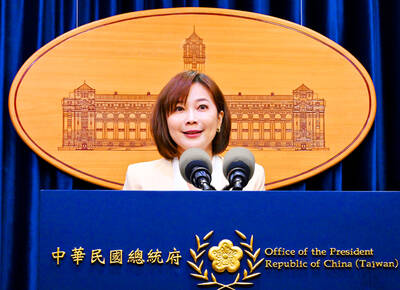
ECONOMIC COERCION: Such actions are often inconsistently applied, sometimes resumed, and sometimes just halted, the Presidential Office spokeswoman said The government backs healthy and orderly cross-strait exchanges, but such arrangements should not be made with political conditions attached and never be used as leverage for political maneuvering or partisan agendas, Presidential Office spokeswoman Karen Kuo (郭雅慧) said yesterday. Kuo made the remarks after China earlier in the day announced 10 new “incentive measures” for Taiwan, following a landmark meeting between Chinese President Xi Jinping (習近平) and Chinese Nationalist Party (KMT) Chairwoman Cheng Li-wun (鄭麗文) in Beijing on Friday. The measures, unveiled by China’s Xinhua news agency, include plans to resume individual travel by residents of Shanghai and China’s Fujian


 RSS
RSS