


Aboriginal rights campaigners yesterday condemned the government for having not carried out a promise to reinstate traditional Aboriginal territories, and they demanded that an independent agency be established to restore Aboriginal rights to land and transitional justice.
President Tsai Ing-wen (蔡英文) on Aug. 1 last year delivered a landmark apology to Taiwan’s Aborigines for their deprivation of rights in the hundreds of years since the mass migration of Han people began.
She promised to reinstate land rights, self-determination, economic development, cultural and language preservation and other rights protection.
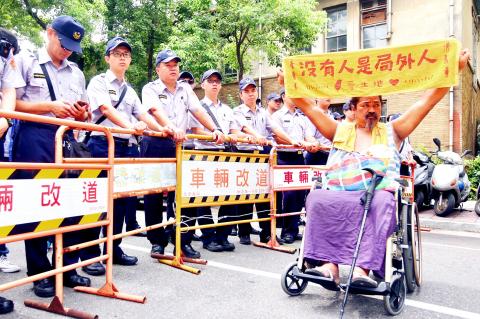
Photo: CNA
Tsai yesterday said the government has worked to preserve Aboriginal languages and culture by immersing Aboriginal preschoolers and students in a learning environment where their native languages are spoken.
Aboriginal campaigners who have been staging a camp-out near the Presidential Office Building in Taipei for 160 days said Tsai had failed to keep her promises to restore Aboriginal rights.
They criticized the guidelines the Cabinet released on Feb. 14 on the delineation of traditional Aboriginal territories, which would restrict the application of the “traditional area” label to government-owned land, explicitly excluding private land.
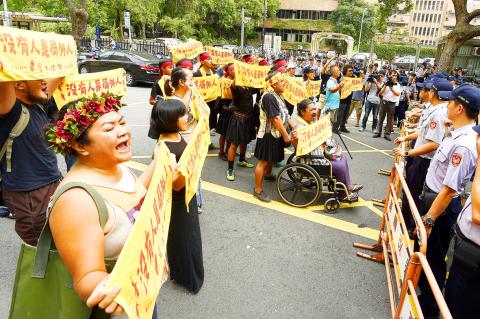
Photo: Chen Chih-chu, Taipei Times
It would reduce recognized traditional territories from 1.8 million hectares to 800,000 hectares while companies would be allowed to develop traditional Aboriginal land that is now in private hands without the consent of local Aborigines, they said.
“Tsai promised that the government would prioritize the issue of traditional territories, but it turns out it is only limited to government-owned land,” Amis activist Panai Kusui said.
Documentary filmmaker Mayaw Biho, an Amis who has been an active member of the camp-out, called on the government to legislate an Aboriginal transitional justice law and establish an agency similar to the Cabinet’s Ill-gotten Party Assets Settlement Committee to investigate the deprivation of Aboriginal rights.
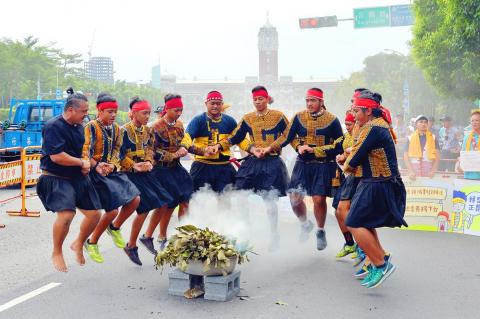
Photo: CNA
That would be a way to achieve understanding and reconciliation, he said.
The Presidential Office’s Indigenous Historical Justice and Transitional Justice Committee, which was established last year to understand the history of Aboriginal rights deprivation and reinstate those rights, does not have the necessary executive or investigative powers to perform its functions, Mayaw said.
“It is an irresponsible reform if the ruling party acts like it has done a lot and put in a great deal of effort in an effort to convince the public it is trying to tackle a problem,” Sunflower movement leader Lin Fei-fang (林飛帆) said.
Lin criticized Presidential Office Deputy Secretary-General Yao Jen-to (姚人多) and Democratic Progressive Party Legislator Kolas Yotaka for saying that the protesters do not respresent the nation’s Aborigines.
“Why can a person in power [Yao] be so careless about his authority, but treat protesters in quite a different way? What is the difference between the government and the Chinese Nationalist Party [KMT]?” Lin said.
The Executive Yuan said that efforts are under way to provide further protection to Aboriginal languages, land and resource rights.
The president has held talks with Aboriginal delegates, and the traditional territories delineation guidelines and landmark Aboriginal Language Development Act (原住民族語言發展法) have been promulgated, while legal rulings have been made to ensure that Aborigines could practice traditional hunting, fishing and harvesting, the Executive Yuan said.
The Cabinet has also completed the preliminary investigation into a government decision to deposit nuclear waste on Orchid Island (蘭嶼, Lanyu) without the knowledge and consent of the local Tao community when Chiang Ching-kuo (蔣經國) and Sun Yun-suan (孫運璿) were premier.
The Cabinet will create an institutional environment for the development of Aboriginal cultures and achieve transitional justice and harmony between ethnic groups, the Executive Yuan said.

LEVERAGE: China did not ‘need to fire a shot’ to deny Taiwan airspace over Africa when it owns ‘half the continent’s debt,’ a US official said, calling it economic warfare The EU has raised concerns about overflight rights following the delay of President William Lai’s (賴清德) planned state visit to the Kingdom of Eswatini after three African nations denied overflight clearance for his charter at the last minute. Taiwanese allies Paraguay and Saint Kitts and Nevis, as well as several US lawmakers and the Inter-Parliamentary Alliance on China (IPAC) condemned China for allegedly pressuring the countries. Lai was scheduled to fly directly to Taiwan’s only African ally from yesterday to Sunday to celebrate the 40th anniversary of King Mswati III’s accession and his 58th birthday, but Seychelles, Mauritius and Madagascar suddenly revoked
The number of pet cats in Taiwan surpassed that of pet dogs for the first time last year, reaching 1,742,033, a 32.8 percent increase from 2023, the Ministry of Agriculture said yesterday, citing a survey. By contrast, the number of pet dogs declined slightly by 1.2 percent over the same period to 1,462,528, the ministry said. Despite the shift, households with dogs still slightly outnumber those with cats by 1.2 percent. However, while the number of households with multiple dogs has remained relatively stable, households keeping more than two cats have increased, contributing to the overall rise in the feline population. The trend
China on Wednesday teased in a video an aircraft carrier that could be its fourth, and the first using nuclear power, while making an allusion to Taiwan and vowing to further build up its islands, as it looks to boost maritime power, secure resources and bolster territorial claims. The video, issued on the eve of the 77th founding anniversary of the Chinese People’s Liberation Army Navy, featured fictional officers with names that are homophones of three commissioned aircraft carriers, the Liaoning (遼寧), Shandong (山東) and Fujian (福建). Titled Into the Deep, it showed a 19-year-old named “Hejian” (何劍) joining the group, sparking
Taiwan has signed six arms procurement offers from the US totaling more than NT$208 billion (US$6.59 billion) covering long-range precision strike systems, missile stockpile replenishment and joint production of large-caliber ammunition, the Ministry of National Defense said yesterday. The government’s proposed NT$1.25 trillion special defense budget has been stalled in the Legislative Yuan as opposition lawmakers question the amount and procurement items, while the Presidential Office and defense ministry say that the full amount is necessary to safeguard Taiwan. Minister of National Defense Wellington Koo (顧立雄) on Monday briefed the legislature’s Foreign Affairs and National Defense Committee on the defense budget for


 RSS
RSS