


Taiwanese officials are to bring up the procurement of Lockheed Martin F-35B jets and submarine technology in the Monterey Talks, an annual high-level defense dialogue in the US scheduled for the middle of next month.
The precise time and location of the talks is classified.
It is believed that key members of the US government are to be present, a high-ranking official said on condition of anonymity.
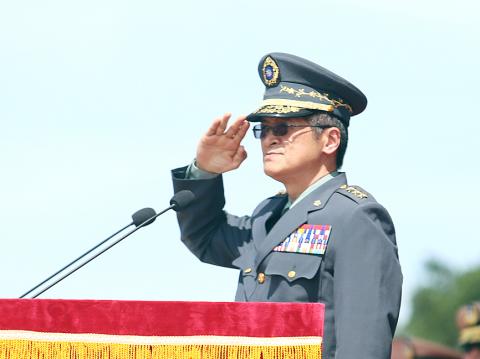
Photo: CNA
It is to be the first round of the talks since US President Donald Trump took office.
The meeting is the highest level of dialogue between the two nations.
Historically, it is attended by the top leaders of the two nations’ defense, intelligence and diplomatic establishments, as well as the commander of the US Pacific Command, the director of the American Institute in Taiwan and Taiwan’s representative to the US.
Previously, it was reported that President Tsai Ing-wen’s (蔡英文) administration wished to upgrade its delegation by sending National Security Council Secretary-General Yen Teh-fa (嚴德發), but the official dismissed the story.
The Cabinet, following precedent, instead named council Deputy Secretary-General York Chen (陳文政) as envoy.
Vice Minister of National Defense Pu Tze-chun (蒲澤春), Deputy Minister of Foreign Affairs Paul Chang (章文樑) and Mainland Affairs Council Deputy Minister Lin Cheng-yi (林正義) are also expected to attend.
The US government has not fixed its list of attendees, the official said in response to speculation about which US officials would attend.
“Experience tells us that high-ranking officials often do little more than show up at the banquet before leaving, giving little time to talk. The important thing is to meet officials who are in charge of things that are relevant to us,” the official added.
Last month, the Trump administration approved the sale of eight classes of weapons and technologies, including ground-attack missiles and torpedoes — a sale that was originally scheduled to be approved before Trump took office.
However, the Tsai administration also wants to buy F-35B jets — a variant of the fifth-generation fighter-bomber that is capable of vertical takeoff and short landings — and wishes to obtain technology for the nation’s domestic submarine program.
The F-35B’s ability to operate from improvised runways could be a boon to Taiwan’s defense if its airbases came under attack by Chinese missiles, while domestically built submarines would be important in attrition and defense.
However, the nation’s diplomats talk about arms sales whenever they meet US defense officials, the official said.
“Such discussions are certainly to be expected at the Monterey Talks. We also anticipate that no immediate conclusion will be reached at the meeting. The US side is not going to say yes or no on the spot. Instead, they are going to speak in ambiguous terms and take the transcripts back for further consideration,” the official said.
When asked to comment on the possibility that the US Navy might make port calls in Taiwan, the official said that the issue rests with the US Congress in its review of the National Defense Authorization Act for the US’ next fiscal year.
“As a matter of etiquette, the executive and legislative branches need to be kept separate. It will not be appropriate to talk about this with their executive departments,” the official said.

‘NO SECURITY RISK’: The Railway Bureau reassured the public that the technicians’ activities were limited to technical guidance and did not involve sensitive systems The Railway Bureau yesterday said it had invited eight Chinese technicians to assist with an airport MRT construction project. The bureau issued the confirmation after an Internet user said Chinese nationals had entered the construction zone of Taiwan Taoyuan International Airport’s Terminal 3 project. They asked why “individuals from an enemy state” were allowed access to such a major national infrastructure project, which raised serious concerns over Taiwan’s industrial safety, sensitive systems and information security. The bureau’s Northern Region Engineering Branch Office said subcontractor Taiwan Handle Industrial Co (台灣手把工業) of the Taoyuan airport MRT’s “Contract No. CU05 Project A14 Station Civil, MEP &

The National Chungshan Institute of Science and Technology yesterday showcased its locally developed variants of the Vision 60 robotic patrol dog, which it plans to deploy on the nation’s outlying territories in the South China Sea. The variants were produced under the Joint Lab project — created by the institute and domestic companies — and assembled with domestically produced motors, lenses and artificial intelligence (AI) systems alongside licensed tech from the US, Missile and Rocket Systems Research Division deputy director Jen Kuo-kang (任國光) told the media event at a military base in Taipei’s Dazhi (大直) area. Taiwan has built up its strengths

TIT-FOR-TAT: The US allegedly revoked the visa of a Chinese national working at Xinhua News Agency in the US in response to Beijing’s expulsion of Vivian Wang The Presidential Office yesterday condemned China for expelling a New York Times correspondent from Beijing following the newspaper’s interview with President William Lai (賴清德), saying the move highlighted Beijing’s suppression of press freedom and its threat to international news media. Taiwan has noted a series of recent incidents in which Beijing used similar tactics to “threaten and pressure international media outlets and journalists,” Presidential Office spokeswoman Karen Kuo (郭雅慧) said in a statement. “This concerns not only press freedom and freedom of expression, but also the safety of journalists, and Taiwan and relevant partners are paying close attention to the situation,” she

NOT IMMEDIATE: Taiwan has a chance to appeal the proposed 10 percent tariff before it starts, while other countries face a 12.5 percent tariff from the trade office Taiwan is among 60 economies determined by the US to have failed to impose or enforce a ban on the importation of goods produced with forced labor, according to a notice released on Tuesday by the Office of the US Trade Representative (USTR), which proposed imposing an additional 10 percent or more tariff on them. The USTR in a statement said that following an investigation, it had determined under Section 301 of the Trade Act of 1974 that the failure of the 60 economies to impose and effectively enforce a prohibition on the importation of goods produced with forced labor is


 RSS
RSS