


Taiwanese military jets scrambled to shadow a Chinese aircraft carrier passing through the Taiwan Strait en route to Hong Kong to mark the 20th anniversary of the former British colony’s return to China.
Chinese President Xi Jinping (習近平) on Saturday swore in Hong Kong’s new leader with a stark warning that Beijing would not tolerate any challenge to its authority in the divided territory, in his strongest speech yet amid concerns over what some perceive as increased meddling by Beijing.
The Soviet-built Liaoning, whose home port is in northern China, on Saturday entered Taiwan’s air defense identification zone (ADIZ) and was sailing just west of the middle of the Taiwan Strait, the Ministry of Defense said in a statement.
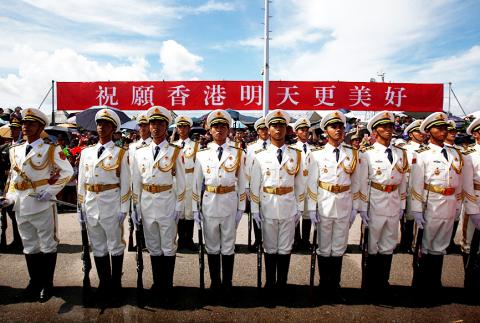
Photo: Reuters
Taiwan deployed military jets and ships to monitor the fleet’s passage, the ministry said.
Nothing abnormal had been detected as the Chinese battle group headed southwest and was expected to leave Taiwan’s ADIZ by yesterday evening, the ministry said.
The naval formation headed by the Liaoning entered Taiwan’s ADIZ on Saturday and was yesterday sailing southwest along the Taiwan Strait, the Ministry of National Defense said.
The battle group was sailing west of the Taiwan Strait’s mid-line, the ministry said, predicting that it would leave the ADIZ by 8:30pm yesterday. This could not be confirmed as of press time last night.
Under the military’s regulations for handling quickly changing conditions during periods of regular combat readiness, aircraft and ships were dispatched to monitor the formation’s movement and the military would take responsive action in the event of any abrupt developments, the ministry said.
“Currently no such situation has occurred,” it added.
The Liaoning is to be open to the public in Hong Kong to showcase the “military might” of the Chinese People’s Liberation Army Navy, Xinhua news agency cited its spokesman, Liang Yang (梁陽), as saying.
It is due to arrive on Friday, Hong Kong media said.
The formation is comprised of the Liaoning, the destroyers Jinan and Yinchuan, the frigate Yantai, and a squadron of J-15 fighter jets and helicopters, Yang told reporters.
It was the third time that the Liaoning has sailed near Taiwan in past months for what Beijing has said were routine drills in December last year and again in January.
China has never renounced the use of force to bring Taiwan under its control.

‘NO SECURITY RISK’: The Railway Bureau reassured the public that the technicians’ activities were limited to technical guidance and did not involve sensitive systems The Railway Bureau yesterday said it had invited eight Chinese technicians to assist with an airport MRT construction project. The bureau issued the confirmation after an Internet user said Chinese nationals had entered the construction zone of Taiwan Taoyuan International Airport’s Terminal 3 project. They asked why “individuals from an enemy state” were allowed access to such a major national infrastructure project, which raised serious concerns over Taiwan’s industrial safety, sensitive systems and information security. The bureau’s Northern Region Engineering Branch Office said subcontractor Taiwan Handle Industrial Co (台灣手把工業) of the Taoyuan airport MRT’s “Contract No. CU05 Project A14 Station Civil, MEP &

The National Chungshan Institute of Science and Technology yesterday showcased its locally developed variants of the Vision 60 robotic patrol dog, which it plans to deploy on the nation’s outlying territories in the South China Sea. The variants were produced under the Joint Lab project — created by the institute and domestic companies — and assembled with domestically produced motors, lenses and artificial intelligence (AI) systems alongside licensed tech from the US, Missile and Rocket Systems Research Division deputy director Jen Kuo-kang (任國光) told the media event at a military base in Taipei’s Dazhi (大直) area. Taiwan has built up its strengths
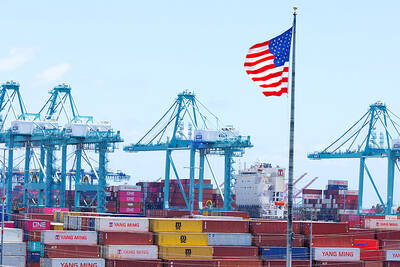
NOT IMMEDIATE: Taiwan has a chance to appeal the proposed 10 percent tariff before it starts, while other countries face a 12.5 percent tariff from the trade office Taiwan is among 60 economies determined by the US to have failed to impose or enforce a ban on the importation of goods produced with forced labor, according to a notice released on Tuesday by the Office of the US Trade Representative (USTR), which proposed imposing an additional 10 percent or more tariff on them. The USTR in a statement said that following an investigation, it had determined under Section 301 of the Trade Act of 1974 that the failure of the 60 economies to impose and effectively enforce a prohibition on the importation of goods produced with forced labor is

RIGHT DIRECTION: Taiwan’s efforts to prevent forced labor include a proposal to ‘fully prohibit’ employers from withholding workers’ documents, an official said Taiwan is to establish a mechanism to restrict imports of goods linked to forced labor, the Executive Yuan said yesterday, after the US proposed imposing additional tariffs on Taiwanese goods over labor concerns. “The Ministry of Labor and the Ministry of Economic Affairs are to establish an interministerial review procedure,” Executive Yuan spokesperson Michelle Lee (李慧芝) said at a news briefing in Taipei. “The government is to use the Foreign Trade Act [貿易法] as the legal basis to restrict imports of goods produced with forced labor” and bring its supply chain governance more in line with international standards on human rights, resilience


 RSS
RSS