


Thousands of protesters yesterday marched from the Executive Yuan to the Presidential Office Building in Taipei to back demands that the government terminate a controversial extension of Asia Cement Corp’s (亞泥) mining rights in Hualien County’s Sincheng Township (新城).
Members of protest organizer Citizen of the Earth, Taiwan (CET) and others gathered in front of the Control Yuan shouting: “Abolish Asia Cement’s mining rights! Reform the mining sector!”
Democratic Progressive Party (DPP) Legislator Lin Shu-fen (林淑芬) said Asia Cement did not obtain the consent of Aboriginal landowners before applying for the extension of its mining rights, which it should have done to conform to Article 21 of the Indigenous Peoples Basic Act (原住民基本法).
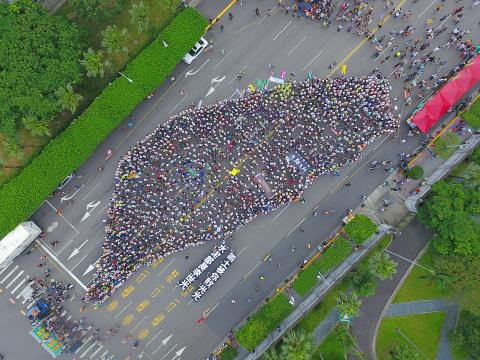
Photo courtesy of Citizens of the Earth, Taiwan
The Ministry of Economic Affairs said on Monday last week that its approval of the extension was not illegal, with Executive Yuan spokesperson Hsu Kuo-yung (徐國勇) saying the administration supports the ministry’s decision.
“Is the Indigenous Peoples Basic Act not a legal regulation?” Lin said. “Should the Executive Yuan not do its job according to the law?”
The CET led protesters to the Executive Yuan, which was guarded by dozens of police officers with shields in front of the main gate of the compound.
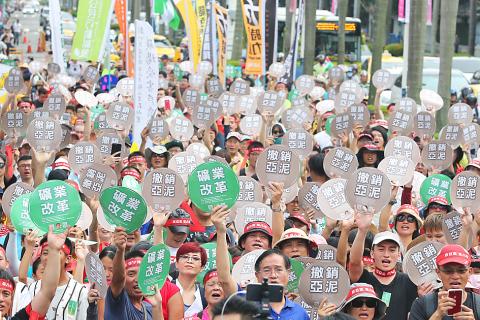
Photo: CNA
“If Aborigines can be deprived of their land, are the properties of other people not also likely to be expropriated by the authorities at some point?” CET researcher Pan Cheng-cheng (潘正正) said.
Performing on a stage mounted on a truck that drove alongside the marchers, musician Huang Wei-jie (黃瑋傑) told the crowd: “Do not forget what kind of power and responsibility we have in our hands.”
At one point during the march the protesters formed the outline of Taiwan proper.
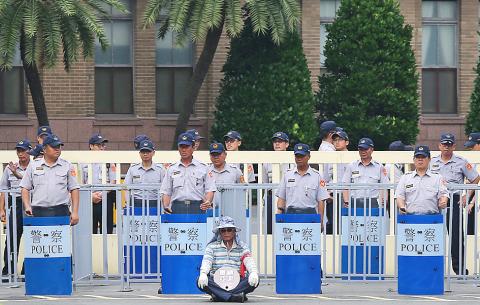
Photo: CNA
By 6pm there were about 7,000 protesters on Ketagalan Boulevard facing the Presidential Office Building, the Wild at Heart Legal Defense Association posted on Facebook.
From her wheelchair, Tien Chun-chou (田春綢), a 74-year-old Truku Aborigine, said that she has fought for 20 years to reclaim her family’s land from Asia Cement.
Political commentator Yao Li-ming (姚立明) said he had followed the mining extension issue since March.
“You can see that most protesters are, unlike me, young people,” he said. “They can see very clearly how the bureaucracy has been covering up for corporations.”
Another protester surnamed Juan (阮), who works as a consultant for land developers, said he was surprised to learn that the company’s extension had been granted in just three months.
“We always face a lot of difficulties when applying for land development permits,” he said.
DPP Legislator Chen Man-li (陳曼麗), who joined the march, said the government should request that all mining firms stop their mining activity until problems with the Mining Act are resolved.
However, the current extraordinary session of the legislature is unlikely to review proposed amendments to the act, as it has many other bills to review, Chen said.
Asia Cement’s mining activities in Sincheng came under renewed criticism after aerial footage from documentary filmmaker Chi Po-lin (齊柏林) — who was killed on June 10 in a helicopter crash while filming — appeared to show that it has expanded its mining operations.
President Tsai Ing-wen (蔡英文) on Saturday presented a posthumous commendation for Chi Po-lin to his father, Chi Wei-hsin (齊維新), at a retrospective of the filmmaker and photographer’s work at Songshan Cultural and Creative Park in Taipei.
Losing Chi was like losing “a pair of divine eyes,” she said, adding that the government would reform the mining sector.
Asia Cement Corp yesterday expressed its respect for the opinions of every individual and group.
In a four-point statement on its Web site, it said its current mining operation in Hualien County is not within the boundaries of Taroko National Park, adding that it has been abiding by the law and welcomes examination by all sides.
It will follow the government’s policies in promoting the economy and would make contributions toward sustainable development in Taiwan, it said.

A signaling system malfunction disrupted high-speed rail (HSR) services beginning at 8am today, with trains temporarily reduced to three northbound and three southbound trains per hour as authorities conduct inspections. The malfunction occurred on a section of track in Miaoli County during pre-operation checks early this morning, forcing northbound and southbound trains to use a single track, the HSR operator said. The regular schedule has been replaced with three hourly trains offering only nonreserved seating in each direction, stopping at every station, it said, adding that business class cars would still have reserved seating. Departures from terminal stations are scheduled at the top

DRONE CENTRAL: Taiwan aims to become Asia’s democratic hub for drones, with most exports focused on high-quality military-grade models, an official said Taiwan’s drone industry is expected to expand significantly by 2030, producing 100,000 units per month and exporting half of them, the Ministry of Economic Affairs said yesterday. Current drone production capacity is about 15,000 units per month, but the industry can quickly scale up as demand increases, Industrial Development Administration Director-General Chiou Chyou-huey (邱求慧) told a news conference in Taipei. Taiwan’s drone output grew 2.5-fold last year to NT$12.9 billion (US$408.3 million) under a government program to develop the uncrewed vehicle sector, he said. The Executive Yuan in October last year approved plans to invest NT$44.2 billion into domestic production of uncrewed aerial

VERBOSE VESSELS: A CGA cutter and a China Coast Guard exchanged verbal barbs for more than a day in Taiwanese-controlled waters before the Chinese vessel left The Taiwanese and Chinese coast guards had a standoff near the strategically located Pratas Islands (Dongsha Islands, 東沙群島) in the north of the South China Sea, the Coast Guard Administration (CGA) said yesterday. The two sides engaged in intense radio exchanges over sovereignty claims during the 33-hour standoff. China Coast Guard vessel 3501 eventually left the restricted waters, 26.6 nautical miles (49.2km) west of the Pratas Islands, at 5pm yesterday, the CGA said. Lying approximately between southern Taiwan and Hong Kong, the Taiwan-controlled Pratas are seen by some security experts as vulnerable to Chinese attack due to their distance — more than
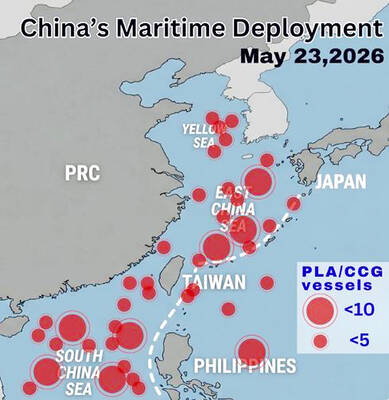
WARNING: China should stop engaging in actions that undermine regional peace and stability, as it would only build resentment among people across the Strait, the CGA said China has deployed more than 100 navy, coast guard and other vessels in waters from the Yellow Sea to the South China Sea and the western Pacific since US President Donald Trump and Chinese President Xi Jinping (習近平) met in Beijing, National Security Council Secretary-General Joseph Wu (吳釗燮) said yesterday. “In this part of the world, #China is the one & only PROBLEM wrecking the #StatusQuo & threatening regional peace & stability,” Wu wrote on X. In a separate post, he said Beijing was coercing Taiwan’s maritime domain, calling it illegal and provocative, after the Coast Guard Administration (CGA) expelled a


 RSS
RSS