


Russian opposition demonstrators yesterday appeared in court after nationwide anti-corruption protests called by leading Kremlin critic Alexei Navalny, who was slapped with a 30-day jail sentence.
More than 1,700 people were detained at Monday’s demonstrations, mainly in Moscow and Saint Petersburg, but the Kremlin said police had acted correctly and slammed the “dangerous” actions of protesters.
Several criminal probes into violence against police were launched, although protesters said it was the police who used excessive force.
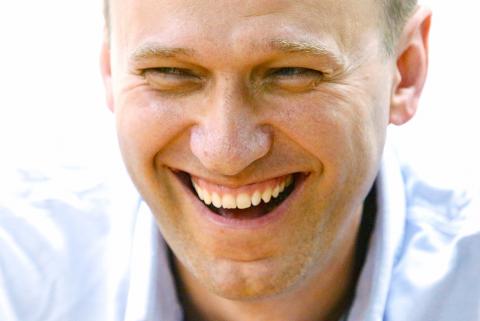
Photo: Reuters
Many spent the night in police stations and were shuttled to court for violating demonstration regulations that could see them spend up to 15 days in jail.
At the Tverskoi District Court in Moscow, 19-year-old Roman said he was grabbed by five riot policemen before being bundled into a van with 20 others.
“They put me in an arm lock and hit me in the stomach,” said the student, who could face a fine after attending his first unauthorized rally.
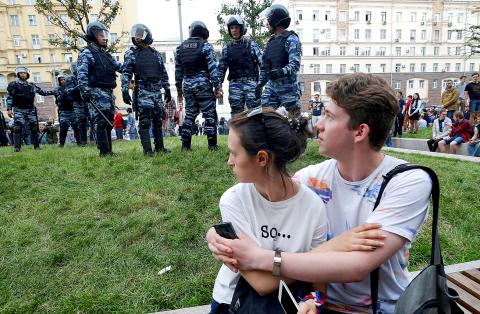
Photo: Reuters
Others were less lucky, with the same court sentencing three people to 10 days in jail.
The Moscow protest was originally sanctioned in a different location, but Navalny changed the venue, saying that authorities were blocking efforts to rent a stage and sound equipment.
He called on supporters to go to the arterial Tverskaya Street instead.
He himself never made it to the protest as police arrested him in the stairwell of his apartment building before the rally began.
The 41-year-old has announced his intention to run for president against Russian President Vladimir Putin and has been campaigning relentlessly around the nation while also mounting a strong online presence via YouTube videos, attracting a younger generation, including minors.
Kremlin spokesman Dmitry Peskov said authorized rallies were “normal,” but dubbed people taking their protest to city festivities as “provocateurs.”
The powerful Russian Investigative Committee yesterday said one protester “sprayed tear gas into the eyes of a riot police officer who was carrying out his duties during the unsanctioned rally” and would be charged.
Another criminal case was launched in Saint Petersburg, where a policeman had a tooth knocked out, local news Web site Fontanka reported.
The protests in cities from Vladivostok to the Black Sea resort of Sochi and Norilsk beyond the Arctic Circle follow a previous unsanctioned rally called by Navalny on March 26 that sparked a similar police reaction.
The rallies are the largest to be held nationwide since a wave of street actions in 2011 to 2012 protesting against Putin’s re-election to a third Kremlin term.
The arrests have drawn condemnation from Washington, Brussels and several human rights organisations, who called on protesters to be released.
“The Russian people deserve a government that supports an open marketplace of ideas,” White House spokesman Sean Spicer said.
Amnesty International said that “a crackdown on peaceful protests in which hundreds of people were arrested and numerous others beaten by police demonstrates the authorities’ utter contempt for fundamental human rights.”

SILENCING CRITICS: In addition to blocking Taiwan, China aimed to prevent rights activists from speaking out against authoritarian states, a Cabinet department said The Ministry of Foreign Affairs (MOFA) yesterday condemned transnational repression by Beijing after RightsCon, a major digital human rights conference scheduled to be held in Zambia this week, was abruptly canceled due to Chinese pressure over Taiwanese participation. This year’s RightsCon, the world’s largest conference discussing issues “at the intersection of human rights and technology,” was scheduled to take place from tomorrow to Friday in Lusaka, and expected to draw 2,600 in-person attendees from 150 countries, along with 1,100 online participants. However, organizers were forced to cancel the event due to behind-the-scenes pressure from China, the ministry said, expressing its “strongest condemnation”
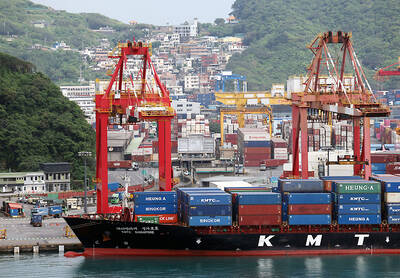
Taiwan’s economy grew far faster than expected in the first quarter, as booming demand for artificial intelligence (AI) applications drove a surge in exports, spilling over into investment and consumption, the Directorate-General of Budget, Accounting and Statistics (DGBAS) said yesterday. GDP growth was 13.69 percent year-on-year during the January-to-March period, beating the DGBAS’ February forecast by 2.23 percentage points and marking the most robust growth in nearly four decades, DGBAS senior official Chiang Hsin-yi (江心怡) told a news conference in Taipei. The result was powered by exports, which remain the backbone of Taiwan’s economy, Chiang said. Outbound shipments jumped 51.12 percent year-on-year to
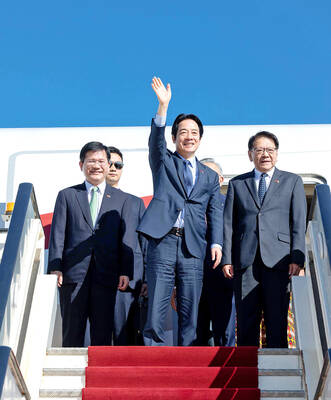
DELAYED BUT DETERMINED: The president’s visit highlights Taiwan’s right to international engagement amid regional pressure from China President Willaim Lai (賴清德) yesterday arrived in Eswatini, more than a week after his planned visit to Taiwan’s sole African ally was suspended because of revoked overflight permits. “The visit, originally scheduled for April 22, was postponed due to unforeseen external factors,” Lai wrote on social media. “After several days of careful arrangements by our diplomatic and national security teams, we successfully arrived today.” Lai said he looked forward to further deepening Taiwan-Eswatini relations through closer cooperation in the economy, agriculture, culture and education, as well as advancing the nation’s international partnerships. The president was initially scheduled to arrive in time to celebrate
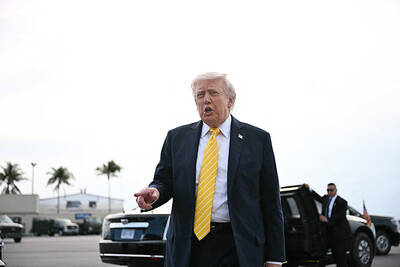
Iran’s Islamic Revolutionary Guard Corp (IRGC) yesterday said the US faced a choice between an “impossible” military operation or a “bad deal” with Tehran, after US President Donald Trump disparaged Iran’s latest peace proposal. Negotiations between the two countries have been deadlocked since a ceasefire came into effect on April 8, with only one round of direct peace talks held so far. Iran’s Tasnim and Fars news agencies reported that Tehran had submitted a 14-point proposal to mediator Pakistan, but Trump was quick to cast doubt on it. “I will soon be reviewing the plan that Iran has just sent to us, but


 RSS
RSS