


The National Immigration Agency yesterday said that an 18-year-old Hong Kong woman who allegedly jumped bail in the territory after being accused of offenses in last year’s Mong Kok civil unrest has overstayed her visa by more than four months.
Lee Sin-yi (李倩怡) — who Hong Kong news Web site am730 on Thursday reported was in Taiwan on a tourist visa, but seeking asylum — was one of 91 people detained by Hong Kong police after the unrest over the Lunar New Year.
She was to attend her first court hearing on Jan. 17 at a district court after being released on bail, am730 reported.
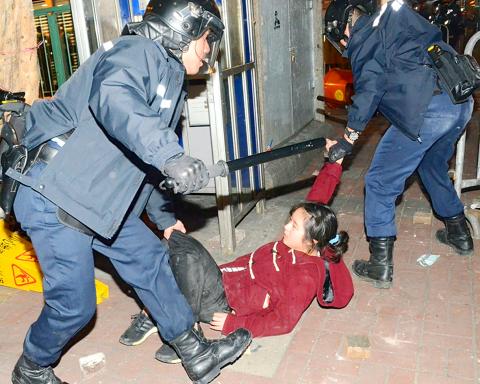
Screen grab from the Sing Tao Daily Web site, http://std.stheadline.com
However, the Chinese-language Headline Daily yesterday reported that Lee had allegedly fled the territory to seek asylum in Taiwan.
She was listed as a wanted person on Thursday last week after skipping her court hearing, it said.
The unrest erupted after the Hong Kong government sought to evict unlicensed food vendors from the Mong Kok area during the Lunar New Year holidays.
Protesters clashed with authorities in a bid to prevent the evictions.
Lee was charged with one count of assaulting a police officer and two counts of rioting.
The immigration agency said that Lee had passed through Taiwanese customs on Jan. 6, but there was no record that she had exited the country.
The Mainland Affairs Council on Thursday said that the government would observe all interactions with residents from Hong Kong and Macau as stipulated in the Act Governing Relations With Hong Kong and Macau (香港澳門關係條例).
The council said that it has not received a request for asylum from Lee.
The immigration agency would process Lee according to the regulations once she has been located, it said.
Hong Kong police yesterday declined to comment on the ongoing investigation.

KEY INDUSTRY: The vice premier discussed a plan to create a non-red drone supply chain by next year, which has been allocated a budget of more than NT$7.2 billion The government has budgeted NT$44.2 billion (US$1.38 billion) to cultivate Taiwan’s uncrewed aerial vehicle (UAV) industry over the next five years, which would make the nation a major player in the industry’s democratic supply chain in the Asia-Pacific region, Premier Cho Jung-tai (卓榮泰) said yesterday. Cho made the remarks during a visit to the facilities of Cub Elecparts Inc (為升電裝). Democratic Progressive Party (DPP) Legislator Chen Su-yueh (陳素月) and Chinese Nationalist Party (KMT) Legislator Hsieh Yi-fong (謝依鳳) also participated in the trip. Cub Elecparts has transitioned from the automotive industry to the defense industry, which is the top priority among the nation’s
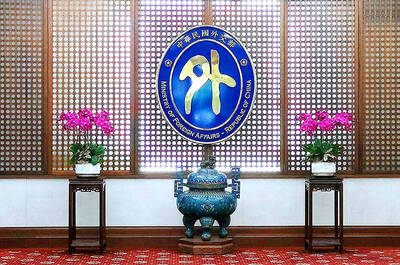
SOUTH KOREA DISPUTE: If Seoul continues to ignore its request, Taiwan would change South Korea’s designation on its arrival cards, the foreign ministry said If South Korea does not reply appropriately to a request to correct Taiwan’s name on its e-Arrival card system before March 31, the government would take corresponding measures to change how South Korea is labeled on the online Taiwan Arrival Card system, the Ministry of Foreign Affairs said yesterday. South Korea’s e-Arrival card system lists Taiwan as “China (Taiwan)” in the “point of departure” and “next destination” fields. Taipei has asked Seoul to change the wording. Since March 1, South Koreans who hold government-issued Alien Resident Certificates (ARC) have been identified as from “South Korea” rather than the “Republic of Korea,” the
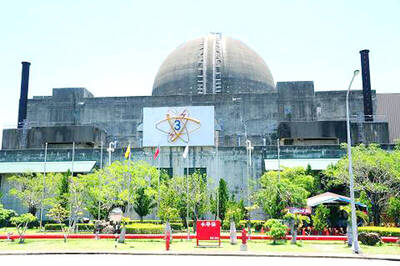
SUFFICIENT: The president said Taiwan has enough oil for next month, with reserves covering more than 100 days and natural gas enough for 12 to 14 days A restart plan for the Guosheng Nuclear Power Plant in New Taipei City’s Wanli District (萬里) and the Ma-anshan Nuclear Power Plant in Pingtung County’s Hengchun Township (恆春) would be submitted to the Nuclear Safety Commission by the end of the month, President William Lai (賴清德) said yesterday, reversing the government’s policy to abolish nuclear energy. On May 17 last year, Taiwan shut down its last nuclear reactor and became the first non-nuclear nation in East Asia, fulfilling the Democratic Progressive Party (DPP) government’s pledge of a “nuclear-free homeland.” Even without nuclear power, Taiwan can maintain a stable electricity supply until 2032,
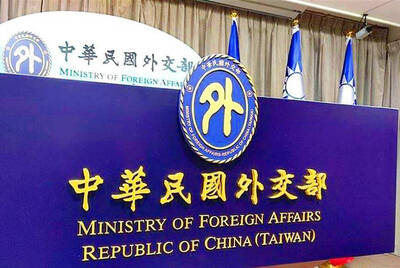
DEROGATORY: WTO host Cameroon’s designation of Taiwan as a ‘province of China’ seriously undermines the nation’s status and rights as a WTO member, MOFA said The Ministry of Foreign Affairs (MOFA) yesterday condemned Cameroon for listing Taiwan as “Taiwan, Province of China” in visa documents for an upcoming WTO ministerial conference, a move that led to Taiwan’s withdrawal from the event. The designation “seriously undermined” Taiwan’s status and rights as a WTO member, the ministry said in a statement. It is the first time since 2001 that Taiwan has declined to attend a WTO Ministerial Conference. The conference is scheduled to take place from Thursday to Sunday next week in Yaounde, the capital of Cameroon. Taiwan had planned to send a delegation led by Minister Without Portfolio


 RSS
RSS