


Democratic Progressive Party (DPP) lawmakers are divided over whether a draft bill to relax restrictions on foreign graduates seeking internships in Taiwan would create a loophole for firms to introduce cheap foreign workers and lower average salaries.
The Cabinet has proposed granting one-year visas to foreign college graduates within two years of their graduation and a two-year internship visa to specialists in the fields of science, technology, engineering and math.
At present, only current students can apply for internship visas, not graduates.
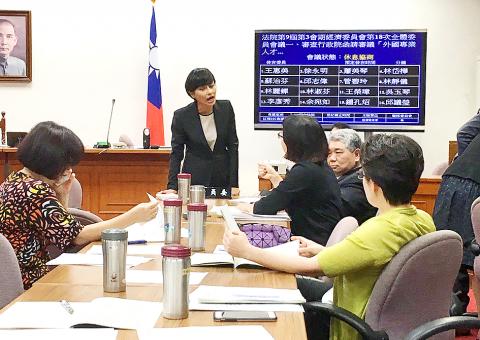
Photo: CNA
The bill would also relax constraints on residence and work permits, taxation, healthcare and retirement benefits to attract foreign white-collar workers to make up for a brain drain Taiwan is experiencing and boost the nation’s competitiveness.
The Cabinet draft is under review at the legislature.
DPP Legislator Lin Shu-feng (林淑芬) on Monday said that the internship rules were only made to relieve “the shortage of cheap white-collar workers for businesses.”
While businesses are required to pay at least NT$47,971 per month for a foreign white-collar worker, there is no minimum or maximum on intern salaries, which Lin said would allow businesses to hire cheap workers instead of high-salaried specialists.
The outflow of white-collar workers Taiwan is experiencing has been caused by wage stagnation, and easing rules on internship visas would only prolong the stagnation, Lin said.
“If foreign graduates are allowed to intern in Taiwan within two years of their graduation, will they take over low-level white-collar jobs?” Lin said on Facebook.
DPP Legislator Karen Yu (余宛如) has come under fire for her support of the Cabinet’s proposal.
Yu said the National Development Council estimates that the relaxation would have a limited effect on Taiwan’s labor market, and the legislation would only allow for an increase of 200 foreign interns per year.
There were only 458 foreign interns last year, and increasing that number would hardly affect the job market, regardless of the interns’ salary level, Yu said.
“Is it not strange to link the wage stagnation problem of Taiwan’s job market — which has more than 10 million workers — with that handful of foreign interns?” she said.
The law was drafted taking into account the immigration laws of other nations, she said.
Changes must be made to the industrial structure to enable Taiwan to compete in the future, she said.

South Korea has adjusted its electronic arrival card system to no longer list Taiwan as a part of China, a move that the Ministry of Foreign Affairs said would help facilitate exchanges between the two sides. South Korea previously listed “Taiwan” as “Taiwan (China)” in the drop-down menus of its online arrival card system, where people had to fill out where they came from and their next destination. The ministry had requested South Korea make a revision and said it would change South Korea’s name on Taiwan’s online immigration system from “Republic of Korea” to “Korea (South),” should the issue not be

Tainan, Taipei and New Taipei City recorded the highest fines nationwide for illegal accommodations in the first quarter of this year, with fines issued in the three cities each exceeding NT$7 million (US$220,639), Tourism Administration data showed. Among them, Taipei had the highest number of illegal short-term rental units, with 410. There were 3,280 legally registered hotels nationwide in the first quarter, down by 14 properties, or 0.43 percent, from a year earlier, likely indicating operators exiting the market, the agency said. However, the number of unregistered properties rose to 1,174, including 314 illegal hotels and 860 illegal short-term rental
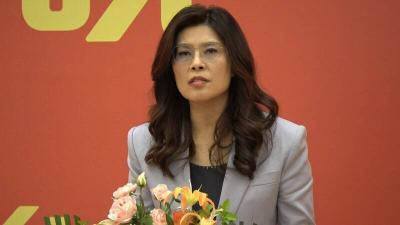
Both sides of the Taiwan Strait share a political foundation based on the “1992 consensus” and opposition to Taiwanese independence, Chinese Nationalist Party (KMT) Chairwoman Cheng Li-wun (鄭麗文) today said during her meeting with Chinese President Xi Jinping (習近平). Both sides of the Strait should plan and build institutionalized and sustainable mechanisms for dialogue and cooperation based on that foundation to make peaceful development across the Strait irreversible, she said. Peace is a shared moral value across the Strait, and both sides should move beyond political confrontation to seek institutionalized solutions to prevent war, she said. Mutually beneficial cross-strait relations are what the
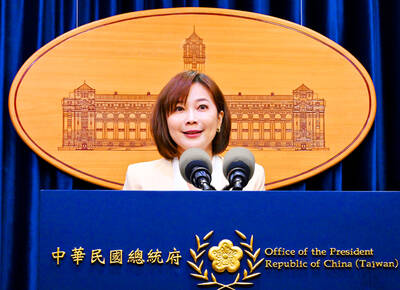
ECONOMIC COERCION: Such actions are often inconsistently applied, sometimes resumed, and sometimes just halted, the Presidential Office spokeswoman said The government backs healthy and orderly cross-strait exchanges, but such arrangements should not be made with political conditions attached and never be used as leverage for political maneuvering or partisan agendas, Presidential Office spokeswoman Karen Kuo (郭雅慧) said yesterday. Kuo made the remarks after China earlier in the day announced 10 new “incentive measures” for Taiwan, following a landmark meeting between Chinese President Xi Jinping (習近平) and Chinese Nationalist Party (KMT) Chairwoman Cheng Li-wun (鄭麗文) in Beijing on Friday. The measures, unveiled by China’s Xinhua news agency, include plans to resume individual travel by residents of Shanghai and China’s Fujian


 RSS
RSS