


An event was held in Taipei yesterday to commemorate the 28th anniversary of the Tiananmen Square Massacre, with participants calling on China to respect human rights and release arrested Taiwanese human rights advocate Lee Ming-che (李明哲).
More than 100 people attended the event near Taipei’s Liberty Square to remember the bloody crackdown in Beijing on June 4, 1989.
The event also paid tribute to a number of prisoners of conscience held by Chinese authorities, including Lee.
Exiled Chinese dissident Wang Dan (王丹), a prominent student leader of the 1989 Beijing democracy movement, said the annual commemoration was not just a tribute to those who died in the massacre, but also a plea for universal human rights and democracy.
“[The event] is also a protest against the Chinese Communist Party [CCP], which cannot be forgiven for their crimes,” Wang said.
“It is useless to place hopes in the Chinese government. Tsai should address her words to the Chinese people and speak to Chinese society so that ordinary Chinese can understand how much Taiwan’s president cares about them,” he said.
He asked Taiwanese to continue organizing events commemorating the massacre to renew the spirit of democracy and human rights and protest against the CCP.
“We might not have money, power or many people to campaign for our cause, but we do have persistence. Persistence is the most powerful weapon we have, and we could win if we use that weapon long enough,” he said, citing the decades-long efforts of gay rights advocate Chi Chia-wei (祁家威), which Wang said led to a landmark constitutional ruling in favor of same-sex marriage last month.
Calling for Lee’s release, Taiwan Association for Human Rights secretary-general Chiu E-ling (邱伊翎) said the government should take a tougher stance toward China over unwarranted arrests of Taiwanese.
Lee went missing on March 19 after entering China via Macau and was later confirmed to have been detained by the Chinese authorities.
China on May 26 announced that Lee was arrested on charges of “subversion of state power.”
“It is difficult to imagine that Taiwanese could be charged with such an archaic crime as state subversion in 2017,” Chiu said.
Lee’s arrest is clear evidence that Taiwan cannot distance itself from human rights violations in China and other nations, Chiu said.
“If Taiwan identifies itself as a democracy, it has to ask its partners to observe the same human rights values instead of giving in to human rights violations while seeking [economic] cooperation opportunities,” she said.
Chiu urged the government to take concrete action, such as implementing economic sanctions if Beijing continues to ignore Taipei’s demands on Lee’s case.
“The government cannot just resort to empty calls without taking any concrete action. Otherwise, China will believe that the arrest would have no impact on cross-strait relations,” she said.
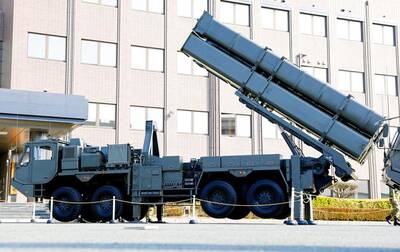
Japan has deployed long-range missiles in a southwestern region near China, the Japanese defense minister said yesterday, at a time when ties with Beijing are at their lowest in recent years. The missiles were installed in Kumamoto in the southern region of Kyushu, as Japan is attempting to shore up its military capacity as China steps up naval activity in the East China Sea. “Standoff defense capabilities enable us to counter the threat of enemy forces attempting to invade our country ... while ensuring the safety of our personnel,” Japanese Minister of Defense Shinjiro Koizumi said. “This is an extremely important initiative for
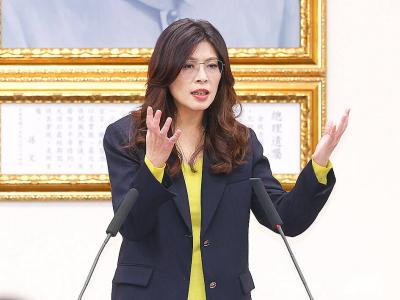
Chinese Nationalist Party (KMT) Chairwoman Cheng Li-wun (鄭麗文) today accepted an invitation from Chinese President Xi Jinping (習近平) to lead a delegation to China next month, saying she hopes to promote the peaceful development of cross-strait relations and bring stability to the Taiwan Strait. “I am grateful and happy to accept this invitation,” Cheng said in a statement from the KMT chairperson’s office. Cheng said she hopes both sides can work together to promote the peaceful development of cross-strait relations, enhance exchange and cooperation, bring stability to the Taiwan Strait and improve people’s livelihoods. At today's news conference, Cheng said any efforts to

MORE POPULAR: Taiwan Pass sales increased by 59 percent during the first quarter compared with the same period last year, the Tourism Administration said The Tourism Administration yesterday said that it has streamlined the Taiwan Pass, with two versions available for purchase beginning today. The tourism agency has made the pass available to international tourists since 2024, allowing them to access the high-speed rail, Taiwan Railway Corp services, four MRT systems and four Taiwan Tourist Shuttles. Previously, five types of Taiwan Pass were available, but some tourists have said that the offerings were too complicated. The agency said only two types of Taiwan Pass would be available, starting from a three-day pass with the high-speed rail and a three-day pass with Taiwan Railway Corp. The former costs NT$2,800

The nation’s fastest supercomputer, Nano 4 (晶創26), is scheduled to be launched in the third quarter, and would be used to train large language models in finance and national defense sectors, the National Center for High-Performance Computing (NCHC) said. The supercomputer, which would operate at about 86.05 petaflops, is being tested at a new cloud computing center in the Southern Taiwan Science Park in Tainan. The exterior of the server cabinet features chip circuitry patterns overlaid with a map of Taiwan, highlighting the nation’s central position in the semiconductor industry. The center also houses Taiwania 2, Taiwania 3, Forerunner 1 and


 RSS
RSS