


The government would definitely express its anger and frustration to the WHO about not being invited to attend the annual World Health Assembly (WHA), Minister of Health and Welfare Chen Shih-chung (陳時中) said yesterday, adding that all protests would be conducted in a legal manner.
The WHA, the decisionmaking body of the WHO, is scheduled to meet in Geneva, Switzerland, from Monday to May 31.
The nation’s delegation, the “WHA Action Team,” is scheduled to depart for Geneva early tomorrow morning, Chen told a news conference in Taipei.
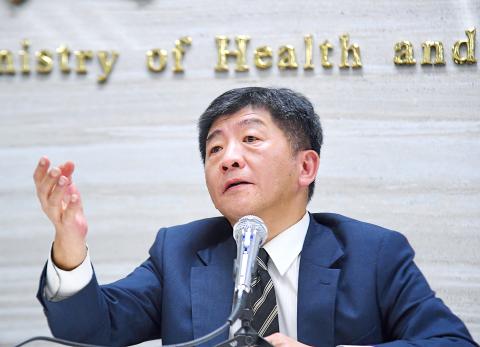
Photo: CNA
Chen is the designated leader of the team and is being accompanied by key officials from the Ministry of Health and Welfare.
The Taiwan United Nations Alliance and Taiwan Youth Group, two local non-governmental organizations, would also have delegations in Geneva promoting Taiwan’s attendance at the WHA, he said.
Based on the ministry’s itinerary, the WHA Action Team is to arrive in Geneva at about noon tomorrow.
Bilateral meetings with Taiwan’s allies and nations friendly to Taiwan are to begin on Sunday and continue until Thursday. In between the bilateral meetings with various nations, the WHA Action Team is to hold an international news conference at the Geneva Press Club on Monday morning.
The Taiwan United Nations Alliance’s delegation is to host a Taiwan Night on Monday night, to which officials from nations supporting Taiwan’s attendance at the WHA would be invited.
The official delegation is to leave Geneva on Friday next week.
Chen said his main task is to communicate with the WHO about the importance of Taiwan in global disease-prevention efforts and the necessity of Taiwan’s participation at the WHA.
Taiwan has a lot to contribute, from the establishment of the National Health Insurance system that offers quality and affordable healthcare to its experience of combating the SARS outbreak in 2003, he said.
“We have also been included in the US Global Cooperation Training Framework because of our experiences handling contagious diseases. Now we have learned faster ways to identify patients who have contracted the Zika virus, dengue fever or Ebola,” Chen said.
“Taiwan has evolved from a country that needs help from the WHO to one that can form partnerships with other countries, and has the ability to identify diseases and control their outbreaks,” he said.
Separately, 21 US senators on Wednesday signed a letter to US Secretary of Health and Human Services Tom Price to “express profound concern” over Taiwan’s exclusion from this year’s WHA due to Chinese obstruction.
They also expressed the hope that the US “will renew its efforts, with like-minded countries, to affirm observer status for Taiwan at future WHAs, a policy held by the past two administrations.”
The letter was also sent to US Secretary of State Rex Tillerson.
“As an American partner, and one of the most developed democracies and economies in the region, Taiwan has much to contribute to the WHA,” the letter said. “Its advanced healthcare system and record of providing humanitarian relief underscore the importance of its inclusion in global health forums.”
The letter also said that infectious diseases do not recognize international borders and the inclusion of all international parties is crucial to protecting global health — particularly given Taiwan’s record of strong public health institutions.
“Neither Taiwan nor the international community is served by restricting Taiwan’s access to timely information and important resources that protect public health,” it said.
Taiwan first attended the WHA as an observer in 2009 and had taken part in every meeting since then, until this year.
Its exclusion is widely seen as the latest move by China to clamp down on Taiwan’s international participation since President Tsai Ing-wen (蔡英文) came to power in May last year.
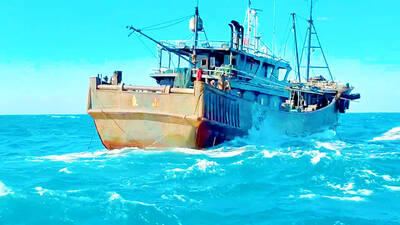
MAKING WAVES: China’s maritime militia could become a nontraditional threat in war, clogging up shipping lanes to prevent US or Japanese intervention, a report said About 1,900 Chinese ships flying flags of convenience and fishing vessels that participated in China’s military exercises around Taiwan last month and in January have been listed for monitoring, Coast Guard Administration (CGA) Deputy Director-General Hsieh Ching-chin (謝慶欽) said yesterday. Following amendments to the Commercial Port Act (商港法) and the Law of Ships (船舶法) last month, the CGA can designate possible berthing areas or deny ports of call for vessels suspected of loitering around areas where undersea cables can be accessed, Oceans Affairs Council Minister Kuan Bi-ling (管碧玲) said. The list of suspected ships, originally 300, had risen to about 1,900 as
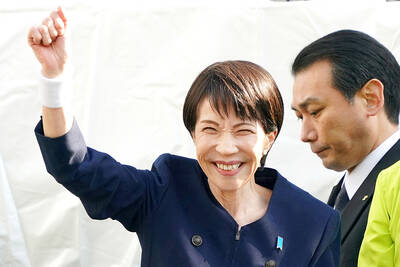
Japan’s strategic alliance with the US would collapse if Tokyo were to turn away from a conflict in Taiwan, Japanese Prime Minister Sanae Takaichi said yesterday, but distanced herself from previous comments that suggested a possible military response in such an event. Takaichi expressed her latest views on a nationally broadcast TV program late on Monday, where an opposition party leader criticized her for igniting tensions with China with the earlier remarks. Ties between Japan and China have sunk to the worst level in years after Takaichi said in November that a hypothetical Chinese attack on Taiwan could bring about a Japanese
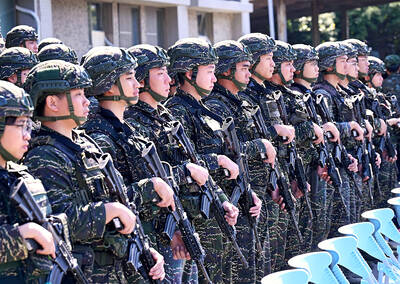
MORE RESPONSIBILITY: Draftees would be expected to fight alongside professional soldiers, likely requiring the transformation of some training brigades into combat units The armed forces are to start incorporating new conscripts into combined arms brigades this year to enhance combat readiness, the Executive Yuan’s latest policy report said. The new policy would affect Taiwanese men entering the military for their compulsory service, which was extended to one year under reforms by then-president Tsai Ing-wen (蔡英文) in 2022. The conscripts would be trained to operate machine guns, uncrewed aerial vehicles, anti-tank guided missile launchers and Stinger air defense systems, the report said, adding that the basic training would be lengthened to eight weeks. After basic training, conscripts would be sorted into infantry battalions that would take
DEEP-STRIKE CAPABILITY: The scenario simulated a PLA drill that turned into an assault on Taiwan’s critical infrastructure, with the launchers providing fire support Taiwan yesterday conducted this year’s first military exercises at Longsiang Base in Taichung, demonstrating the newly acquired High Mobility Artillery Rocket System’s (HIMARS) ability to provide fire support and deep-strike capabilities. The scenario simulated an attack on Penghu County, with HIMARS trucks immediately rolling into designated launch areas and firing barrages at the Wangan (望安) and Cimei (七美) islands, simulating the provision of fire support against invading forces. The HIMARS are supposed to “fire and leave,” which would significantly increase personnel and equipment survivability, a military official said. The drill simulated an exercise launched by the Chinese People’s Liberation Army (PLA) Eastern


 RSS
RSS