


The Han Kuang field exercises this year are to simulate a Chinese attack on the Ching Chuan Kang (清泉崗) Air Base in Taichung, a senior Ministry of National Defense official said yesterday.
An exercise to repel an amphibious invasion is to be staged on Thursday next week in Penghu County by all branches of the armed forces, followed the next day by the “assault” on Ching Chuan Kang Air Base, the official said on condition of anonymity.
The air base is to come under attack from the north, south and east, the official said.
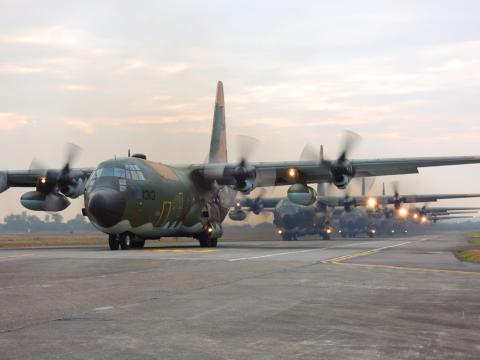
Photo: Lo Tian-pin, Taipei Times
An air-land scenario has been devised to address the growing threat of a multi-directional Chinese attack launched from the sea against high-value military targets, the official said.
It is likely that China’s People’s Liberation Army (PLA) has included those options in case of a cross-strait war because PLA aviation exercises are increasingly conducted in air and sea space to the east, north and south of Taiwan, the official said.
The defense of the base will be the final stage of the field exercises, and is to take place under the assumption that Chinese missile strikes on Taiwan’s air and naval bases and political-military centers have degraded the nation’s radar and air-defense systems, the official said.
Under that hypothesis, the PLA might launch additional strikes via long-range bombers and carrier-based planes on Taiwan proper, the official said.
The ministry’s initial plan to defend the airbase included only simulated attacks by Chinese airborne units, but on May 1 senior commanders added air attacks by fighters and bombers to the mix, the official said.
According to an air traffic notice from the military, a pair of Dassault Mirage 2000 fighters from the Hsinchu Air Base would first act as combat air patrol, before becoming the aggressor and reconnoitering the air space over Taichung.
Four AIDC F-CK-1s from the Tainan Air Base are to simulate air attacks on the Taichung base, while four F-16s based in Hualien are to cross the Central Mountain Range to attack it.
A mixed air squadron based in Pingtung County is to conduct a simulated attack by airborne troops.
The invaders are to launch a paratroop attack by dropping six planeloads of special operations forces as well as supplies and vehicles.
Defensive actions are to involve all branches, including interceptions by air force fighters and army surface-to-air missiles.
Army and marines ground troops will conduct anti-airborne missions and counterattacks to retake the base, the official said.
This story has been updated since it was first published to correct the romanized name of the drills to Han Kuang.

‘NO SECURITY RISK’: The Railway Bureau reassured the public that the technicians’ activities were limited to technical guidance and did not involve sensitive systems The Railway Bureau yesterday said it had invited eight Chinese technicians to assist with an airport MRT construction project. The bureau issued the confirmation after an Internet user said Chinese nationals had entered the construction zone of Taiwan Taoyuan International Airport’s Terminal 3 project. They asked why “individuals from an enemy state” were allowed access to such a major national infrastructure project, which raised serious concerns over Taiwan’s industrial safety, sensitive systems and information security. The bureau’s Northern Region Engineering Branch Office said subcontractor Taiwan Handle Industrial Co (台灣手把工業) of the Taoyuan airport MRT’s “Contract No. CU05 Project A14 Station Civil, MEP &

The National Chungshan Institute of Science and Technology yesterday showcased its locally developed variants of the Vision 60 robotic patrol dog, which it plans to deploy on the nation’s outlying territories in the South China Sea. The variants were produced under the Joint Lab project — created by the institute and domestic companies — and assembled with domestically produced motors, lenses and artificial intelligence (AI) systems alongside licensed tech from the US, Missile and Rocket Systems Research Division deputy director Jen Kuo-kang (任國光) told the media event at a military base in Taipei’s Dazhi (大直) area. Taiwan has built up its strengths

NOT IMMEDIATE: Taiwan has a chance to appeal the proposed 10 percent tariff before it starts, while other countries face a 12.5 percent tariff from the trade office Taiwan is among 60 economies determined by the US to have failed to impose or enforce a ban on the importation of goods produced with forced labor, according to a notice released on Tuesday by the Office of the US Trade Representative (USTR), which proposed imposing an additional 10 percent or more tariff on them. The USTR in a statement said that following an investigation, it had determined under Section 301 of the Trade Act of 1974 that the failure of the 60 economies to impose and effectively enforce a prohibition on the importation of goods produced with forced labor is

TIT-FOR-TAT: The US allegedly revoked the visa of a Chinese national working at Xinhua News Agency in the US in response to Beijing’s expulsion of Vivian Wang The Presidential Office yesterday condemned China for expelling a New York Times correspondent from Beijing following the newspaper’s interview with President William Lai (賴清德), saying the move highlighted Beijing’s suppression of press freedom and its threat to international news media. Taiwan has noted a series of recent incidents in which Beijing used similar tactics to “threaten and pressure international media outlets and journalists,” Presidential Office spokeswoman Karen Kuo (郭雅慧) said in a statement. “This concerns not only press freedom and freedom of expression, but also the safety of journalists, and Taiwan and relevant partners are paying close attention to the situation,” she


 RSS
RSS