


Tourists were back on the Champs-Elysees early yesterday with a mixture of shock and defiance, a day after a man shot dead a police officer on the world famous avenue on the eve of France’s election.
“I needed to get out, to come back here and see the sunshine, and that everything was OK,” said Lebanese tourist Zeina Bitar, 45, who was shopping on the boulevard with her children when the gunman struck.
Nearby, a police officer laid a white rose at the site where the shooter felled his comrade with an automatic weapon, unleashing a firefight in which the assailant was killed and two other officers were wounded.
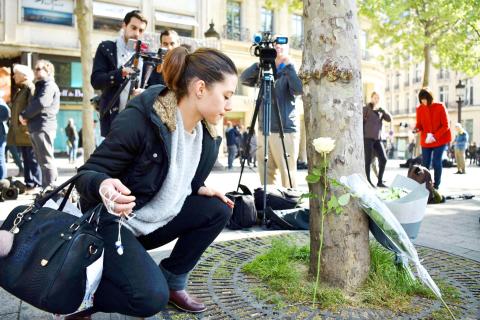
Photo: AFP
“We heard the shots and people were running in every direction, but people were calm, we were well treated and they gave us hot chocolate,” Bitar said, adding that her children were in tears.
Under a cloudless spring sky, the dozens of emergency and security vehicles of the night before had been replaced by media trucks on the glitzy tree-lined avenue — a symbol of Paris.
Passersby snapped pictures of shop windows punctured by bullet holes.
“What’s happening here?” asked Indian tourist Chaintnya Veeraghanta, 25, who had been unaware of the shooting. “I knew there were terrorism attacks in France last year, but I thought it was over.”
More than 230 people have been killed in terror attacks in France since early 2015, leading to a ramping up of security, with thousands of troops deployed to patrol key sites.
“It was scary. We heard the shots so we ran to our hotel ... and found out it was terrorism by watching the news,” said Eric Winkler, 51, an American visiting the French capital from Boston.
However, he and his 16-year-old daughter Hailey took it in their stride.
“It’s happening all over the world, also in America,” he said. “We have to deal with it, they’re not going to stop us from living and doing what we want to do.”
Bitar’s friend, Pascale Saad, 42, also from Lebanon, said she was worried about the effects the attack would have on France’s presidential election starting with its first round of voting tomorrow.
“I really don’t know what’s going to happen Sunday,” she said. “I’m afraid that things will degenerate and that people will all vote for Marine Le Pen.”
The far-right presidential candidate, who is riding high in the polls, is seen as the most hardline on the issue of terror attacks and advocates harsh limits on immigration.
Visiting from Los Angeles, 60-year-old Felix Cervantes said he could have been at the Champs-Elysees on Thursday evening, but had gone to the Louvre instead.
“I’m not afraid at all,” Cervantes said. “We’re going to stay in Paris till next week whatever happens.”
Scottish tourist Lesley Douglas, 55, had mixed feelings.
“We’re convinced that Paris is the safest place in the world, but of course we were scared seeing the policemen with their guns,” she said.
However, her 62-year-old husband Michael was adamant that the couple would visit the French capital “for years to come,” adding: “Vive Paris.”

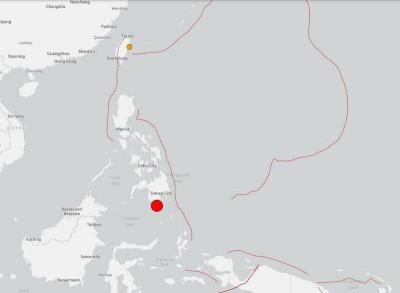
A magnitude 7.8 earthquake struck off the southern coast of Mindanao in the Philippines at 7:38am today, prompting the US Tsunami Warning System to issue an alert for neighboring countries, including Taiwan. The system issued a purple alert indicating a "tsunami threat." The potential threat zone includes Taiwan, the Philippines, Papua New Guinea, Yap and Palau. Philippine authorities were assessing the damage from the quake, with the office of civil defense seeking to verifying initial reports that 15 people had been killed and 129 injured in the region, mostly from falling debris. Arlene Hollero, disaster chief of Maasim town in the Philippines' Sarangani Province,
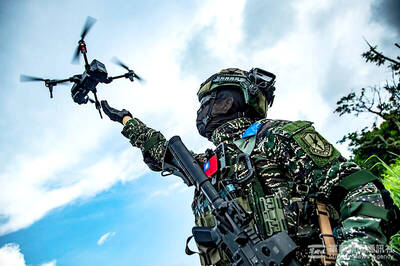
RESILIENCE: Taiwan plays a key role in semiconductors, energy, information infrastructure and advanced manufacturing, AIT Director Raymond Greene said Taiwan’s continued investment in deterrence and resilience remains vital, especially in uncrewed systems and other emerging technologies, American Institute in Taiwan (AIT) Director Raymond Greene said yesterday. Greene made the remarks at the annual National Strategic Summit on Supply Chain Resilience held by the Research Institute for Democracy, Society and Emerging Technology (DSET), a government-backed think tank. As Taiwan last year became the US’ fourth-largest trading partner and supply chain security is becoming more important, cooperation in emerging technologies continues to deepen between the two countries, he said. The US is committed to accelerating innovation, building key infrastructure, strengthening cooperation
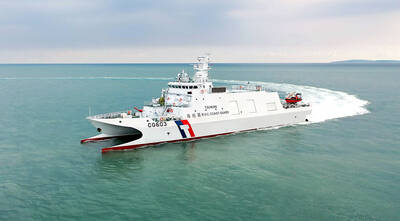
‘GRAY ZONE’ PRESSURE: Beijing’s activities are intended to create the deceitful impression that China has jurisdiction over the area around Taiwan, the CGA said Taiwan’s rights over its territorial waters and exclusive economic zone must not be violated by any country, the Mainland Affairs Council said yesterday, adding that it will not accept any unprovoked actions. The council issued the remarks in response to the China Coast Guard conducting maritime enforcement drills near eastern Taiwan and claiming to fully exercise China’s maritime administrative law enforcement authority. The Coast Guard Administration (CGA) has been closely monitoring the situation and is taking concrete steps to defend the nation’s sovereignty and secure its waters, the council said. China has no sovereign rights over the waters off eastern

The National Chungshan Institute of Science and Technology yesterday showcased its locally developed variants of the Vision 60 robotic patrol dog, which it plans to deploy on the nation’s outlying territories in the South China Sea. The variants were produced under the Joint Lab project — created by the institute and domestic companies — and assembled with domestically produced motors, lenses and artificial intelligence (AI) systems alongside licensed tech from the US, Missile and Rocket Systems Research Division deputy director Jen Kuo-kang (任國光) told the media event at a military base in Taipei’s Dazhi (大直) area. Taiwan has built up its strengths


 RSS
RSS