


President Tsai Ing-wen (蔡英文) yesterday called for peace and understanding as the legislature began its review of pension reform proposals.
The reform proposals have been moved forward following a year of public discussions at meetings of the Presidential Office’s pension reform committee, public hearings and a national conference on pension reform, Tsai said.
The Executive Yuan and the Legislative Yuan have proposed draft bills to lower income replacement rates, increase pension premiums, raise the retirement age and phase out the preferential savings rate for retired military personnel, civil servants and teachers.
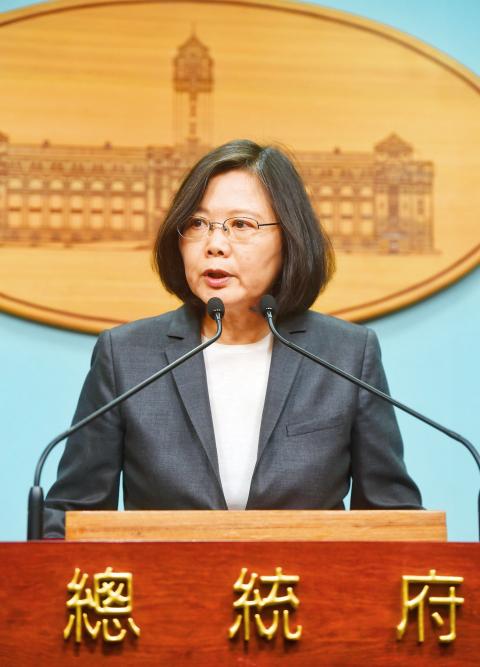
Photo: Fang Pin-chao, Taipei Times
“It is the last mile to complete the reform,” Tsai said at a news conference in the Presidential Office in Taipei.
“As president, I want to say thank you to all public employees. It is because of your understanding that the reform is possible and that young public employees have hope for the future,” Tsai said.
“Former administrations — be it run by the Chinese Nationalist Party [KMT] or the Democratic Progressive Party [DPP] — knew where the problems lay, but they never completely reformed the pension systems, although efforts were made,” she said. “The responsibility has fallen on us and we have to share the burden and go full out to complete the task. The reform has to succeed.”
Tsai also called for peace after some protesters tried to physically obstruct the legislative review.
“We will not tolerate the use of violence to delay reforms. Authorities will investigate any violence that obstructs legislators, government officials or other personnel from entering the Legislative Yuan,” she said.
A total of 11 incidents were reported yesterday, with Taipei Mayor Ko Wen-je (柯文哲), Taipei Deputy Mayor Charles Lin (林欽榮), Changhua County Commissioner Wei Ming-ku (魏明谷), DPP legislators Wang Ting-yu (王定宇) and Tsai Yi-yu (蔡易餘) and New Power Party Legislator Hsu Yung-ming (徐永明) allegedly being assaulted when they tried to enter the Legislative Yuan.
“The goal of pension reform is not to target or stigmatize anyone. The reform is like halting a horse on the edge of a cliff, and it is critically urgent to save the pension fund from the brink of bankruptcy,” Tsai said.
Her administration would complete the reform and make pensions sustainable and fair, she added.
Minister Without Portfolio Lin Wan-i (林萬億) said he does not expect legislative review of the proposals to be finalized by the end of next month, and an extraordinary session is likely to be called to complete the review.
Lin, who serves as deputy convener and executive director of the pension reform committee, said further discussions are needed in terms of the speed of the phase-out of the 18 percent preferential savings rate for retired public employees and the minimum monthly pension for military personnel.
The committee proposes phasing out the preferential rate in six years, while the DPP favors two years and the NPP three years, so further negotiations are needed to settle the differences, he said.
While the committee has yet to set a “pension floor” that would allow retired military personnel whose monthly pension falls below this figure to continue to enjoy the 18 percent preferential rate, Lin said the “floor” would not be set above NT$40,000.
The floor set for public servants and teachers is NT$32,160.
“Reforms have to ensure a basic standard of living for retirees because reforms have to be humanitarian,” he said.

MAKING WAVES: China’s maritime militia could become a nontraditional threat in war, clogging up shipping lanes to prevent US or Japanese intervention, a report said About 1,900 Chinese ships flying flags of convenience and fishing vessels that participated in China’s military exercises around Taiwan last month and in January have been listed for monitoring, Coast Guard Administration (CGA) Deputy Director-General Hsieh Ching-chin (謝慶欽) said yesterday. Following amendments to the Commercial Port Act (商港法) and the Law of Ships (船舶法) last month, the CGA can designate possible berthing areas or deny ports of call for vessels suspected of loitering around areas where undersea cables can be accessed, Oceans Affairs Council Minister Kuan Bi-ling (管碧玲) said. The list of suspected ships, originally 300, had risen to about 1,900 as
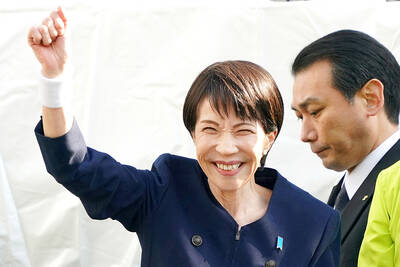
Japan’s strategic alliance with the US would collapse if Tokyo were to turn away from a conflict in Taiwan, Japanese Prime Minister Sanae Takaichi said yesterday, but distanced herself from previous comments that suggested a possible military response in such an event. Takaichi expressed her latest views on a nationally broadcast TV program late on Monday, where an opposition party leader criticized her for igniting tensions with China with the earlier remarks. Ties between Japan and China have sunk to the worst level in years after Takaichi said in November that a hypothetical Chinese attack on Taiwan could bring about a Japanese

Right-wing political scientist Laura Fernandez on Sunday won Costa Rica’s presidential election by a landslide, after promising to crack down on rising violence linked to the cocaine trade. Fernandez’s nearest rival, economist Alvaro Ramos, conceded defeat as results showed the ruling party far exceeding the threshold of 40 percent needed to avoid a runoff. With 94 percent of polling stations counted, the political heir of outgoing Costa Rican President Rodrigo Chaves had captured 48.3 percent of the vote compared with Ramos’ 33.4 percent, the Supreme Electoral Tribunal said. As soon as the first results were announced, members of Fernandez’s Sovereign People’s Party
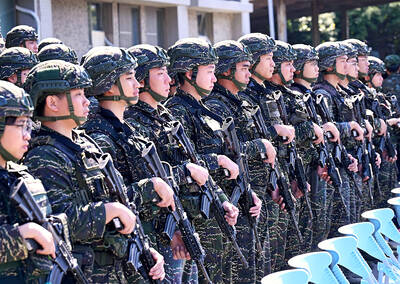
MORE RESPONSIBILITY: Draftees would be expected to fight alongside professional soldiers, likely requiring the transformation of some training brigades into combat units The armed forces are to start incorporating new conscripts into combined arms brigades this year to enhance combat readiness, the Executive Yuan’s latest policy report said. The new policy would affect Taiwanese men entering the military for their compulsory service, which was extended to one year under reforms by then-president Tsai Ing-wen (蔡英文) in 2022. The conscripts would be trained to operate machine guns, uncrewed aerial vehicles, anti-tank guided missile launchers and Stinger air defense systems, the report said, adding that the basic training would be lengthened to eight weeks. After basic training, conscripts would be sorted into infantry battalions that would take


 RSS
RSS