


The Taipei District Court yesterday found former president Ma Ying-jeou (馬英九) not guilty of libel and leaking of confidential information in the first ruling on a lawsuit filed by Democratic Progressive Party caucus whip Ker Chien-ming (柯建銘).
The court said there was insufficient evidence to prove allegations that Ma had requested then-prosecutor-general Huang Shih-ming (黃世銘) to leak information from a judicial investigation, obtained through wiretapping of a telephone conversation in September 2013.
Ker filed libel charges against the former president on Oct. 3, 2013, accusing him of contravening the Personal Information Protection Act (個人資料保護法) and the Security and Surveillance Act (通訊監察保護法).
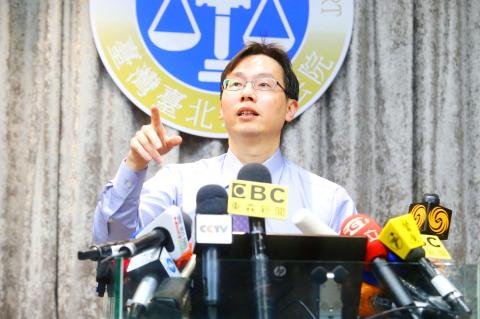
Photo: CNA
Taipei District Court Chief Judge Liao Chien-yu (廖建瑜) said Ma was accused of asking his then-personal secretary Lin Yu-chen (林有振) to call Huang and request that he visit Ma at his presidential residence on Sept. 1, 2013 — a call that lasted one minute and 46 seconds.
WIRETAPPING
Ma allegedly asked Huang, who was in charge of the Special Investigation Division (SID) of the Supreme Prosecutors’ Office, to submit a report — which contained details obtained through wiretapping — regarding alleged improper political lobbying in conversations between Ker and then-legislative speaker Wang Jin-pyng (王金平).
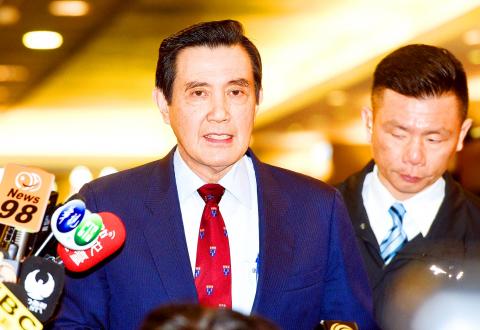
Photo: Peter Lo, Taipei Times
“Witness testimonies and documentation presented by Ker were unable to prove that Ma had instructed Huang to present any information obtained through the SID’s probe and results from the wiretapping. As such, there was no indication he ordered others to leak confidential information,” Liao said.
NOT LIBEL
“Regarding Ma’s accusations that Ker conducted improper political lobbying, the court finds that Ma’s comments belong within the scope of public interest and that Ma gave his commentary with good intentions and therefore is not in breach of libel laws,” Liao added.
“We thank the Taipei District Court judges for undertaking this case and for their efforts to uncover the truth and make an appropriate ruling that conforms with the law,” Ma’s office said.
Ker said that the ruling was a “grave mistake” and that he would appeal.
“Huang, who was convicted of leaking state secrets, committed the crime at Ma’s instruction, but the court cleared Ma, a ruling that is inconsistent with Huang’s conviction,” Ker said.
Criticizing the verdict, which said that a crucial call record could not prove that Ma ordered Huang to leak state secrets, Ker said Ma’s guilt was evident, but he was acquitted because there was no audio recording of Ma giving the order.
“The judge has acquitted Ma on trivial details, but ignored the damage he has done to the constitutional mechanism. This negligent ruling cannot convince the public, and the verdict is written just like Ma’s defense,” Ker said.
DPP spokesman Wang Min-sheng (王閔生) said the ruling could not disguise that Ma intervened to try to oust a political rival, and called on the court to make a fair judgement.
The Taipei District Prosecutors’ Office on March 14 indicted Ma on charges of leaking classified information and abuse of authority in connection with the Ker-Wang conversation.
Additional reporting by Chen Wei-han

‘NO SECURITY RISK’: The Railway Bureau reassured the public that the technicians’ activities were limited to technical guidance and did not involve sensitive systems The Railway Bureau yesterday said it had invited eight Chinese technicians to assist with an airport MRT construction project. The bureau issued the confirmation after an Internet user said Chinese nationals had entered the construction zone of Taiwan Taoyuan International Airport’s Terminal 3 project. They asked why “individuals from an enemy state” were allowed access to such a major national infrastructure project, which raised serious concerns over Taiwan’s industrial safety, sensitive systems and information security. The bureau’s Northern Region Engineering Branch Office said subcontractor Taiwan Handle Industrial Co (台灣手把工業) of the Taoyuan airport MRT’s “Contract No. CU05 Project A14 Station Civil, MEP &

The National Chungshan Institute of Science and Technology yesterday showcased its locally developed variants of the Vision 60 robotic patrol dog, which it plans to deploy on the nation’s outlying territories in the South China Sea. The variants were produced under the Joint Lab project — created by the institute and domestic companies — and assembled with domestically produced motors, lenses and artificial intelligence (AI) systems alongside licensed tech from the US, Missile and Rocket Systems Research Division deputy director Jen Kuo-kang (任國光) told the media event at a military base in Taipei’s Dazhi (大直) area. Taiwan has built up its strengths

NOT IMMEDIATE: Taiwan has a chance to appeal the proposed 10 percent tariff before it starts, while other countries face a 12.5 percent tariff from the trade office Taiwan is among 60 economies determined by the US to have failed to impose or enforce a ban on the importation of goods produced with forced labor, according to a notice released on Tuesday by the Office of the US Trade Representative (USTR), which proposed imposing an additional 10 percent or more tariff on them. The USTR in a statement said that following an investigation, it had determined under Section 301 of the Trade Act of 1974 that the failure of the 60 economies to impose and effectively enforce a prohibition on the importation of goods produced with forced labor is

TIT-FOR-TAT: The US allegedly revoked the visa of a Chinese national working at Xinhua News Agency in the US in response to Beijing’s expulsion of Vivian Wang The Presidential Office yesterday condemned China for expelling a New York Times correspondent from Beijing following the newspaper’s interview with President William Lai (賴清德), saying the move highlighted Beijing’s suppression of press freedom and its threat to international news media. Taiwan has noted a series of recent incidents in which Beijing used similar tactics to “threaten and pressure international media outlets and journalists,” Presidential Office spokeswoman Karen Kuo (郭雅慧) said in a statement. “This concerns not only press freedom and freedom of expression, but also the safety of journalists, and Taiwan and relevant partners are paying close attention to the situation,” she


 RSS
RSS