


The government would create a budget for a direct railway line connecting Taipei and Yilan County if the project passes an Environmental Impact Assessment (EIA) Committee and other agencies, Minister of Transportation and Communications Hochen Tan (賀陳旦) said yesterday.
Hochen told the legislature’s Transportation Committee that about half of the NT$880 billion (US$29 billion) for the “Forward-Looking Infrastructure Construction Project,” has been allocated to railway-related projects.
The Cabinet listed 38 projects for cities and counties governed by the Democratic Progressive Party (DPP), but a direct Taipei-Yilan railway line proposed by lawmakers representing Yilan County was excluded from the list.
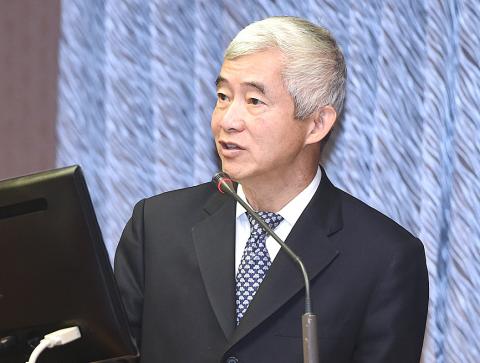
Photo: Liao Chen-huei, Taipei Times
DPP Legislator Chen Ou-po (陳歐珀), who recently announced his bid to run for Yilan County commissioner, criticized the government for its ignorance of the needs of the county’s residents, first by former president Ma Ying-jeou’s (馬英九) “i-Taiwan” 12 Infrastructure Projects and now by President Tsai Ing-wen’s (蔡英文) proposal.
Chen said the government has budgeted nearly NT$450 billion for railway-related projects, but the county would receive only NT$12 million to pay for the proposed direct railway line and environmental impact analysis, even though it requested NT$130 billion.
Chen asked if the Ministry of Transportation and Communications supports the project, adding that the government cannot just stop a project because it is struck down by an EIA Committee.
“Yilan residents pride themselves on being highly environmentally conscious. I oppose the No. 2 route proposed by the Railway Reconstruction Bureau, which would be unsafe and harmful to the environment,” he said.
“However, if option No. 1, which is parallel to the Chiang Wei-shui Memorial Freeway [National Freeway No. 5], fails to secure EIA committee approval, the government has to amend the project and make it viable again,” he added.
Chen said he believed the project would be technically viable, using the Channel Tunnel that links England and France as an example.
Chen said that Feitsui Reservoir’s (翡翠水庫) water quality would be worse without the construction of the Hsuehshan Tunnel (雪山隧道), in opposition to environmentalists opinions.
Hochen told lawmakers that the ministry’s assessment of the project is scheduled to be completed by the middle of next year, adding that the project would undergo EIA Committee review after it is approved by the ministry and the Executive Yuan.
Should the project secure committee approval, the ministry can start allocating a budget for it from the special budget program and the ministry’s annual budget, Hochen said.
Even though the a small budget has been earmarked for Yilan County, Hochen said that there are still many things that the central government can do to address the transport needs of east coast residents. Building a crossover railway line between Cidu (七堵) and Badu (八堵) railway stations would quickly enhance train capacity heading to Hualien and Taitung, Hochen said.

A signaling system malfunction disrupted high-speed rail (HSR) services beginning at 8am today, with trains temporarily reduced to three northbound and three southbound trains per hour as authorities conduct inspections. The malfunction occurred on a section of track in Miaoli County during pre-operation checks early this morning, forcing northbound and southbound trains to use a single track, the HSR operator said. The regular schedule has been replaced with three hourly trains offering only nonreserved seating in each direction, stopping at every station, it said, adding that business class cars would still have reserved seating. Departures from terminal stations are scheduled at the top
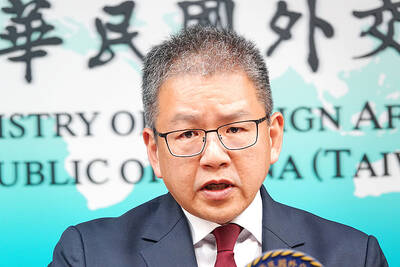
Taiwan is still in the process of assessing the possibility of recruiting workers from Eswatini, the Ministry of Foreign Affairs said yesterday, adding that its goal is to help Eswatini upgrade its vocational training centers. If there are plans to recruit workers from Eswatini, safeguarding national security, protecting public health and ensuring the employment rights of Taiwanese would be prerequisites, Department of West Asian and African Affairs Director-General Yen Chia-liang (顏嘉良) told a news conference. Key considerations would also include filling labor shortages in specific industries, and fostering bilateral professional and technical exchanges, he said. Yen was asked about the progress of labor

VERBOSE VESSELS: A CGA cutter and a China Coast Guard exchanged verbal barbs for more than a day in Taiwanese-controlled waters before the Chinese vessel left The Taiwanese and Chinese coast guards had a standoff near the strategically located Pratas Islands (Dongsha Islands, 東沙群島) in the north of the South China Sea, the Coast Guard Administration (CGA) said yesterday. The two sides engaged in intense radio exchanges over sovereignty claims during the 33-hour standoff. China Coast Guard vessel 3501 eventually left the restricted waters, 26.6 nautical miles (49.2km) west of the Pratas Islands, at 5pm yesterday, the CGA said. Lying approximately between southern Taiwan and Hong Kong, the Taiwan-controlled Pratas are seen by some security experts as vulnerable to Chinese attack due to their distance — more than

A US uncrewed surface vessel (USV) encountered multiple Chinese warships during an autonomous transit of the Taiwan Strait, US defense company Seasats said in a statement on Wednesday. Seasats announced that a Lightfish USV had completed the first autonomous transit of the Taiwan Strait. Over five days, the USV traversed the entire length of the Strait while constantly monitoring surface vessel traffic, the company said. The Lightfish encountered multiple Chinese warships, one of which was a Chinese People’s Liberation Army Navy (PLAN) Type 056 corvette, it said. The Chinese vessels were operating “well within Taiwan’s exclusive economic zone without transmitting their identity via the


 RSS
RSS