


China has started fresh construction work in the disputed South China Sea, new satellite images show, a sign that Beijing is continuing to strengthen its military reach across the vital trade waterway.
Regional military attaches and experts believe the work shows China’s determination to build up its network of reefs and islets, even if it is seeking to avoid a fresh confrontation with the US President Donald Trump’s administration.
An image of North Island (北島) in the Paracel Islands (Xisha Islands, 西沙群島) taken on Monday last week shows recent work including land clearing and possible preparation for a harbor to support what experts believe might be eventual military installations. Initial work was damaged in a typhoon last year.
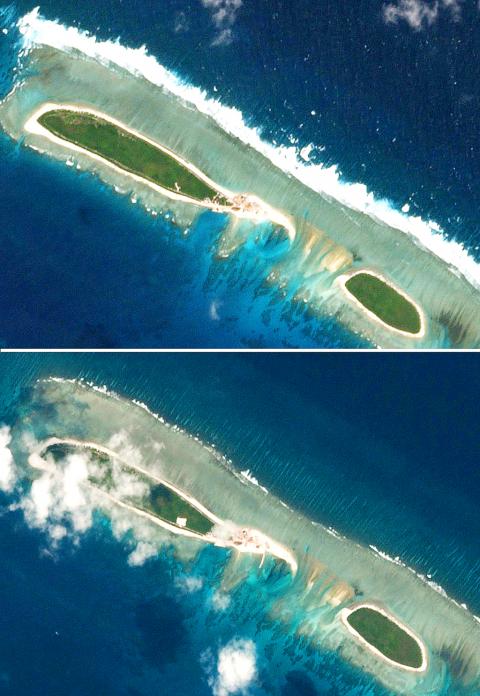
Photo: Reuters
The pictures, provided by private satellite firm Planet Labs, follow reports in January showing work undertaken on nearby Tree Island (Jhaoshu Island, 趙述島) and other features in the Paracels, which are also claimed by Taiwan and Vietnam.
Diplomats briefed on the latest Western intelligence assessments say Beijing is pursuing efforts to dominate its maritime “backyard,” even if it tweaks the timing of moves to avoid being overtly provocative.
“The Paracels are going to be vital to any future Chinese attempt to dominate the South China Sea,” said Carl Thayer, a South China Sea expert at the Australian Defence Force Academy. “We can see they are committed to militarization, whatever the official rhetoric tells us, even if they are going to do it bit by bit.”
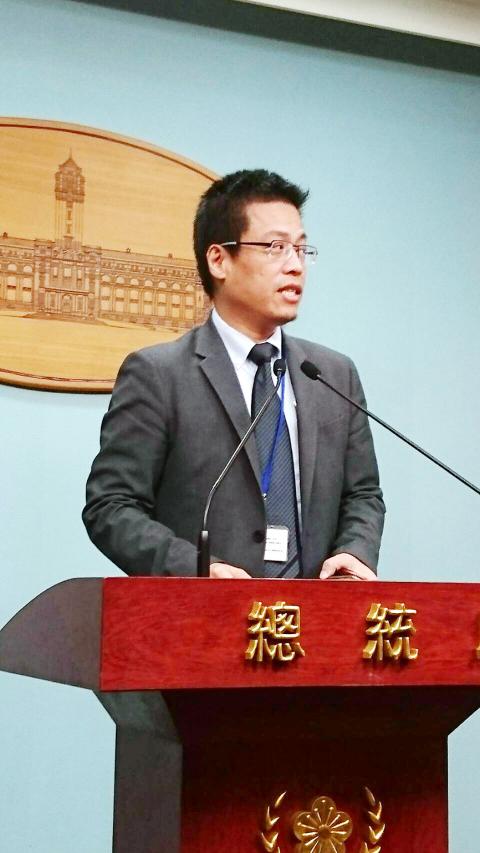
Photo: Chung Li-hua, Taipei Times
The more widely disputed Spratly Islands (Nansha Islands, 南沙群島) to the south are higher profile, but the Paracels are key to China’s presence in the South China Sea.
China has temporarily based surface-to-air missile launchers and jets at long established bases on Woody Island (Yongxing Island, 永興島) in the Paracels, helping protect its nuclear submarine facilities on Hainan Island.
North Island is part of an arc of reefs that are expected to form a protective screen for Woody, which includes civilian facilities and a listening post.
Zhang Baohui (張寶輝), a security expert at Hong Kong’s Lingnan University, said he believed China was pursuing its goal of strengthening its facilities in the Paracels and had calculated that the Trump administration would not overreact given other priorities.
“There’s also uncertainty with this young Trump administration, but this is very important work to the Chinese ... the Paracels are vital to defending Hainan, which is in turn important to China’s nuclear deterrent,” Zhang said. “The calculation here is that it is really only Vietnam that will be rattled by this.”
The Vietnamese Ministry of Foreign Affairs did not respond to requests for comment.
The Chinese Ministry of National Defense said it was “not familiar” with any work at North Island.
“What needs to be stressed is that the Xisha Islands are China’s inherent territory,” it said.
A US official, speaking on the condition of anonymity, was unable to confirm new construction work on North Island, but said it would not be surprising.
“It would be in line with what they have been doing, why else would they be clearing land on the islands but for militarization,” the official said. “There is no other reason to have a presence there.”
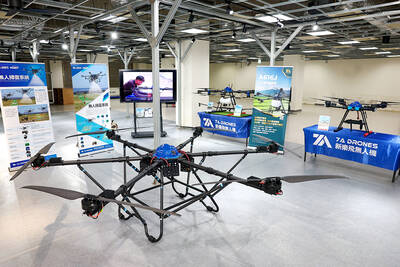
DRONE CENTRAL: Taiwan aims to become Asia’s democratic hub for drones, with most exports focused on high-quality military-grade models, an official said Taiwan’s drone industry is expected to expand significantly by 2030, producing 100,000 units per month and exporting half of them, the Ministry of Economic Affairs said yesterday. Current drone production capacity is about 15,000 units per month, but the industry can quickly scale up as demand increases, Industrial Development Administration Director-General Chiou Chyou-huey (邱求慧) told a news conference in Taipei. Taiwan’s drone output grew 2.5-fold last year to NT$12.9 billion (US$408.3 million) under a government program to develop the uncrewed vehicle sector, he said. The Executive Yuan in October last year approved plans to invest NT$44.2 billion into domestic production of uncrewed aerial
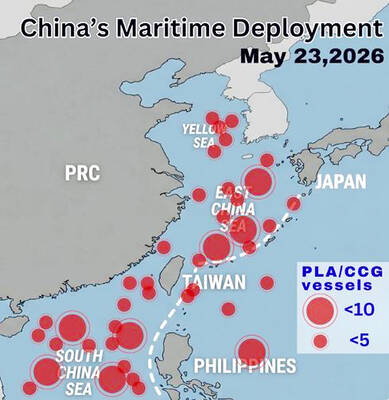
WARNING: China should stop engaging in actions that undermine regional peace and stability, as it would only build resentment among people across the Strait, the CGA said China has deployed more than 100 navy, coast guard and other vessels in waters from the Yellow Sea to the South China Sea and the western Pacific since US President Donald Trump and Chinese President Xi Jinping (習近平) met in Beijing, National Security Council Secretary-General Joseph Wu (吳釗燮) said yesterday. “In this part of the world, #China is the one & only PROBLEM wrecking the #StatusQuo & threatening regional peace & stability,” Wu wrote on X. In a separate post, he said Beijing was coercing Taiwan’s maritime domain, calling it illegal and provocative, after the Coast Guard Administration (CGA) expelled a
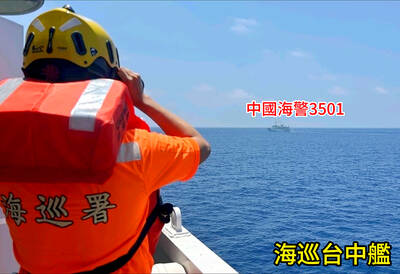
VERBOSE VESSELS: A CGA cutter and a China Coast Guard exchanged verbal barbs for more than a day in Taiwanese-controlled waters before the Chinese vessel left The Taiwanese and Chinese coast guards had a standoff near the strategically located Pratas Islands (Dongsha Islands, 東沙群島) in the north of the South China Sea, the Coast Guard Administration (CGA) said yesterday. The two sides engaged in intense radio exchanges over sovereignty claims during the 33-hour standoff. China Coast Guard vessel 3501 eventually left the restricted waters, 26.6 nautical miles (49.2km) west of the Pratas Islands, at 5pm yesterday, the CGA said. Lying approximately between southern Taiwan and Hong Kong, the Taiwan-controlled Pratas are seen by some security experts as vulnerable to Chinese attack due to their distance — more than
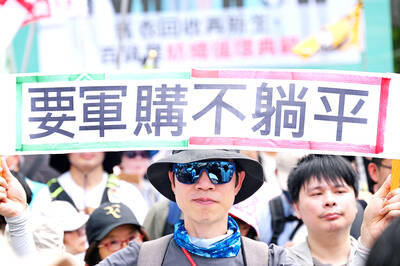
More than 8,000 people took part in a rally in Taipei yesterday to express support for more defense spending, after the opposition slashed the Cabinet’s proposed NT$1.25 trillion (US$39.6 billion) special defense budget and capped it at NT$780 billion. The demonstrators urged the Cabinet to propose another bill. Taiwan Economic Democracy Union convener Lai Chung-chiang (賴中強) said the main problem of the passed budget plan is the removal of funding for critical items, not just that the total amount is smaller. Critical budget items included purchasing or developing uncrewed vehicles, Strong Bow (強弓) missile systems, additional ammunition, artificial intelligence-powered combat systems and Taiwan-US


 RSS
RSS