


Lawmakers yesterday joined sports fans in demanding that the Chinese Taipei Baseball Association (CTBA) be abolished and that major reforms of the nation’s sports establishment be instituted, with Premier Lin Chuan (林全) promising to review the matter and initiate changes following the national team’s dismal performance at the World Baseball Classic earlier this week.
Angry sports fans, fed up with the perceived mismanagement by the association and the team’s failures at major baseball tournaments, joined forces to launch an online campaign calling for the CTBA to be disbanded or rebuilt, which has garnered more than 40,000 signatures over the past few days.
“The Cabinet will conduct reviews to determine why the national squad did not have the best possible lineup and why players could not perform at their best,” Lin said at the Legislative Yuan in Taipei.
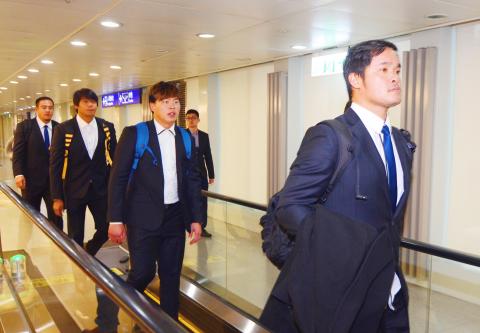
Photo: CNA
“We must have comprehensive reviews to identify deficiencies, which will include the Sports Administration and the CTBA,” Lin said. “While the CTBA is a non-governmental organization, the government has to lead the nation’s sports policies, so we will utilize our influence and mandate to push for reform.”
The Executive Yuan later announced the appointment of Lin Te-fu (林德褔) as director-general of the Sports Administration.
Lin Te-fu was head of the Sports Council under the previous Democratic Progressive Party (DPP) administration, when he oversaw the merger of Taiwan’s professional baseball leagues in 2003, the overall management of the nation’s athletes for the 2004 Athens Olympics and the institution of a national sports center for athlete training.
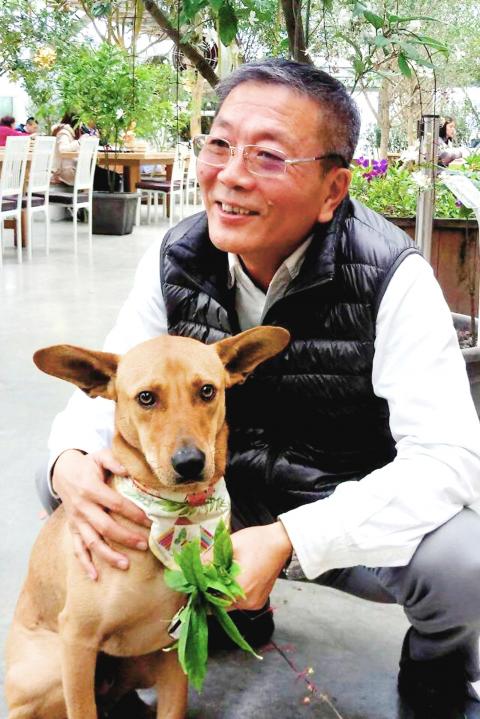
Photo: CNA
At a news conference, DPP Legislator Lin Chun-hsien (林俊憲) called for the CTBA to be abolished and its officials to be dismissed so that it could be rebuilt into a new organization called the “Taiwan Baseball Association.”
“We have had a long-running problem of conflict between the CTBA and the Chinese Professional Baseball League [CPBL],” he said.
“It is politics interfering with sports,” Lin Chun-hsien said. “When the CTBA becomes a villainous organization, how can our players be expected to compete for the nation’s honor?”
He said he would introduce amendments to enable the disbanding of the CTBA, “which is rotten from its roots,” to allow it to be rebuilt from the ground up.
“The infighting got worse for the World Baseball Classic, with [the CPBL’s Lamigo Monkeys] completely boycotting the CTBA-organized national team,” he added.
Lin Chun-hsien blamed the Chinese Nationalist Party (KMT) for Taiwanese baseball’s mismanagement and state of disarray, saying: “Both the CTBA and CPBL have been monopolized by the KMT.”
“The CTBA’s chairman is Liao Cheng-ching (廖正井), a former KMT legislator. KMT Legislator John Wu (吳志揚) is commissioner of the CPBL,” he said. “These two bodies fight each other for control and financial interests, and they refuse to cooperate for the sake of the nation, resulting in our national sport, baseball, being sacrificed.”
“So, it is not even wrangling over politics, but fighting over power and money, as both sides are controlled by the KMT,” he added.
DPP Legislator Chang Liao Wan-chien (張廖萬堅) announced at the news conference that he would resign as a member of the CTBA’s board of directors.
“I hope this move will initiate the reform process at the CTBA, which has been administered as a ‘closed shop’ with ‘black-box’ operations,” Chang Liao said. “It is time for all politicians to resign from the nation’s governing sports bodies.”
“We welcome the Executive Yuan and accountants to come to our offices and audit our financial records,” Liao Cheng-ching said, in response to the accusations. “We can stand up to the test.”
“How can we just disband? The international baseball community has always endorsed us for doing a good job,” he added, in response to the fans’ online petition.

PROVOCATIVE: Chinese Deputy Ambassador to the UN Sun Lei accused Japan of sending military vessels to deliberately provoke tensions in the Taiwan Strait China denounced remarks by Japan and the EU about the South China Sea at a UN Security Council meeting on Monday, and accused Tokyo of provocative behavior in the Taiwan Strait and planning military expansion. Ayano Kunimitsu, a Japanese vice foreign minister, told the Council meeting on maritime security that Tokyo was seriously concerned about the situation in the East China and South China seas, and reiterated Japan’s opposition to any attempt to change the “status quo” by force, and obstruction of freedom of navigation and overflight. Stavros Lambrinidis, head of the EU delegation to the UN, also highlighted South China Sea
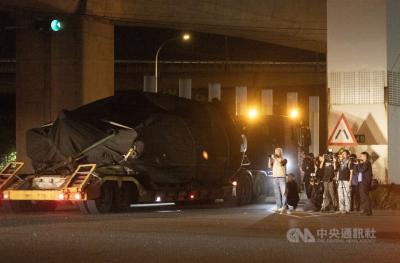
The final batch of 28 M1A2T Abrams tanks purchased from the US arrived at Taipei Port last night and were transported to the Armor Training Command in Hsinchu County’s Hukou Township (湖口), completing the military’s multi-year procurement of 108 of the tanks. Starting at 12:10am today, reporters observed more than a dozen civilian flatbed trailers departing from Taipei Port, each carrying an M1A2T tank covered with black waterproof tarps. Escorted by military vehicles, the convoy traveled via the West Coast Expressway to the Armor Training Command, with police implementing traffic control. The army operates about 1,000 tanks, including CM-11 Brave Tiger
Taiwan Semiconductor Manufacturing Co (TSMC, 台積電), the world’s largest contract chipmaker, said it expects its 2-nanometer (2nm) chip capacity to grow at a compound annual rate of 70 percent from this year to 2028. The projection comes as five fabs begin volume production of 2-nanometer chips this year — two in Hsinchu and three in Kaohsiung — TSMC senior vice president and deputy cochief operating officer Cliff Hou (侯永清) said at the company’s annual technology symposium in Silicon Valley, California, last week. Output in the first year of 2-nanometer production, which began in the fourth quarter of last year, is expected to
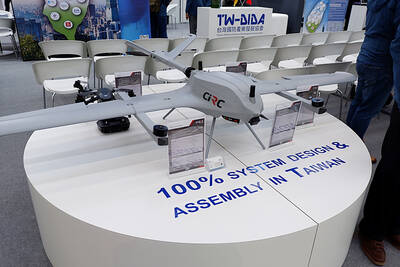
Taiwan’s drone exports surged past US$100 million in the first quarter, exceeding last year’s full-year total, with the Czech Republic emerging as the largest buyer, the Ministry of Economic Affairs said. Exports of complete drones reached US$115.85 million in the period, about 1.2 times the total recorded for all of last year, the ministry said in a report. Exports to the Czech Republic accounted for about US$100 million, far outpacing other markets. Poland, last year’s top destination, recorded about US$11.75 million in the first quarter. Taiwan’s drone exports have expanded rapidly in the past few years, with last year’s total


 RSS
RSS