


US-backed Iraqi security forces captured Mosul airport yesterday, state television said, in a major gain in operations to drive the Islamic State group from the western half of the city.
Iraqi Elite Counter Terrorism forces advanced from the southwest and entered the Ghozlani army base along with the southwestern districts of Tal al-Rumman and al-Mamoun.
Losing Mosul could spell the end of the Iraqi side of the militants’ self-styled caliphate in Iraq and Syria, which Islamic State group leader Abu Bakr al-Baghdadi declared from the city after sweeping through vast areas of Iraq in 2014.
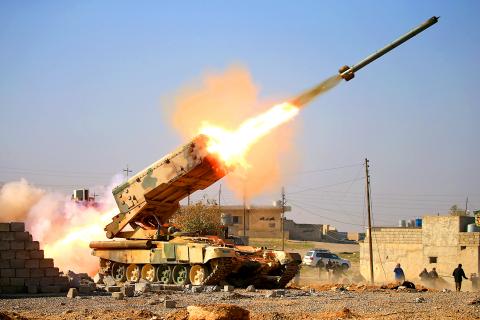
Photo: Reuters
Iraqi forces hope to use the airport as a launchpad for their campaign to drive the militants from Iraq’s second-largest city.
A Reuters correspondent saw more than 100 civilians fleeing toward Iraqi security forces from the district of al-Mamoun. Some of them were wounded.
“DAESH fled when counterterrorism Humvees reached al-Mamoun. We were afraid and we decided to escape toward the Humvees,” said Ahmed Atiya, one of the escaped civilians said, referring to the Islamic State group by its Arabic acronym.
Federal police and an elite Iraqi interior ministry unit known as Rapid Response had battled their way into the airport as Islamic State group fighters fought back using suicide car bombs, a Reuters correspondent in the area south of Mosul airport said.
Police officers said the militants had also deployed bomb-carrying drones against the Iraqi Counter Terrorism Forces advancing from the southwestern side of the city.
“We are attacking DAESH [Islamic State] from multiple fronts to distract them and prevent them regrouping,” said Police Captain Amir Abdul Kareem, whose units were fighting near the Ghozlani military base. “It’s the best way to knock them down quickly.”
Western advisers supporting Iraqi forces were seen about 2km away from the front line to the southwest of Mosul, a Reuters correspondent said.
Iraqi forces last month ousted the Islamic State group from eastern Mosul and embarked on a new offensive against the militant group in densely populated western Mosul this week.
US special forces in armored vehicles positioned near Mosul airport yesterday looked on as Iraqi troops advanced and a helicopter strafed suspected Islamic State positions.
Counterterrorism troops fought their way inside the Ghozlani military base, which includes barracks and training grounds close to the Baghdad-Mosul highway, a spokesman said.
The airport and the base, captured by Islamic State group fighters when they overran Mosul in June 2014, have been heavily damaged by US-led airstrikes intended to wear down the militants ahead of the offensive, a senior Iraqi official said.
The US military commander in Iraq has said he believes US-backed forces will retake both of the Islamic State group’s urban bastions — the other is the Syrian city of Raqqa — within the next six months.

NETWORK-MAPPING PROJECT: The database contains 170 detailed files of Taiwanese politicians and about 23 million records of household registration data in Taiwan China has developed a network-mapping project targeting political figures and parties in Taiwan to monitor public opinion during elections and to craft tailored influence campaigns aimed at dividing Taiwanese society, according to documents leaked by Chinese technology firm GoLaxy (中科天璣). The documents, collected by Taipei-based Doublethink Lab, showed a database was specifically created to gather detailed information on Taiwanese political figures, including their political affiliations, job histories, birthplaces, residences, education, religion and a brief biography about them. Several notable Taiwanese politicians are in the database, including President William Lai (賴清德), former president Tsai Ing-wen (蔡英文), Minister of Foreign Affairs Lin Chia-lung (林佳龍),

RECOGNITION: Former Fijian prime minister Mahendra Chaudhry said that Taiwan’s New Southbound Policy serves as a stabilizing force in the Indo-Pacific region Taiwan can lead the unification of the Chinese people, Nobel Peace Prize laureate and former Polish president Lech Walesa said in Taipei yesterday, adding that as the world order is changing, peaceful discussion would find good solutions, and that the use of force and coercion would always fail. Walesa made the remarks during his keynote address at a luncheon of the Yushan Forum in Taipei, titled “Indo-Pacific Partnership Prospects: Taiwan’s Values, Technology and Resilience,” organized by the Taiwan-Asia Exchange Foundation with the Ministry of Foreign Affairs. Walesa said that he had been at the forefront of a big peaceful revolution and “if
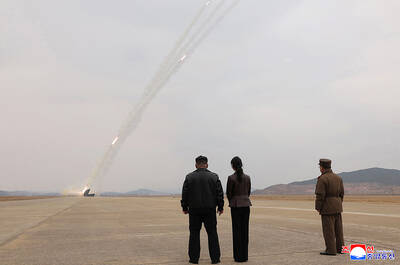
North Korea tested nuclear-capable rocket launchers, state media reported yesterday, a day after Seoul detected the launch of about 10 ballistic missiles. The test comes after South Korean and US forces launched their springtime military drills, due to run until Thursday. North Korean leader Kim Jong-un on Saturday oversaw the testing of the multiple rocket launcher system (MRLS), the Korean Central News Agency (KCNA) said. The test involved 12 600mm-caliber ultra-precision multiple rocket launchers and two artillery companies, it said. Kim said the drill gave Pyongyang’s enemies, within the 420km striking range, a sense of “uneasiness” and “a deep understanding
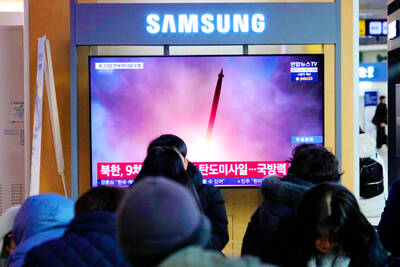
North Korea yesterday fired about 10 ballistic missiles to the sea toward Japan, the South Korean Joint Chiefs of Staff (JCS) said, days after Pyongyang warned of “terrible consequences” over ongoing South Korea-US military drills. Pyongyang recently dashed hopes of a diplomatic thaw with Seoul, Washington’s security ally, describing its latest peace efforts as a “clumsy, deceptive farce.” Seoul’s military detected “around 10 ballistic missiles launched from the Sunan area in North Korea toward the East Sea [Sea of Japan] at around 1:20pm,” JCS said in a statement, referring to South Korea’s name for the body of water. The missiles


 RSS
RSS