


The US is to post US Marines at the new compound of the American Institute in Taiwan (AIT) once it is completed and AIT personnel are moved to the site in Taipei’s Neihu District (內湖), former AIT director Stephen Young said on Wednesday.
Young, who served as AIT director from 2006 to 2009, said he had pushed strongly for the US to “have a [US] Marine security detachment protecting the mission in Taipei” and that he is “proud to say that it is the case today.”
The retired diplomat made the remarks at a speech at a conference held by Global Taiwan Institute, a Washington think tank, to discuss US President Donald Trump’s Taiwan policy.
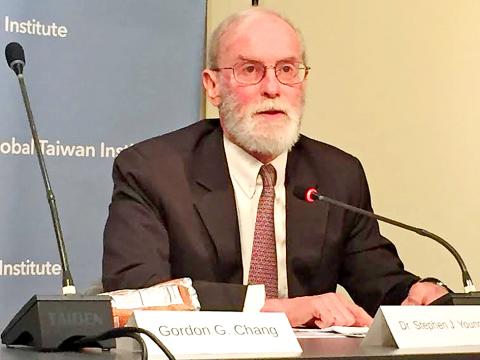
Photo: Nadia Tsao, Taipei Times
The AIT’s current Taipei office is in Daan District (大安).
The AIT has said that it will make the move to Neihu sometime this year.
“We made sure when we were designing our new office building that we were going to build a very nice marine house for our guys there,” Young said of the new facility.
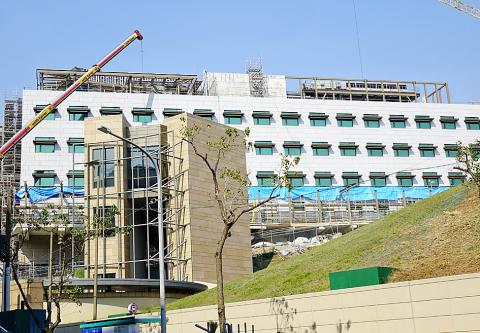
Photo: Chang Chia-ming, Taipei Times
This is not only because they deserve it for their own purposes, “but because when you go around the world, a marine house is the social center of any diplomatic corps and it will be in Taipei as well,” Young said.
This will be “a symbolic expression” of the US’ commitment to its friends in Taiwan, Young said.
It is not known whether the proposed marines unit would wear a military uniform as their counterparts do when protecting US embassies in other countries.
US Marines are posted at US overseas missions around the world to protect the diplomatic facilities and the personnel stationed there. A marine house is built to accommodate them.
Since Taipei and Washington severed diplomatic ties in 1979, there have been no US Marines stationed at the AIT office, because the US maintains only unofficial ties with Taiwan.
Having US Marines posted at the new AIT compound would likely be seen here as an indication of warm relations between the two nations.
The AIT yesterday said that it would not discuss specific security matters regarding the protection of its facility.
However, the new compound “is a demonstration of our ongoing and continuously deepening commitment to Taiwan,” AIT spokeswoman Sonia Urbom said.
“As is the practice at AIT’s current location, personnel detailed to AIT will provide security for the office compound, in cooperation with local authorities,” she said.
She said the projected completion date for the new facility is the middle of this year.
“We will begin the process of moving locations after the project has been completed,” she said.
Young’s speech was not the first time that a US Marine guard detachement at the Neihu site has been mooted.
The US Department of State ran an advertisement in the Taipei Times and the China Post on April 19, 2008, seeking contractors to build quarters for US Marine security guards at the Neihu compound.
On April 21, then-State Department spokesman Tom Casey told reporters in Washington that the procurement announcement did not indicate anything more than in seeking a contractor, as the US wants to give bidders a “full range of options.”
The notices “included the broadest possible kinds of elements that might be included” in the new facility, Casey said.
The Marine Corps Times newspaper in April 2009 reported that the US Marine Corps had included the new facility on a list of new US embassy buildings for a meeting with State Department officials on security, but the meeting ended before the Taipei facility was discussed.
There were more media reports last year that US Marines would be based at the new compound, but AIT Director Kin Moy did not confirm it at the time.
The Ministry of National Defense yesterday said it would not comment on the issue, as it should be left to the AIT and the State Department to do so.
There have been US military attaches assigned to AIT’s Taipei office since 2005, but they do not wear their uniforms and keep a low profile.
Additional reporting by Aaron Tu and Diane Baker

The National Chungshan Institute of Science and Technology yesterday showcased its locally developed variants of the Vision 60 robotic patrol dog, which it plans to deploy on the nation’s outlying territories in the South China Sea. The variants were produced under the Joint Lab project — created by the institute and domestic companies — and assembled with domestically produced motors, lenses and artificial intelligence (AI) systems alongside licensed tech from the US, Missile and Rocket Systems Research Division deputy director Jen Kuo-kang (任國光) told the media event at a military base in Taipei’s Dazhi (大直) area. Taiwan has built up its strengths

RIGHT DIRECTION: Taiwan’s efforts to prevent forced labor include a proposal to ‘fully prohibit’ employers from withholding workers’ documents, an official said Taiwan is to establish a mechanism to restrict imports of goods linked to forced labor, the Executive Yuan said yesterday, after the US proposed imposing additional tariffs on Taiwanese goods over labor concerns. “The Ministry of Labor and the Ministry of Economic Affairs are to establish an interministerial review procedure,” Executive Yuan spokesperson Michelle Lee (李慧芝) said at a news briefing in Taipei. “The government is to use the Foreign Trade Act [貿易法] as the legal basis to restrict imports of goods produced with forced labor” and bring its supply chain governance more in line with international standards on human rights, resilience

NOT IMMEDIATE: Taiwan has a chance to appeal the proposed 10 percent tariff before it starts, while other countries face a 12.5 percent tariff from the trade office Taiwan is among 60 economies determined by the US to have failed to impose or enforce a ban on the importation of goods produced with forced labor, according to a notice released on Tuesday by the Office of the US Trade Representative (USTR), which proposed imposing an additional 10 percent or more tariff on them. The USTR in a statement said that following an investigation, it had determined under Section 301 of the Trade Act of 1974 that the failure of the 60 economies to impose and effectively enforce a prohibition on the importation of goods produced with forced labor is

TIT-FOR-TAT: The US allegedly revoked the visa of a Chinese national working at Xinhua News Agency in the US in response to Beijing’s expulsion of Vivian Wang The Presidential Office yesterday condemned China for expelling a New York Times correspondent from Beijing following the newspaper’s interview with President William Lai (賴清德), saying the move highlighted Beijing’s suppression of press freedom and its threat to international news media. Taiwan has noted a series of recent incidents in which Beijing used similar tactics to “threaten and pressure international media outlets and journalists,” Presidential Office spokeswoman Karen Kuo (郭雅慧) said in a statement. “This concerns not only press freedom and freedom of expression, but also the safety of journalists, and Taiwan and relevant partners are paying close attention to the situation,” she


 RSS
RSS