

The Directorate-General of Highways (DGH) yesterday said that it would discuss with the Ministry of Labor the best way to regulate the working hours of tour bus drivers, after it was reported that the tour bus driver killed in a freeway accident in Taipei on Monday night had worked 18 days consecutively and 16 hours per day.
Directorate-General of Highways Director-General Chen Yen-po (陳彥伯) said that the government had consulted the regulations of other nations when it stipulated the rules on tour bus drivers’ working hours in the Transportation Management Regulations (汽車運輸業管理規則).
The regulations stipulate that bus drivers must not drive more than 10 hours per day and that they should take at least a 30-minute break when they drive consecutively for four hours.
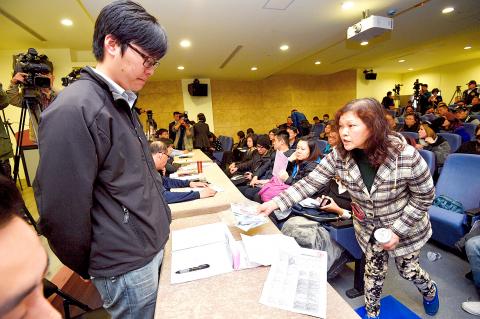
Photo: Lo Pei-der, Taipei Times
Should they prefer to take multiple small breaks instead of one 30-minute break, each break must be no less than 15 minutes.
Drivers can adjust their break times if they are stuck in traffic and must continue driving.
The regulations also stipulate that the maximum consecutive driving time is six hours and drivers must take a 45-minute break afterward.
In addition, drivers should have a rest of at least 10 consecutive hours between working days.
The rest can be eight consecutive hours if there is a change of shift, but the adjustment must not occur more than two times per week or consecutively.
The regulations are similar to those used in the UK, Chen said.
Chen on Tuesday said that the work hours of the tour bus drivers are counted only when their hands are on the steering wheel, which stirred public anger.
He said he had just been trying to explain the difference between the duration of a tour and the driving time, as people tend to confuse the two time periods, Chen said.
Some nations use the former to limit drivers’ working hours, while others clearly state the number of hours a driver can work per day, he said.
Chiao Tung University transportation and logistics management department associate professor Wang Jin-yuan (王晉元) suggested that tour bus operators be asked to arrange two drivers for each bus on long-distance tours, similar to the regulations enforced in Germany.
However, the arrangement would definitely increase companies’ operating costs and consumers must realize that safety comes at a price, Wang said.
“If a one-day tour requires the bus to travel a long distance, the Tourism Bureau could ask travel agencies to have two drivers on board. The bureau could also ban the sale of such tours,” Wang said.

‘GLOBAL WARNING’: The infiltration is not just a local problem, as Beijing has been deploying the same tactics worldwide against Western democracies, a report said Between 50,000 and 100,000 Chinese spies are operating in Taiwan, far more than the National Security Bureau’s previous estimate of 5,000, German journalist and author Jurgen Kremb said on Monday. Kremb presented his research, titled “The War of Spies: How China’s Intelligence Services Are Infiltrating Taiwan — and What Europe Must Learn from It,” at a joint event held by the Taiwan offices of the Friedrich Naumann Foundation and the European Values Center for Security Policy. The report was published in June in the Ministry of Justice Investigation Bureau’s Prospect & Exploration Monthly (展望與探索月刊). By spies, he said he was referring to informants,

PRICE STABILIZATION: The Ministry of Economic Affairs has urged the legislature to support the Cabinet’s supplementary budget for state-owned energy companies State-owned oil supplier CPC Corp, Taiwan (CPC, 台灣中油) on Saturday announced that it would raise domestic gasoline prices by NT$0.7 (US$0.02) per liter and diesel prices by NT$0.6 per liter this week after international crude oil prices rose above US$100 per barrel last week. Formosa Petrochemical Corp (台塑石化) yesterday said that it matched CPC’s price adjustments for this week. The decisions end a six-week period during which CPC and Formosa kept fuel prices in Taiwan unchanged. Retail gasoline prices this week would rise to NT$31.2, NT$32.7 and NT$34.7 per liter for 92, 95 and 98-octane unleaded gasoline respectively at CPC
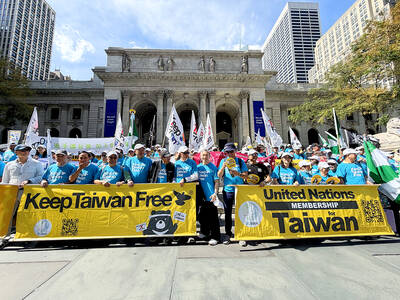
More than 100 Taiwanese-Americans, Taiwanese lawmakers and members of civic groups on Saturday marched through New York City to call for Taiwan’s participation in the UN, with Marshall Island Permanent Representative to the UN John Silk joining the event to show support. Participants chanted: “UN for Taiwan” and “Keep Taiwan Free” as they marched through central Manhattan, passing Times Square and Bryant Park before ending near the New York Public Library. The annual march brought together Taiwanese community groups from across the US East Coast. Silk expressed hope that Taiwan would one day be able to participate in UN meetings

Two aides at independent Legislator May Chin’s (高金素梅) office were ordered detained incommunicado yesterday in a broadening probe into alleged Chinese espionage by Chin’s former chief of staff, Chang Chun-chieh (張俊傑). The move to hold Lin I-chun (林怡君) and current chief of staff Chen Chih-huang (陳智葟) in custody came four days after Chang, indicted on corruption charges, cut off his electronic monitoring wristband and jumped bail. The High Prosecutors’ Office said that it believes Chang had developed a Chinese spy ring, which might have operated for more than a decade, with funding from China, and that Lin and Chen were suspected of


 RSS
RSS