

The government has no comment on Cambodian Prime Minister Hun Sen’s remarks that the Republic of China’s (ROC) flag is banned from being raised in his country to “respect the sovereignty of China,” Ministry of Foreign Affairs (MOFA) spokeswoman Eleanor Wang (王珮玲) said yesterday.
According to the Cambodian Daily, Hun Sen reiterated his government’s support for Beijing’s “one China” principle during a dinner on Saturday hosted by the Cambodian-Chinese Association.
“We should not do anything that affects respect for China’s sovereignty and independence through shaking hands and stepping on feet,” the paper quoted him as saying. “I request to people here: Please do not raise the Taiwanese flag whenever you are gathering, even at a hotel during Taiwan’s national holidays. It is not allowed.”
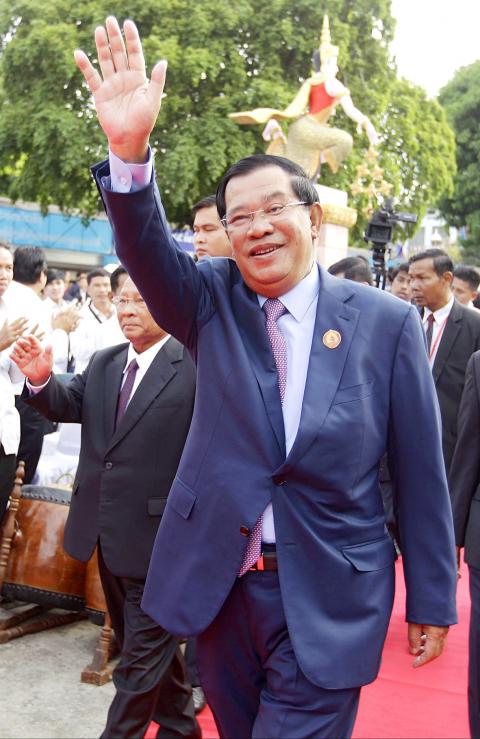
Photo: AP
Calling Taiwan and Tibet provinces of China, Hun Sen said that his nation’s foreign policy is the one that has been implemented since the Sihanouk regime, referring to King Norodom Sihanouk.
“As an independent, sovereign nation, we endeavor to maintain peace and stability in the Asia-Pacific region and are willing to establish a friendly and mutually beneficial relationship with any country in the region, including Cambodia,” Wang said.
The Cambodia Daily also reported that Taiwan tried to establish a trade office in Phnom Penh, but was snubbed by Hun Sen in 2009 and again in July 2014, citing the government’s adherence to the “one China” principle.
Wang declined to say if the government had tried to set up an office, but said that it is “not possible for the ministry to set up a representative office or trade office in every country around the world.”
“Jurisdictions” have been drawn up instead, and affairs with Cambodia are handled by the Taiwan Economic and Cultural Office in Ho Chih Minh City, Vietnam, she said.
Asked if Hun Sen’s comments would have a negative impact on the government’s “new southbound policy,” Wang said: “No comment.”
The Cambodian leader’s remarks were based on “his own thoughts and calculations,” Wang added.
However, lawmakers said Hun Sen’s remarks might be a sign of increasingly aggressive Chinese diplomatic moves against Taiwan in Southeast Asia.
“From the Nigeria incident to the Cambodian prime minister’s remarks, there has been a noticeable escalation of China’s efforts to turn its diplomatic allies against Taiwan,” Democratic Progressive Party (DPP) Legislator Lo Chih-cheng (羅致政) said.
Nigeria last month said it would cease all diplomatic relations with Taiwan in accordance with the “one China” principle.
China was presumably behind Hun Sen’s reiteration of the ban on the ROC flag, but Beijing need not and should not launch another “diplomatic war” against Taipei, which would only hurt cross-strait relations, Lo said.
DPP Legislator Gao Jyh-peng (高志鵬) said that while Hun Sen’s comments might reflect his own choice to submit to Beijing, other ASEAN states where Taiwanese businesses have a strong presence might also be subject to Beijing’s coercive diplomacy.
Chinese Nationalist Party (KMT) caucus convener Sufin Siluko (廖國棟) said Hun Sen’s remarks must reflect a demand from Beijing, as Cambodia has always been close to China.
“The two sides of the Taiwan Strait should come up with a new way to handling things like this,” he said.
“The Chinese government should relax a bit and try not to be so tense and demanding, considering that the people on both sides of the Strait are ethnic Chinese,” the KMT lawmaker said.
The government should also reflect on why cross-strait relations have deteriorated so badly, he said.
New Power Party Legislator Freddy Lim (林昶佐) said a policy that ignores the existence of Taiwan because of pressure from China is futile and unhelpful in protecting Taiwanese and Cambodians.

Taiwan, which accounts for more than half of the global outsourced semiconductor assembly and testing market, is well-positioned to develop copackaged optics (CPO) and manufacture precision silicon photonics chips, the Ministry of Economic Affairs said yesterday. Silicon photonics are emerging as a mainstream optical communications technology and is seen as key to overcoming bottlenecks in AI computing power. The technology is a key project under the government’s New 10 Major AI Infrastructure Projects, with industry, government, academia and research institutions working to overcome critical technological hurdles and build a self-reliant silicon photonics supply chain, the ministry said. Nvidia Corp in March invested US$4
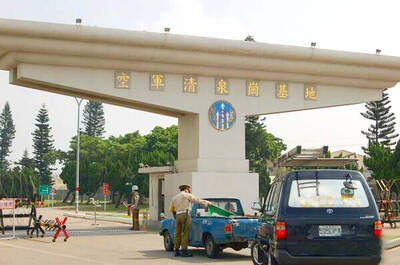
An unauthorized drone intrusion over Ching Chuan Kang Air Base (清泉崗基地) at Taichung International Airport on Tuesday night forced the temporary closure of the base, diverting eight fighter jets and delaying a commercial flight, authorities said. Air Force Command Headquarters said that clear weather had allowed for scheduled night training exercises, but after a drone was spotted entering the airspace, the control tower declared an emergency closure of the airport, forcing eight Indigenous Defense Fighter jets in the air to divert and land at Hsinchu Air Base (新竹基地). Taichung airport director Chang Jui-shu (張瑞澍) said the airspace intrusion lasted from 7:37pm to
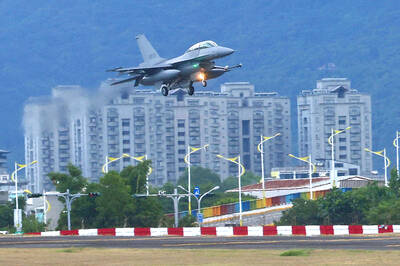
The air force plans to build 26 more hardened aircraft shelters as the number of F-16Vs stationed along Taiwan’s east coast is expected to reach 120 when the final shipment of 66 jets procured from the US arrives. The incoming jets would be stationed at Chihhang Air Base in Taitung County, augmenting the F-16V Block 20s operated by the 5th Tactical Fighter Wing in Hualien County, officials said yesterday. The air force plans to allocate more than NT$6.88 billion (US$218.1 million) from next year to 2031 to build the shelters in Hualien and Taitung as part of the implementation of a “one
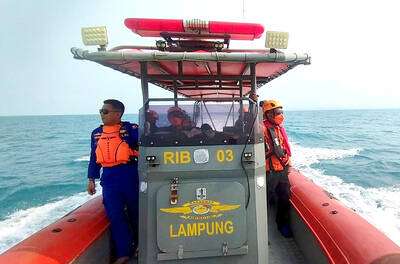
Indonesian rescuers searched for eight people who went missing at sea while heading to a volcanic island to report on an eruption there, officials said yesterday. Anak Krakatau initially erupted for about 25 hours over the weekend, and it has since continued to erupt intermittently with explosions ejecting lava, ash and incandescent volcanic material from the crater, the Indonesian Geology Agency said in a statement. A speedboat carrying five photojournalists, two crew members and a route guide lost contact after leaving Carita, a coastal town in Banten Province, for the volcanic island, Banten Province Search and Rescue Office Chief Al Amrad said. He


 RSS
RSS