


A majority of the public hopes that pension reform can be completed by the end of this year, with policies put forward by the Pension Reform Committee garnering widespread support from public and private-sector workers younger than 40, the results of a survey released yesterday by the Democratic Progressive Party (DPP) found.
Overall, 70.4 percent of respondents said that they want pension reform to be accomplished before next year, while 25.9 percent stated the opposite view.
However, when broken down into private-sector workers and public-sector workers, only 44.2 percent of public-sector workers were in favor of the reform, while 55.8 percent were against it, while 72.5 percent of private-sector workers supported reform, as opposed to 25.1 percent against.
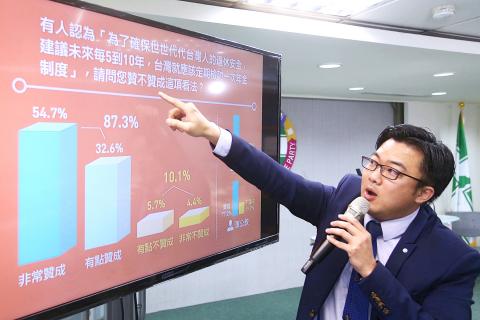
Photo: CNA
Public-sector workers were more supportive of forming a “sustainable pension system that the government can afford that ensures all present and future retirees would receive their pensions,” with 88 percent of them responding positively to the idea, compared with the 86.8 percent registered by private-sector workers, the results showed.
A majority of private-sector workers and public-sector workers, 90.3 percent and 77.2 percent respectively, said they would like the pension system to be reviewed every five or 10 years to ensure that it is financially sound, while 19.7 percent of public-sector workers and 8 percent of private-sector workers had the contrary opinion, the survey found.
The proposed “transferable pension” system, which allows the pensions private-sector workers have accrued to be added to the amount of time they serve as a public servant, if they make such a transition, similarly won nonpartisan support from both private-sector workers and public-sector workers, registering support ratings of 87 percent and 89.6 percent respectively, the poll showed.
Categorized by age group, about 70 percent of public-sector workers under 40 expressed approval of the policies put forward by the committee so far, the results showed.
They include plans to gradually increase the labor insurance premium from 12 percent to 18 percent to prevent the pension system from going bankrupt, and to gradually phase out the 18 percent preferential savings interest rate enjoyed by public-sector workers hired before 1995.
Asked how the government would address detractors of pension reform, DPP spokesman Yang Chia-liang (楊家俍) said that it would focus on debunking rumors and erroneous information being disseminated on social media to boost the public’s confidence in reform.
A DPP source said that the survey also showed growing support for President Tsai Ing-wen (蔡英文) after her administration had laid out its pension reforms.
The party’s latest survey found that Tsai had an approval rating of 43.9 percent after a national convention on pension reform.
The survey, conducted among Taiwanese aged at least 20, collected 1,009 valid samples nationwide, with a 95 percent confidence level and a 3.1 percent margin of error.
Additional reporting by CNA

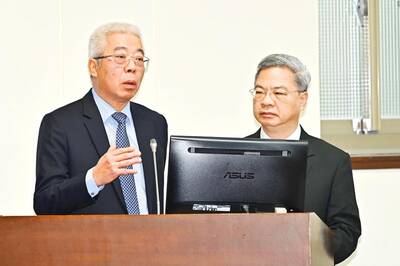
Taiwan has arranged for about 8 million barrels of crude oil, or about one-third of its monthly needs, to be shipped from the Red Sea this month to bypass the Strait of Hormuz and ease domestic supply pressures, CPC Corp, Taiwan (CPC, 台灣中油) said yesterday. The state-run oil company has worked with Middle Eastern suppliers to secure routes other than the Strait of Hormuz, through which about 20 percent of the world’s oil and liquefied natural gas typically passes, CPC chairman Fang Jeng-zen (方振仁) said at a meeting of the legislature’s Economics Committee in Taipei. Suppliers in Saudi Arabia have indicated they
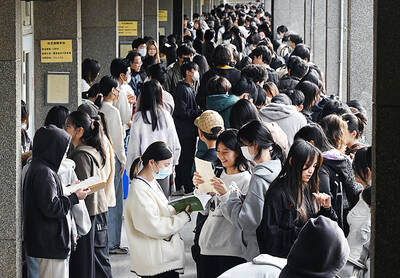
A global survey showed that 60 percent of Taiwanese had attained higher education, second only to Canada, the Ministry of the Interior said. Taiwan easily surpassed the global average of 43 percent and ranked ahead of major economies, including Japan, South Korea and the US, data from the Organisation for Economic Co-operation and Development (OECD) for 2024 showed. Taiwan has a high literacy rate, data released by the ministry showed. As of the end of last year, Taiwan had 20.617 million people aged 15 or older, accounting for 88.5 percent of the total population, with a literacy rate of 99.4 percent, the data

CCP ‘PAWN’? Beijing could use the KMT chairwoman’s visit to signal to the world that many people in Taiwan support the ‘one China’ principle, an academic said Chinese Nationalist Party (KMT) Chairwoman Cheng Li-wun (鄭麗文) yesterday arrived in China for a “peace” mission and potential meeting with Chinese President Xi Jinping (習近平), while a Taiwanese minister detailed the number of Chinese warships currently deployed around the nation. Cheng is visiting at a time of increased Chinese military pressure on Taiwan, as the opposition-dominated Legislative Yuan stalls a government plan for US$40 billion in extra defense spending. Speaking to reporters before going to the airport, Cheng said she was going on a “historic journey for peace,” but added that some people felt uneasy about her trip. “If you truly love Taiwan,

NEW LOW: The council in 2024 based predictions on a pessimistic estimate for the nation’s total fertility rate of 0.84, but last year that rate was 0.69, 17 percent lower An expected National Development Council (NDC) report expects the nation’s population to drop below 12 million by 2065, with the old-age dependency ratio to top 100 percent sooner than 2070, sources said yesterday. The council is slated to release its latest population projections in August, using an ultra-low fertility model, the sources said. The previous report projected that Taiwan’s population would fall to 14.37 million by 2070, but based on a new estimate of the total fertility rate (TFR) — the average number of children born to a woman over her lifetime — the population is expected to reach 12 million by


 RSS
RSS