


Following an uneventful arrival in Taiwan on Saturday night, Hong Kong democracy campaigner Joshua Wong (黃之鋒) yesterday spoke to a group of Taiwanese students in Taipei about his involvement in the territory’s struggle for self-determination.
Wong was escorted by police at Taiwan Taoyuan International Airport after disembarking, and his speech was marked by a heavy police presence, although there was no protest of any kind.
Wong and three Hong Kong lawmakers, Edward Yiu (姚松炎), Nathan Law (羅冠聰) and Eddie Chu (朱凱迪), were confronted by a group of pro-unification protesters on their arrival at Taoyuan Airport on Jan. 7, with protesters attempting to break a police cordon to attack the four, who were invited to participate in forums organized by the New Power Party.

Photo: Chu Pei-hsiung, Taipei Times
Wong said he was more confident in the Taiwanese police force’s investigation efficiency than in their Hong Kong counterparts.
Only four people were arrested for attacking Law at Hong Kong International Airport on Sunday last week, while 13 people were arrested in Taiwan for attempting to attack Wong and the three pro-localization lawmakers, he said.
Wong said he had not taken any special measures to prevent more conflict with protesters and had only asked the event organizer to attend to his safety.
The event — organized by a think tank affiliated with the Democratic Progressive Party (DPP) — was to familiarize college students with cross-strait political and economic interactions.
Wong and DPP Department of Youth Development director Huang Shou-ta (黃守達) held a discussion about democratic development in Taiwan and Hong Kong.
Wong told dozens of students how “Chinese factors” influenced Hong Kong politics and about his participation in the movement against a pro-China national education scheme in 2012, the “Umbrella movement” in 2014 and the Hong Kong legislative election last year.
“I hope Hong Kong and Taiwan, both subject to the suppression and interference of Beijing, can seek more interactions especially in terms of the political participation of young people,” Wong said.
“It is my first time speaking to a group of students and assistants to lawmakers in Taiwan. I hope I can engage people other than lawmakers and political leaders in Taiwan in the future, including college students of my own age,” he said.
Such interaction is common between democratic societies, Wong said, adding that he would continue to attend similar events.
He said his trip to Taiwan was also to familiarize young Taiwanese with the plight faced by three other Hong Kong lawmakers and himself.
The four might be deprived of their seats in the territory’s Legislative Council for altering their oaths during the swearing-in ceremony, he said, adding that their fate hinges on a court verdict expected next month.
The four could be asked to pay legal expenses of up to HK$10 million (US$1.29 million) should they be disqualified, he said.
“Taiwanese who support democracy and human rights hopefully pay attention to events in Hong Kong,” he said.

‘NO SECURITY RISK’: The Railway Bureau reassured the public that the technicians’ activities were limited to technical guidance and did not involve sensitive systems The Railway Bureau yesterday said it had invited eight Chinese technicians to assist with an airport MRT construction project. The bureau issued the confirmation after an Internet user said Chinese nationals had entered the construction zone of Taiwan Taoyuan International Airport’s Terminal 3 project. They asked why “individuals from an enemy state” were allowed access to such a major national infrastructure project, which raised serious concerns over Taiwan’s industrial safety, sensitive systems and information security. The bureau’s Northern Region Engineering Branch Office said subcontractor Taiwan Handle Industrial Co (台灣手把工業) of the Taoyuan airport MRT’s “Contract No. CU05 Project A14 Station Civil, MEP &

A US uncrewed surface vessel (USV) encountered multiple Chinese warships during an autonomous transit of the Taiwan Strait, US defense company Seasats said in a statement on Wednesday. Seasats announced that a Lightfish USV had completed the first autonomous transit of the Taiwan Strait. Over five days, the USV traversed the entire length of the Strait while constantly monitoring surface vessel traffic, the company said. The Lightfish encountered multiple Chinese warships, one of which was a Chinese People’s Liberation Army Navy (PLAN) Type 056 corvette, it said. The Chinese vessels were operating “well within Taiwan’s exclusive economic zone without transmitting their identity via the

Taiwan is still in the process of assessing the possibility of recruiting workers from Eswatini, the Ministry of Foreign Affairs said yesterday, adding that its goal is to help Eswatini upgrade its vocational training centers. If there are plans to recruit workers from Eswatini, safeguarding national security, protecting public health and ensuring the employment rights of Taiwanese would be prerequisites, Department of West Asian and African Affairs Director-General Yen Chia-liang (顏嘉良) told a news conference. Key considerations would also include filling labor shortages in specific industries, and fostering bilateral professional and technical exchanges, he said. Yen was asked about the progress of labor
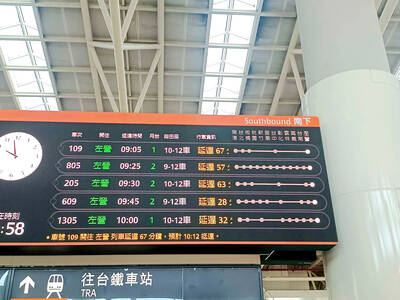
The nation’s usually punctual high-speed rail system yesterday was hit by major disruptions after all scheduled services were canceled and replaced with three hourly trains offering only non-reserved seating, affecting more than 200,000 passengers. Preliminary findings indicate the disruption was caused by a faulty power module in a track switch control cabinet, Taiwan High-Speed Rail Corp (THSRC) said, adding that as a full system inspection could only be conducted after operations end for the day, a decision on whether normal service would resume today would be announced before the first train departs. During a routine inspection early yesterday, a switch signal abnormality


 RSS
RSS