


President Tsai Ing-wen (蔡英文) believes textiles should be at the heart of Taiwan’s thinking in developing new global trade arrangements and strategies, the Presidential Office said in a statement yesterday.
The statement cited Tsai as saying during her recent visit to four of Taiwan’s diplomatic allies in Central America that she judged the textile sector in Central America to have considerable development potential.
The countries have free-trade agreements with the US that could be advantageous for Taiwanese manufacturers in the region, she said.
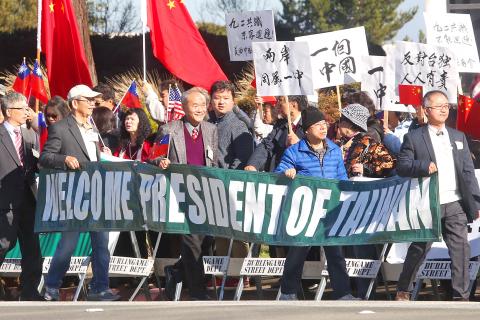
Photo: CNA
With Taiwan Textile Federation chairman Chan Cheng-tien (詹正田) to propose a new strategy for the global development of Taiwan’s textile sector, “this is the time to begin thinking about new arrangements and new strategies, starting with the textile sector,” Tsai said, according to the statement.
Tsai made the remarks at a lunch with more than 800 Taiwanese expats in San Francisco on Saturday, according to the statement.
Chan was a member of Tsai’s delegation during the overseas tour.
Tsai made a stopover in Houston on Jan. 7 and Sunday last week before heading to Central America and arrived in San Francisco on Friday for a transit stop, at the conclusion of a week-long state visit to Honduras, Nicaragua, Guatemala and El Salvador.
Tsai opened a new Twitter account on Saturday during a visit to the company’s San Francisco headquarters.
At the Twitter headquarters, she met with Twitter general counsel Vijaya Gadde, but CEO and co-founder Jack Dorsey was not present, according to a Reuters report that cited a source at the meeting.
Tsai activated a Twitter account in English during her visit. She has a Chinese-language account that she has not used for a few years, Democratic Progressive Party Legislator Pasuya Yao (姚文智) said.
Tsai also attended a lunch with Taiwanese expats at the Hyatt Regency hotel near San Francisco International Airport.
Some protesters rallied against Tsai’s China stance outside the hotel, while others gathered to show their support for the president.
Tsai also attended a ceremony marking the opening of the Executive Center for the Asian Silicon Valley Plan in Silicon Valley on Saturday.
Tsai launched the Asian Silicon Valley Plan in September last year in a bid to “connect Taiwan to global tech clusters and create new industries for the next generation.”
Tsai said she hoped the center would build links with high-tech companies and research institutions in the area so that high-value supply chains of technology, talent and capital could be created to support the plan’s implementation.
The base for the plan’s implementation was inaugurated in Taoyuan on Dec. 25 last year.
During the stopover, Tsai also spoke with a few US friends of Taiwan by telephone, Presidential Office spokesman Alex Huang (黃重諺) said, but the only person he was willing to reveal was US Senator Cory Gardner.
Gardner told Tsai that he asked US president-elect Donald Trump’s nominee for secretary of state — former Exxon Mobil CEO Rex Tillerson — to reaffirm the US’ commitment to Taiwan, based on the Taiwan Relations Act (TRA) and the “six assurances,” during Tillerson’s Senate confirmation hearing on Wednesday last week.
Tsai thanked Gardner and the US for their support for Taiwan, and she invited him to visit Taiwan, Huang said.
She was scheduled to return to Taiwan late yesterday evening Taipei time.
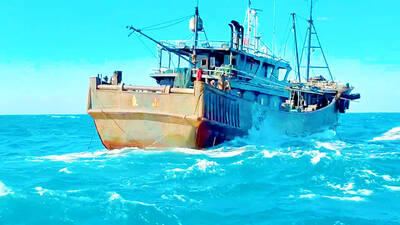
MAKING WAVES: China’s maritime militia could become a nontraditional threat in war, clogging up shipping lanes to prevent US or Japanese intervention, a report said About 1,900 Chinese ships flying flags of convenience and fishing vessels that participated in China’s military exercises around Taiwan last month and in January have been listed for monitoring, Coast Guard Administration (CGA) Deputy Director-General Hsieh Ching-chin (謝慶欽) said yesterday. Following amendments to the Commercial Port Act (商港法) and the Law of Ships (船舶法) last month, the CGA can designate possible berthing areas or deny ports of call for vessels suspected of loitering around areas where undersea cables can be accessed, Oceans Affairs Council Minister Kuan Bi-ling (管碧玲) said. The list of suspected ships, originally 300, had risen to about 1,900 as

Japan’s strategic alliance with the US would collapse if Tokyo were to turn away from a conflict in Taiwan, Japanese Prime Minister Sanae Takaichi said yesterday, but distanced herself from previous comments that suggested a possible military response in such an event. Takaichi expressed her latest views on a nationally broadcast TV program late on Monday, where an opposition party leader criticized her for igniting tensions with China with the earlier remarks. Ties between Japan and China have sunk to the worst level in years after Takaichi said in November that a hypothetical Chinese attack on Taiwan could bring about a Japanese
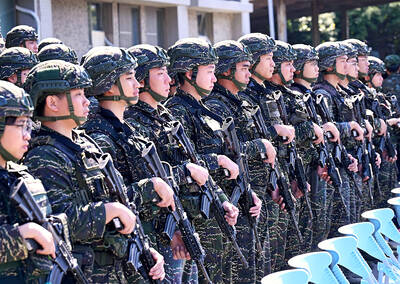
MORE RESPONSIBILITY: Draftees would be expected to fight alongside professional soldiers, likely requiring the transformation of some training brigades into combat units The armed forces are to start incorporating new conscripts into combined arms brigades this year to enhance combat readiness, the Executive Yuan’s latest policy report said. The new policy would affect Taiwanese men entering the military for their compulsory service, which was extended to one year under reforms by then-president Tsai Ing-wen (蔡英文) in 2022. The conscripts would be trained to operate machine guns, uncrewed aerial vehicles, anti-tank guided missile launchers and Stinger air defense systems, the report said, adding that the basic training would be lengthened to eight weeks. After basic training, conscripts would be sorted into infantry battalions that would take
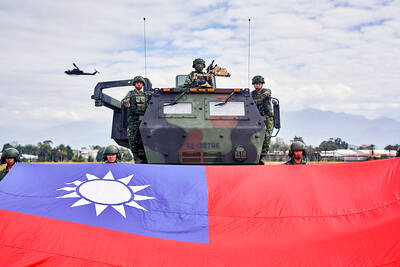
DEEP-STRIKE CAPABILITY: The scenario simulated a PLA drill that turned into an assault on Taiwan’s critical infrastructure, with the launchers providing fire support Taiwan yesterday conducted this year’s first military exercises at Longsiang Base in Taichung, demonstrating the newly acquired High Mobility Artillery Rocket System’s (HIMARS) ability to provide fire support and deep-strike capabilities. The scenario simulated an attack on Penghu County, with HIMARS trucks immediately rolling into designated launch areas and firing barrages at the Wangan (望安) and Cimei (七美) islands, simulating the provision of fire support against invading forces. The HIMARS are supposed to “fire and leave,” which would significantly increase personnel and equipment survivability, a military official said. The drill simulated an exercise launched by the Chinese People’s Liberation Army (PLA) Eastern


 RSS
RSS