

The labor law amendments could improve working conditions, with only limited impact on consumer prices, the Cabinet said yesterday, rebutting what business leaders said were the side effects of the “lose-lose legislation.”
Defending amendments to the Labor Standards Act (勞動基準法), which stipulates a five-day workweek and higher overtime pay, the Executive Yuan said the legislation is a major improvement in general working conditions, while the impact on businesses is acceptable to labor-intensive industries.
Chinese National Federation of Industries secretary-general Tsai Lien-sheng (蔡練生) on Tuesday said the amendments were a “lose-lose” legislation that hurt employers, workers and consumers with increased personnel costs, lower salaries due to fewer working hours and rising consumer prices.
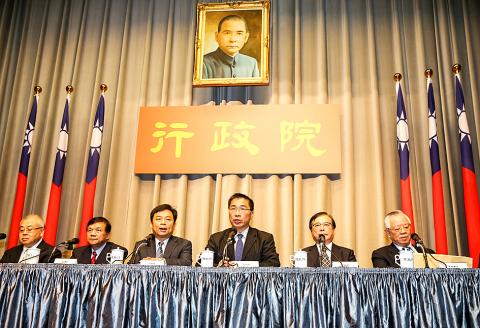
Photo: CNA
“That employers quibble with employees [over overtime pay] is what makes it a lose-lose situation,” Vice Premier Lin Hsi-yao (林錫耀) said, calling on businesses to take care of their employees.
Two major goals of the amendments — to reduce working hours and unify the nation’s leave schemes — have been achieved, although there are side effects, such as a rise in operating costs for labor-intensive businesses.
The legislation hardly affects companies that have already adopted a five-day workweek, which accounts for about 65 percent of the workforce, Lin said.
. Photo: Tsai Wen-chu, Taipei Times
For employers of the other 35 percent of workers, they are likely to see a tolerable increase in personnel costs.
“The public has misunderstood the legislation and believed that businesses would have to pay considerably more in overtime pay, but that is not the case,” Lin said.
The amendments would increase the personnel and operational costs of the manufacturing industry by 1.5 percent and 0.1 percent respectively, National Development Council Deputy Minister Kung Ming-hsin (龔明鑫) said.
As for the service industry, a labor-intensive industry that is more susceptible to the new overtime pay requirements, personnel and operational costs would only increase by 2.1 percent and 0.22 percent respectively, Kung added.
The nation will experience “very mild inflation,” with this year’s inflation estimated at 1.26 percent to 1.46 percent, which is “fairly acceptable,” central bank Governor Perng Fai-nan (彭淮南) said, adding that the central bank would not activate regulatory measures until inflation reaches 2 percent.
The consumer price index is estimated to rise by between 0.2 percent to 0.4 percent this year with the implementation of the legislation and the nation is likely to see a low and stable rise in consumer prices, Perng added.
The Fair Trade Commission is to monitor whether businesses are making coordinated price adjustments to manipulate the market. No such activity has been evident in restaurant prices, it said.
FRIDAY, SATURDAY: While Typhoon Champi might weaken, officials warned about large waves, while some transport services and tourist spots have been affected Typhoon Champi is forecast to have the greatest effect on Taiwan tomorrow and on Saturday, with a sea warning issued late last night and a land warning expected afternoon today, the Central Weather Administration (CWA) said yesterday. The storm’s projected track has shifted slightly westward and it could begin moving away from Taiwan toward Japan’s Kyushu island on Saturday, with the warnings potentially lifted as early as Saturday afternoon, CWA forecaster Chang Cheng-chuan (張承傳) said. As of yesterday afternoon, Champi was about 910km east-southeast of Oluanpi (鵝鑾鼻), Taiwan proper’s southernmost point, CWA data showed. Its maximum sustained winds had weakened slightly to
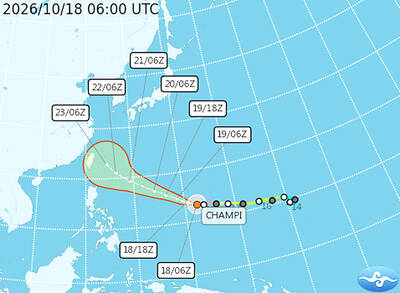
A sea warning for Typhoon Champi could be issued as early as Wednesday night, possibly followed by a land warning on Thursday night or Friday, as the storm approaches Taiwan, the Central Weather Administration (CWA) said yesterday. The typhoon is expected to have its greatest impact on Taiwan on Friday and Saturday, bringing heavy rain to central and northern Taiwan and to Yilan and Hualien counties in the east, CWA forecaster Liu Pei-teng (劉沛滕) said. As of 2pm yesterday, Champi was about 2,470km east-southeast of Oluanpi (鵝鑾鼻), Taiwan’s southernmost tip, moving westnorthwest at 20kph. It had maximum sustained winds of 191kph and a
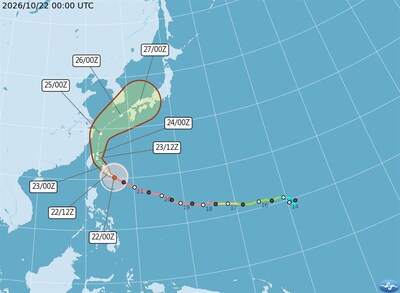
The Central Weather Administration (CWA) today issued a land warning for Typhoon Champi, which is expected to bring heavy rain and strong winds to Taiwan through Saturday. The land warning covered Yilan, Hualien, Taitung and Pingtung counties, CWA data showed. The CWA also issued a sea warning for Typhoon Champi, urging vessels operating in the Bashi Channel, in the south of the Taiwan Strait, as well as waters north, northeast and southeast of Taiwan, to remain on high alert. As of 11am today, Champi was centered about 520km east-southeast of Oluanpi (鵝鑾鼻), Taiwan's southernmost point, moving northwest at 15kph to 20kph, CWA data
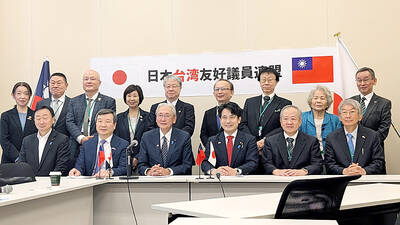
ORIGINS: A Taiwanese doctor practicing in Japan said he no longer needed to cover the nationality label on his license with a sticker, as it used to confuse his patients Starting this month, Taiwanese professionals working in Japan can list “Taiwan” as their place of origin following Tokyo’s easing of rules on “nationality” in official licensing documents. The change was announced yesterday by the Japan-Taiwan Friendship Parliamentarians’ League in Tokyo. The license revision covers 322 professions, including doctors and nurses. Previously, Taiwanese had to list “China” as their nationality on professional certifications and licenses, but the new rules updated the “nationality” to “nationality and region” or “nationality, etc,” allowing Taiwanese to use the name “Taiwan.” The league held a meeting about the revision at the House of Representatives Members’ Office Building in Tokyo


 RSS
RSS