


The Chinese military has become alarmed by what it sees as US president-elect Donald Trump’s support of Taiwan and is considering strong measures to prevent the nation from moving toward independence, sources with ties to senior Chinese military officers said.
Three sources said one possibility being considered was conducting war games near Taiwan. Another was a series of economic measures to cripple the nation.
It was not clear whether any decisions had been taken, but the sources, who spoke on condition of anonymity, said the Taiwan issue had become a hot topic within the upper echelons of China’s People’s Liberation Army in recent weeks.
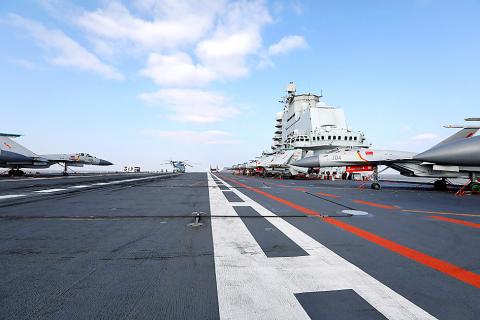
Photo:AFP
Trump, due to take office on Jan. 20, angered Beijing this month by speaking to President Tsai Ing-wen (蔡英文) by telephone, breaking decades of precedent and casting doubt on his incoming administration’s commitment to Beijing’s “one China” policy.
Beijing fears this could embolden supporters of Taiwanese independence.
“If Trump challenges ‘one China’ after becoming president, this would cross our red line,” said another source, who has ties to China’s leadership.
The Chinese Ministry of Defense declined to comment.
An official at the ministry’s news department said China’s position was clearly laid out in the 2005 “Anti-Secession” Law, which authorizes the use of force against Taiwan in the event that China judges the nation to have seceded.
Asked about any possible aggressive moves from China, Ministry of National Defense spokesman Major General Chen Chung-chi (陳中吉) said: “We are fully prepared and plan for the worst while preparing for the best.”
Beijing has also been angered by a trip planned by Tsai this month to Latin America in which she will transit through Houston, Texas, and San Francisco.
China has urged the US to block the stopovers.
Chinese officials have blamed Taiwan for creating trouble rather than Trump, and many of them believe he would be more accommodating to China once in office.
“We’re ready. If Taiwan wants to make trouble so can we. Let’s hit them hard,” said an official in Beijing who meets regularly with China’s most senior military officers, including those who work directly with Chinese President Xi Jinping (習近平).
“We can hold exercises close to Taiwan and show them the damage we could cause. Taiwan will have to give in then,” the official added, citing a recent conversation with one of the military officers.
The US is bound by law to provide Taiwan with the means to defend itself, but it is unclear if the US would send troops in the event of war between Taiwan and China.
Washington also acknowledges Beijing’s position that there is only “one China.”
A retired senior officer who maintains contacts with the People’s Liberation Army said that China probably would not need to fire any missiles to bring Taiwan to its knees. China is Taiwan’s largest trading partner and Taiwan runs a huge trade surplus with China, worth US$27 billion in 2015.
“We can just cut them off economically. No more direct flights, no more trade. Nothing. Taiwan would not last long,” the officer said. “There would be no need for war.”
In addition, any Western economic blockade of China put in place in the event of war with Taiwan would also be damaging to China, already dealing with a slowing economy.
A US defense official, who spoke on condition of anonymity, said Chinese actions had been more provocative in the past month, since Trump won the US election and made comments about Taiwan.
This month, a Chinese naval flotilla headed by its sole aircraft carrier, the Liaoning, took part in drills around Taiwan.
Chinese air force jets have performed similar drills in recent weeks, flying close to the nation, though China has officially called the air force and naval exercises routine.
China also scored a diplomatic victory when Sao Tome and Principe switched recognition from Taiwan to Beijing.
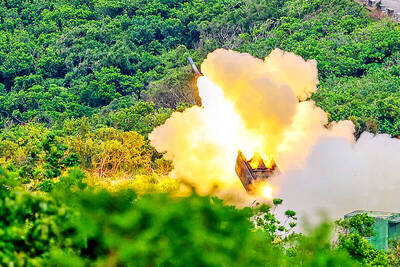
PRECISION STRIKES: The most significant reason to deploy HIMARS to outlying islands is to establish a ‘dead zone’ that the PLA would not dare enter, a source said A High Mobility Artillery Rocket System (HIMARS) would be deployed to Penghu County and Dongyin Island (東引) in Lienchiang County (Matsu) to force the Chinese military to retreat at least 100km from the coastline, a military source said yesterday. Taiwan has been procuring HIMARS and Army Tactical Missile Systems (ATACMS) from the US in batches. Once all batches have been delivered, Taiwan would possess 111 HIMARS units and 504 ATACMS, which have a range of 300km. Considering that “offense is the best defense,” the military plans to forward-deploy the systems to outlying islands such as Penghu and Dongyin so that

WHAT WAS ALL THAT FOR? Jaw Shaw-kong said that Cheng Li-wen had pushed for more drastic cuts and attacked him, just for the outcome to be nearly identical to his bill The legislature yesterday passed a supplementary budget bill to fund the purchase of separate packages of US military equipment, with the combined amount of spending capped at NT$780 billion (US$24.8 billion). The Chinese Nationalist Party (KMT) and Taiwan People’s Party (TPP) used their legislative majority to pass the bill, which runs until 2033 and has two main funding provisions. One was for NT$300 billion of arms sales already approved by the US for Taiwan on Dec. 17 last year, the other was for NT$480 billion for another arms package expected to be announced by Washington. The bill, which fell short of the NT$1.25

A former television news host and six military personnel — active and retired — have been indicted on espionage charges, Kaohsiung prosecutors said yesterday. Lin Chen-you (林宸佑), a former CTi News host and YouTuber, last year allegedly made videos at the direction of a Chinese agent criticizing the Democratic Progressive Party’s recall campaign, the Ciaotou District Prosecutors’ Office told a news conference in Kaohsiung. He allegedly received 4,325 tether coins for the videos from an unidentified person surnamed Huang (黃), believed to be an agent of a hostile foreign power, they said. Lin, also known as Ma Te (馬德), has a show named
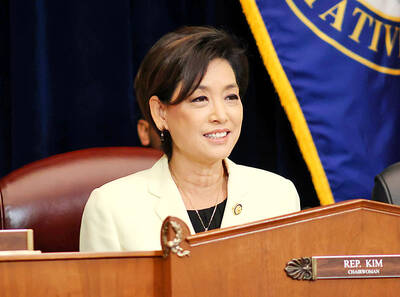
‘CLEAR MESSAGE’: The bill would set up an interagency ‘tiger team’ to review sanctions tools and other economic options to help deter any Chinese aggression toward Taiwan US Representative Young Kim has introduced a bill to deter Chinese aggression against Taiwan, calling for an interagency “tiger team” to preplan coordinated sanctions and economic measures in response to possible Chinese military or political action against Taiwan. “[Chinese President] Xi Jinping [習近平] has directed the People’s Liberation Army to be ready to invade Taiwan by 2027. China has a plan. America should have one too,” Kim said in a news release on Thursday last week. She introduced the “Deter PRC [People’s Republic of China] aggression against Taiwan act” to “ensure the US has a coordinated sanctions strategy ready should


 RSS
RSS