


A naval formation consisting of China’s first aircraft carrier and five other vessels sailed in waters south of Taiwan and cruised past the Pratas Islands (Dongsha Islands, 東沙群島), with Taiwan’s military aircraft and vessels closely monitoring the situation and ready to respond, the Ministry of National Defense (MND) said yesterday.
The Chinese flotilla sailed 20 nautical miles (37km) outside Taiwan’s southeastern air defense zone on Sunday night. Yesterday morning, the fleet reached an area 90 nautical miles south of Pingtung County’s Oluanpi (鵝鑾鼻), the nation’s southernmost tip, the ministry said.
The Soviet-built aircraft carrier, the Liaoning, was southeast of the Taiwan-held Pratas Islands in the South China Sea as of 2pm yesterday and was sailing southwest. China also claims the Pratas Islands.
The ministry said it is closely monitoring the movements of the flotilla, adding that it has mobilized military aircraft and ships to conduct surveillance and reconnaissance missions.
According to photographs posted by Hualien residents and local media reports, the air force scrambled two F-16 jets and two RF-16 reconnaissance aircraft from an air base in Hualien County to track the Liaoning and its escort vessels, with the RF-16 reportedly taking photographs of the flotilla.
In addition, E-2K Hawkeye surveillance aircraft were scrambled from an air force base in Pingtung, while P-3 Orion anti-submarine aircraft were also deployed to patrol Taiwan’s territorial waters, and the navy deployed Cheng Kung-class frigates and Lafayette-class frigates to monitor northeastern and southwestern areas, according to reports.
However, the ministry refused to comment on the reports, saying only that the aircraft and vessels were conducting a joint surveillance operation.
The ministry also refused to reveal whether the Liaoning and the other vessels had conducted an open-sea exercise in the western Pacific or if it was escorted by submarines.
“The MND has kept a close watch on Chinese military activities and the aircraft carrier fleet has navigated outside Taiwan’s air defense identification zone without encroachment of Taiwanese territory,” ministry spokesman Major General Chen Chung-chi (陳中吉) said.
The Liaoning was heading for the South China Sea on a long-distance open-water training mission.
The flotilla sailed through the Miyako Strait between the Japanese islands of Miyako and Okinawa on Sunday before reaching the Bashi Channel between Taiwan and the Philippines.
The mission is the first time that a Chinese aircraft carrier has sailed beyond the first island chain to the Pacific Ocean.
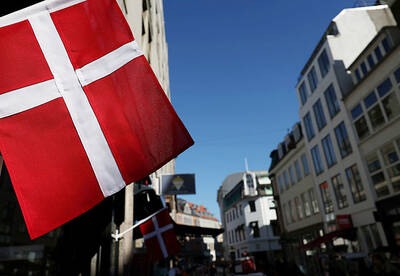
‘UNFRIENDLY’: Changing the nationality listing of Taiwanese residents to ‘China’ goes against EU foreign policy as well as democratic and human rights principles, MOFA said Taiwan yesterday called on Denmark to correct its designation of the nationality of Taiwanese residents as “China” or face retaliatory measures. The Danish government in 2024 changed the nationality of Taiwanese citizens on their residence permits from “Taiwan” to “China.” The decision goes against EU foreign policy and contravenes democratic and human rights principles, Ministry of Foreign Affairs (MOFA) spokesman Hsiao Kuang-wei (蕭光偉) said. Denmark should present a solution acceptable to Taiwan as soon as possible and correct the erroneous designation to preserve the longstanding friendship between the two nations, Hsiao said. The issue could damage Denmark’s image and business reputation in Taiwan,
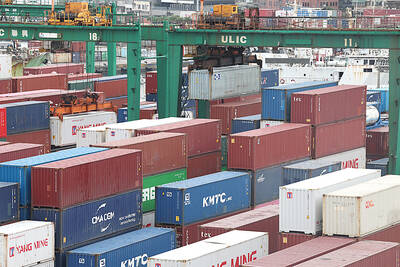
Taiwan climbed to its highest position in global export rankings in more than three decades last year, buoyed by demand linked to artificial intelligence (AI) that lifted shipments of semiconductors and technology products, Ministry of Finance data released yesterday showed. Taiwan accounted for 2.4 percent of global exports last year, or about US$640 billion, ranking 12th worldwide, the data showed. That was up four places from a year earlier and marked the nation’s best ranking since 1994, the ministry said. Taiwan’s share of global exports rose by 0.5 percentage points from the previous year, the largest increase among major economies, reflecting the nation’s
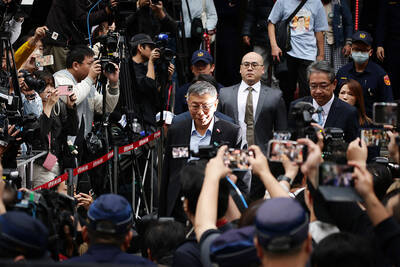
FIRST TRIAL: Ko’s lawyers sought reduced bail and other concessions, as did other defendants, but the bail judge denied their requests, citing the severity of the sentences Former Taipei mayor Ko Wen-je (柯文哲) was yesterday sentenced to 17 years in prison and had his civil rights suspended for six years over corruption, embezzlement and other charges. Taipei prosecutors in December last year asked the Taipei District Court for a combined 28-year, six-month sentence for the four cases against Ko, who founded the Taiwan People’s Party (TPP). The cases were linked to the Core Pacific City (京華城購物中心) redevelopment project and the mismanagement of political donations. Other defendants convicted on separate charges included Chinese Nationalist Party (KMT) Taipei City Councilor Angela Ying (應曉薇), who was handed a 15-year, six-month sentence; Core Pacific

The nation’s fastest supercomputer, Nano 4 (晶創26), is scheduled to be launched in the third quarter, and would be used to train large language models in finance and national defense sectors, the National Center for High-Performance Computing (NCHC) said. The supercomputer, which would operate at about 86.05 petaflops, is being tested at a new cloud computing center in the Southern Taiwan Science Park in Tainan. The exterior of the server cabinet features chip circuitry patterns overlaid with a map of Taiwan, highlighting the nation’s central position in the semiconductor industry. The center also houses Taiwania 2, Taiwania 3, Forerunner 1 and


 RSS
RSS