


The Ministry of National Defense (MND) yesterday said it is fully aware of China’s military activities after photographs of a Chinese bomber said to be flying around Orchid Island (Lanyu, 蘭嶼) and an unidentified mountain range in Taiwan emerged online.
The Chinese People’s Liberation Army Air Force on Friday published a photograph on a popular Chinese microblogging site of an airborne Xian H-6K bomber. Two mountain peaks visible in the background of the image were said by netizens to be either Yushan (玉山) in central Taiwan or Dawushan (大武山) in Pingtung County.
The post did not identify the mountains, with the accompanying text only describing it as “a very meaningful picture.”
Later on Saturday, Chinese netizens disseminated another undated photograph showing the nuclear-capable bomber flying over an island thought to be Taitung County’s Orchid Island.
The images, which were widely reposted by Chinese and Taiwanese online, were said to be taken when Chinese military aircraft carried out training missions around Taiwan’s air defense identification zone. The Chinese air force has conducted two such exercises since Nov. 25.
Ministry spokesman Major General Chen Chung-chi (陳中吉) yesterday said that all Chinese air force exercises were conducted outside Taiwan’s air defense identification zone, adding that it had closely monitored all flights.
Asked whether China had held another training exercise, Chen said the photographs must have been taken some time before the Nov. 25 and Dec. 10 exercises, adding that it was pure speculation to associate the peaks and island in the photographs with Taiwan.
“[The release] is a typical act of propaganda [employed by China], and the [Taiwanese] media are helping China in its ‘advertising campaign,’” he said.
“The goal [of the photographs’ release] is to affect Taiwanese psychologically. There will probably be another picture released tomorrow, as China must be thrilled with the reaction of the Taiwanese media,” he added.
Asked if the pictures were doctored — as has been speculated in military circles — Chen refused to comment, but reiterated that Chinese military aircraft have not intruded into Taiwan’s air defense zone and that the media should not go along with China’s ploys.
The picture of an H-6K bomber flying around an island was reportedly first published by China’s Xinhua news agency on Sept. 13, one day after a training mission in which an unidentified number of H-6K bombers, Su-30 fighters, J-11 fighters and air tankers flew to the West Pacific via the Bashi Strait to practice reconnaissance, sea surface cruising and inflight refueling.
China’s air force carried out four long-distance exercises this year on Sept. 12, Sept. 25, Nov. 25 and Dec. 10, with military aircraft circling around Taiwan’s airspace in some exercises, the ministry said.
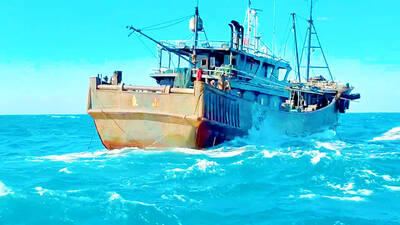
MAKING WAVES: China’s maritime militia could become a nontraditional threat in war, clogging up shipping lanes to prevent US or Japanese intervention, a report said About 1,900 Chinese ships flying flags of convenience and fishing vessels that participated in China’s military exercises around Taiwan last month and in January last year have been listed for monitoring, Coast Guard Administration (CGA) Deputy Director-General Hsieh Ching-chin (謝慶欽) said yesterday. Following amendments to the Commercial Port Act (商港法) and the Law of Ships (船舶法) last month, the CGA can designate possible berthing areas or deny ports of call for vessels suspected of loitering around areas where undersea cables can be accessed, Oceans Affairs Council Minister Kuan Bi-ling (管碧玲) said. The list of suspected ships, originally 300, had risen to about
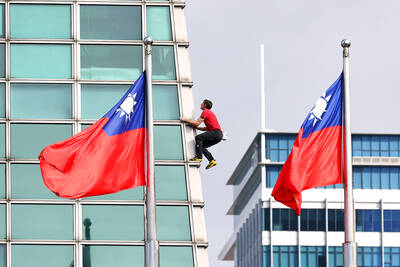
DAREDEVIL: Honnold said it had always been a dream of his to climb Taipei 101, while a Netflix producer said the skyscraper was ‘a real icon of this country’ US climber Alex Honnold yesterday took on Taiwan’s tallest building, becoming the first person to scale Taipei 101 without a rope, harness or safety net. Hundreds of spectators gathered at the base of the 101-story skyscraper to watch Honnold, 40, embark on his daredevil feat, which was also broadcast live on Netflix. Dressed in a red T-shirt and yellow custom-made climbing shoes, Honnold swiftly moved up the southeast face of the glass and steel building. At one point, he stepped onto a platform midway up to wave down at fans and onlookers who were taking photos. People watching from inside

Japan’s strategic alliance with the US would collapse if Tokyo were to turn away from a conflict in Taiwan, Japanese Prime Minister Sanae Takaichi said yesterday, but distanced herself from previous comments that suggested a possible military response in such an event. Takaichi expressed her latest views on a nationally broadcast TV program late on Monday, where an opposition party leader criticized her for igniting tensions with China with the earlier remarks. Ties between Japan and China have sunk to the worst level in years after Takaichi said in November that a hypothetical Chinese attack on Taiwan could bring about a Japanese
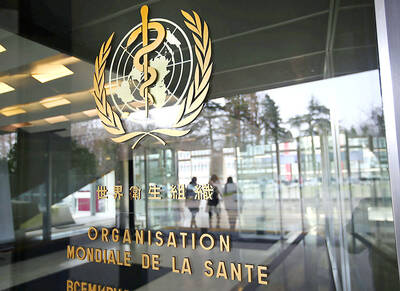
The WHO ignored early COVID-19 warnings from Taiwan, US Deputy Secretary of Health and Human Services Jim O’Neill said on Friday, as part of justification for Washington withdrawing from the global health body. US Secretary of State Marco Rubio on Thursday said that the US was pulling out of the UN agency, as it failed to fulfill its responsibilities during the COVID-19 pandemic. The WHO “ignored early COVID warnings from Taiwan in 2019 by pretending Taiwan did not exist, O’Neill wrote on X on Friday, Taiwan time. “It ignored rigorous science and promoted lockdowns.” The US will “continue international coordination on infectious


 RSS
RSS