


China yesterday called on the US not to let President Tsai Ing-wen (蔡英文) transit there when she visits Guatemala next month, days after US president-elect Donald Trump irked Beijing by speaking to Tsai in a break with decades of precedent.
Her call with Trump on Friday last week was the first by a US president or president-elect with a Taiwanese leader since then-US president Jimmy Carter switched diplomatic recognition from Taiwan to China in 1979.
Tsai is due to visit Guatemala, one of its small band of diplomatic allies, on Jan. 11-12, Guatemalan Minister of Foreign Affairs Carlos Raul Morales told reporters.
He gave no details on what Guatemalan President Jimmy Morales and Tsai would discuss.
The Liberty Times (sister newspaper of the Taipei Times) on Monday reported that Tsai was planning to transit in New York early next month on her way to visit Central American allies Nicaragua, Guatemala and El Salvador.
The Presidential office has not formally confirmed Tsai’s trip, but visits to Taiwan’s allies in the region are normally combined with transit stops in the US and meetings with Taiwan-friendly US officials.
Asked about the possibility of a Tsai stopover in the US, the Chinese Ministry of Foreign Affairs said the “one China” principle is commonly recognized by the international community.
“As for the issue you raise of a ‘transit’ in the United States by the leader of the Taiwan region, her real aim is self-evident,” the ministry said in a statement sent to reporters.
China hopes the US “does not allow her transit, and does not send any wrong signals to ‘Taiwan independence’ forces,” it added.
The Presidential Office said media reports about a January trip were “excessive speculation.”
Ministry of Foreign Affairs spokeswoman Eleanor Wang (王珮玲) yesterday reiterated that any presidential travel details would be issued at the appropriate time.
El Salvador’s government said it was working with Taiwan on plans for a visit by Tsai next month, but gave no specific dates.
The Nicaraguan government had no immediate comment.
However, Nicaraguan President Daniel Ortega is to be sworn in for a third consecutive term on Jan. 10, so Tsai’s trip to Guatemala would dovetail with that ceremony.
The trip would take place before Trump’s inauguration on Jan. 20, and Tsai’s delegation would seek to meet Trump’s team, the Liberty Times said.

SILENCING CRITICS: In addition to blocking Taiwan, China aimed to prevent rights activists from speaking out against authoritarian states, a Cabinet department said The Ministry of Foreign Affairs (MOFA) yesterday condemned transnational repression by Beijing after RightsCon, a major digital human rights conference scheduled to be held in Zambia this week, was abruptly canceled due to Chinese pressure over Taiwanese participation. This year’s RightsCon, the world’s largest conference discussing issues “at the intersection of human rights and technology,” was scheduled to take place from tomorrow to Friday in Lusaka, and expected to draw 2,600 in-person attendees from 150 countries, along with 1,100 online participants. However, organizers were forced to cancel the event due to behind-the-scenes pressure from China, the ministry said, expressing its “strongest condemnation”
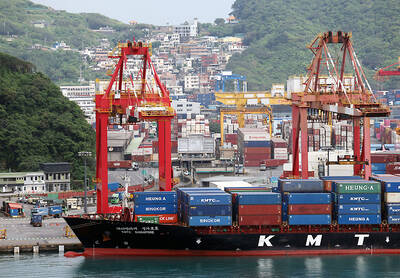
Taiwan’s economy grew far faster than expected in the first quarter, as booming demand for artificial intelligence (AI) applications drove a surge in exports, spilling over into investment and consumption, the Directorate-General of Budget, Accounting and Statistics (DGBAS) said yesterday. GDP growth was 13.69 percent year-on-year during the January-to-March period, beating the DGBAS’ February forecast by 2.23 percentage points and marking the most robust growth in nearly four decades, DGBAS senior official Chiang Hsin-yi (江心怡) told a news conference in Taipei. The result was powered by exports, which remain the backbone of Taiwan’s economy, Chiang said. Outbound shipments jumped 51.12 percent year-on-year to
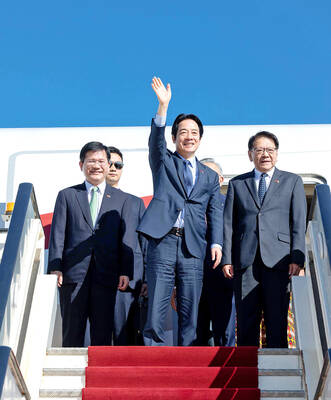
DELAYED BUT DETERMINED: The president’s visit highlights Taiwan’s right to international engagement amid regional pressure from China President Willaim Lai (賴清德) yesterday arrived in Eswatini, more than a week after his planned visit to Taiwan’s sole African ally was suspended because of revoked overflight permits. “The visit, originally scheduled for April 22, was postponed due to unforeseen external factors,” Lai wrote on social media. “After several days of careful arrangements by our diplomatic and national security teams, we successfully arrived today.” Lai said he looked forward to further deepening Taiwan-Eswatini relations through closer cooperation in the economy, agriculture, culture and education, as well as advancing the nation’s international partnerships. The president was initially scheduled to arrive in time to celebrate
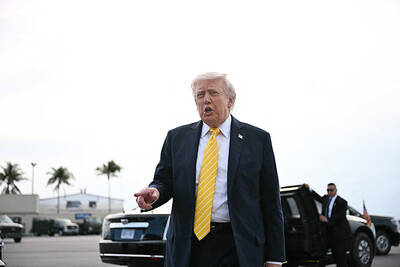
Iran’s Islamic Revolutionary Guard Corp (IRGC) yesterday said the US faced a choice between an “impossible” military operation or a “bad deal” with Tehran, after US President Donald Trump disparaged Iran’s latest peace proposal. Negotiations between the two countries have been deadlocked since a ceasefire came into effect on April 8, with only one round of direct peace talks held so far. Iran’s Tasnim and Fars news agencies reported that Tehran had submitted a 14-point proposal to mediator Pakistan, but Trump was quick to cast doubt on it. “I will soon be reviewing the plan that Iran has just sent to us, but


 RSS
RSS