


The Legislative Yuan yesterday passed amendments to the Civil Servants Election and Recall Act (公職人員選舉罷免法), which lawmakers said returned the power to recall elected officials to the public after it was previously withheld due to high thresholds.
The act prior to amendment stipulated that for officials to be recalled more than half of eligible voters must ratify the proposal and at least half must then vote for the recall.
The amendment dropped the threshold for recall petitions from 2 percent of voters within the elected official’s constituency to 1 percent, while the number of signatures supporting the proposal was cut from 13 percent to 10 percent.
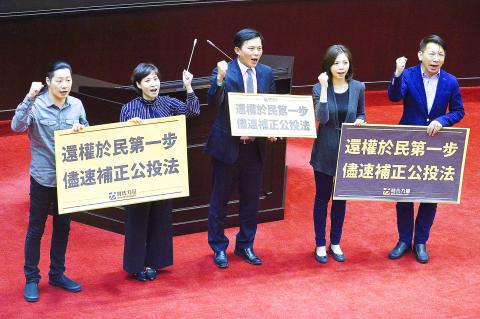
Photo: Chen Chih-chu, Taipei Times
The amount of votes supporting the recall must reach at least a quarter of the original voting population of the constituency, down from half, with at least half voting for the recall.
The amendment also lifted the restrictions on campaign events, with all expenses occurred being tax-deductible. In addition, the restriction that a recall vote could not be held alongside another vote was removed.
The amendment also doubled the number of days for gathering petitions for the recall votes to 60 days for mayors and county commissioners, 40 days for county and city councilors and township mayors, and 20 days for township representatives and borough wardens.
Lawmakers had been divided on whether to retain a threshold for a recall vote, with the New Power Party (NPP) submitting a proposal to do away with such a limitation and adopt a “majority vote.”
The Legislative Yuan finally passed a version agreed upon by the People First Party (PFP) and the Democratic Progressive Party (DPP), which retained a threshold of a quarter of the original voting population of the constituency to guard against abuse of the recall system.
DPP lawmakers hailed the amendment as progress toward direct democracy, while Chinese Nationalist Party (KMT) lawmakers said the DPP might reap what it sowed should the government’s performance fail to satisfy the public.
DPP Legislator Chuang Ruei-hsiung (莊瑞雄) said the NPP’s version would have caused no end of strife due to officials being recalled over every misstep, adding that the lowering of the thresholds would make it easier for voters to exercise their right to recall officials.
The DPP administration would suffer the side-effects of such legislation in years to come, KMT Legislator Lin Te-fu (林德福) said, adding that the party would have to take responsibility for all the policies implemented by a DPP-led legislature.
There have already been calls to recall DPP Legislator Ker Chien-ming (柯建銘), Lin said.
Whether the DPP has harmed its own interests by amending the law remains to be seen, Lin added.
PFP Legislator Chen Yi-chieh (陳怡潔) said the public must have the rights to vote and recall, and the PFP supports the amendment, adding that any recall, so long as it is not politically motivated or based a sense of retribution, would be a good thing.
NPP Legislator Hsu Yung-ming (徐永明) said that despite the amendments not meeting the party’s expectations, it is a step in the right direction.
The NPP supported removing all of the thresholds as it felt that a simple majority would be the best method that represents public opinion, Hsu said.
Any form of threshold protects elected officials and infringes upon people’s rights, Hsu said.
The Project Appendectomy movement, which unsuccessfully sought to recall several KMT lawmakers following the Sunflower movement protests in 2014, issued a statement thanking the Legislative Yuan, saying that the amendment was not only a victory for the movement, but also “a victory for the people and a significant milestone for Taiwan’s democracy.”
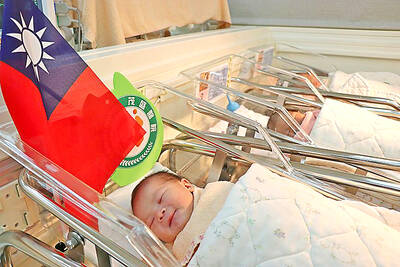
AGING: As of last month, people aged 65 or older accounted for 20.06 percent of the total population and the number of couples who got married fell by 18,685 from 2024 Taiwan has surpassed South Korea as the country least willing to have children, with an annual crude birthrate of 4.62 per 1,000 people, Ministry of the Interior data showed yesterday. The nation was previously ranked the second-lowest country in terms of total fertility rate, or the average number of children a woman has in her lifetime. However, South Korea’s fertility rate began to recover from 2023, with total fertility rate rising from 0.72 and estimated to reach 0.82 to 0.85 by last year, and the crude birthrate projected at 6.7 per 1,000 people. Japan’s crude birthrate was projected to fall below six,
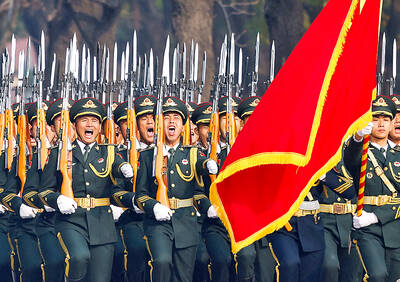
Conflict with Taiwan could leave China with “massive economic disruption, catastrophic military losses, significant social unrest, and devastating sanctions,” a US think tank said in a report released on Monday. The German Marshall Fund released a report titled If China Attacks Taiwan: The Consequences for China of “Minor Conflict” and “Major War” Scenarios. The report details the “massive” economic, military, social and international costs to China in the event of a minor conflict or major war with Taiwan, estimating that the Chinese People’s Liberation Army (PLA) could sustain losses of more than half of its active-duty ground forces, including 100,000 troops. Understanding Chinese
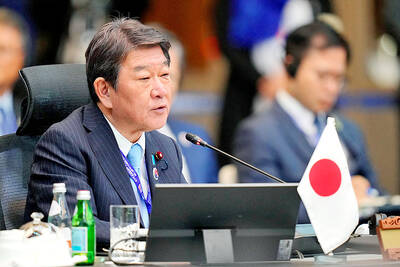
SELF-DEFENSE: Tokyo has accelerated its spending goal and its defense minister said the nation needs to discuss whether it should develop nuclear-powered submarines China is ramping up objections to what it sees as Japan’s desire to acquire nuclear weapons, despite Tokyo’s longstanding renunciation of such arms, deepening another fissure in the two neighbors’ increasingly tense ties. In what appears to be a concerted effort, China’s foreign and defense ministries issued statements on Thursday condemning alleged remilitarism efforts by Tokyo. The remarks came as two of the country’s top think tanks jointly issued a 29-page report framing actions by “right-wing forces” in Japan as posing a “serious threat” to world peace. While that report did not define “right-wing forces,” the Chinese Ministry of Foreign Affairs was
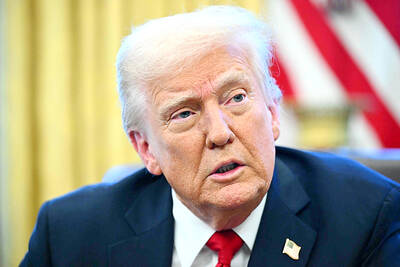
US President Donald Trump in an interview with the New York Times published on Thursday said that “it’s up to” Chinese President Xi Jinping (習近平) what China does on Taiwan, but that he would be “very unhappy” with a change in the “status quo.” “He [Xi] considers it to be a part of China, and that’s up to him what he’s going to be doing, but I’ve expressed to him that I would be very unhappy if he did that, and I don’t think he’ll do that. I hope he doesn’t do that,” Trump said. Trump made the comments in the context


 RSS
RSS