


The government could take over the Chinese Nationalist Party’s (KMT) headquarters in Taipei’s Zhongshan District (中山) if Central Investment Co (中央投資) — a KMT-funded holding company that owns the building — is found to be an illegally obtained asset, Ill-gotten Party Assets Settlement Committee Chairman Wellington Koo (顧立雄) said.
Koo said the committee is to hold an extraordinary meeting today to determine the status of Central Investment and its spinoff, Hsinyutai Co (欣裕台).
If the two companies are recognized as ill-gotten party assets, properties registered under the two companies — including the KMT headquarters — will be transferred to the government, Koo said during a radio interview on Wednesday.
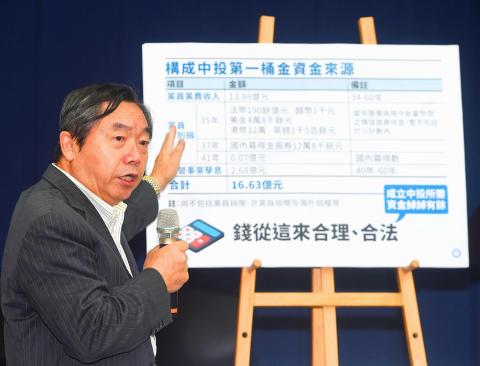
Photo: Liao Chen-huei, Taipei Times
If Central Investment is ordered to return the property to the state, the building could be used for public purposes, such as a library, after a lease between the KMT and Central Investment expires, Koo said.
There are 18 firms registered under Central Investment, including the Chinese-language China Daily News, a construction company, a hotel in Palau and a British Virgin Island-registered company, and they will have to be returned to the state if their parent company is deemed to be ill-gotten assets, he added.
KMT officials condemned what they said were illegal and unconstitutional acts by the committee, adding that the party would take legal action if Central Investment was declared an ill-gotten asset.
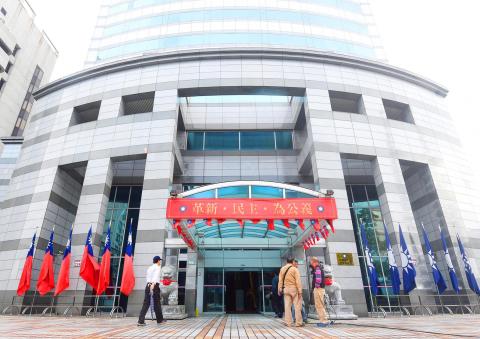
Photo: Liao Chen-huei, Taipei Times
The KMT provided the committee with a number of documents, which it said showed that the founding capital of Central Investment was obtained from legitimate sources, such as party membership fees and political donations, as well as profits generated by a KMT-owned company, KMT Administration and Management Committee director Chiu Da-chan (邱大展) said.
“The KMT has provided proof of the legitimacy of that income, but the committee has not taken this evidence into consideration and [plans to] recognize that income as having been obtained illegally,” Chiu said.
“History will remember if the committee decides to act regardless of the facts and do whatever it wants,” Chiu said.
According to the Act Governing the Handling of Ill-gotten Properties by Political Parties and Their Affiliate Organizations (政黨及其附隨組織不當取得財產處理條例), the KMT should be given one year to declare its assets before the committee determines the status of these assets, he said.
While the committee already recognized Central Investment as a KMT-affiliated organization, it apparently plans to rule on the company’s assets before the KMT has submitted an asset declaration, a move that runs counter to the act, Chiu said.
Central Investment chairman Gordon Chen (陳樹) echoed Chiu’s sentiment, saying the company should be given one year to identify its sources of capital, which he said was collected from at least 16 companies in addition to the KMT.
Prior to that, the committee cannot not make a determination on the company’s assets, Chen said.
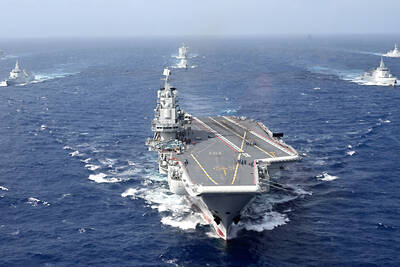
PROVOCATIVE: Chinese Deputy Ambassador to the UN Sun Lei accused Japan of sending military vessels to deliberately provoke tensions in the Taiwan Strait China denounced remarks by Japan and the EU about the South China Sea at a UN Security Council meeting on Monday, and accused Tokyo of provocative behavior in the Taiwan Strait and planning military expansion. Ayano Kunimitsu, a Japanese vice foreign minister, told the Council meeting on maritime security that Tokyo was seriously concerned about the situation in the East China and South China seas, and reiterated Japan’s opposition to any attempt to change the “status quo” by force, and obstruction of freedom of navigation and overflight. Stavros Lambrinidis, head of the EU delegation to the UN, also highlighted South China Sea
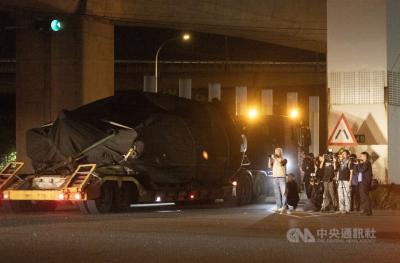
The final batch of 28 M1A2T Abrams tanks purchased from the US arrived at Taipei Port last night and were transported to the Armor Training Command in Hsinchu County’s Hukou Township (湖口), completing the military’s multi-year procurement of 108 of the tanks. Starting at 12:10am today, reporters observed more than a dozen civilian flatbed trailers departing from Taipei Port, each carrying an M1A2T tank covered with black waterproof tarps. Escorted by military vehicles, the convoy traveled via the West Coast Expressway to the Armor Training Command, with police implementing traffic control. The army operates about 1,000 tanks, including CM-11 Brave Tiger
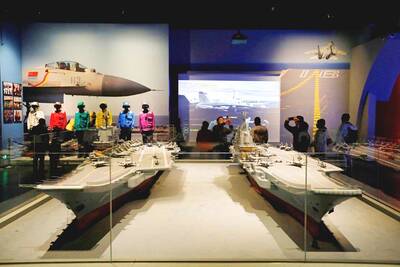
China on Wednesday teased in a video an aircraft carrier that could be its fourth, and the first using nuclear power, while making an allusion to Taiwan and vowing to further build up its islands, as it looks to boost maritime power, secure resources and bolster territorial claims. The video, issued on the eve of the 77th founding anniversary of the Chinese People’s Liberation Army Navy, featured fictional officers with names that are homophones of three commissioned aircraft carriers, the Liaoning (遼寧), Shandong (山東) and Fujian (福建). Titled Into the Deep, it showed a 19-year-old named “Hejian” (何劍) joining the group, sparking
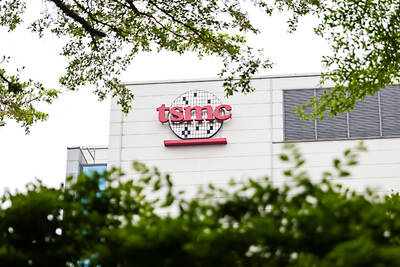
Taiwan Semiconductor Manufacturing Co (TSMC, 台積電), the world’s largest contract chipmaker, said it expects its 2-nanometer (2nm) chip capacity to grow at a compound annual rate of 70 percent from this year to 2028. The projection comes as five fabs begin volume production of 2-nanometer chips this year — two in Hsinchu and three in Kaohsiung — TSMC senior vice president and deputy cochief operating officer Cliff Hou (侯永清) said at the company’s annual technology symposium in Silicon Valley, California, last week. Output in the first year of 2-nanometer production, which began in the fourth quarter of last year, is expected to


 RSS
RSS