


US president-elect Donald Trump has issued a video outlining his policy plans for his first 100 days in office and vowing to issue a note of intent to withdraw from the Trans-Pacific Partnership (TPP) “from day one.”
In the brief clip posted to YouTube on Monday, Trump said that “our transition team is working very smoothly, efficiently and effectively,” contradicting a wealth of media reports telling of chaos at Trump Tower as he struggles to build a team.
He said that he was going to issue a note of intent to withdraw from the TPP, calling it “a potential disaster for our country.”
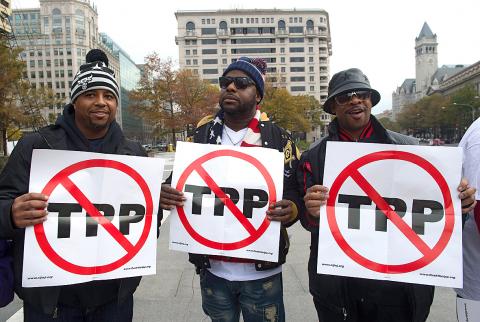
Photo: AFP
Instead he said he would “negotiate fair bilateral trade deals that bring jobs and industry back.”
Hours before Trump’s announcement, Japanese Prime Minister Shinzo Abe said that the TPP would be “meaningless” without US participation.
Speaking to reporters in Buenos Aires on Monday, Abe conceded that other TPP countries had not discussed how to rescue the agreement if Trump carried out his promise to withdraw.
The TPP, which excludes China, is thought to have been high on Abe’s agenda when he became the first foreign leader to meet the president-elect in New York last week.
While details of their 90-minute meeting have not been released, Abe would have used the time to try to persuade Trump to go back on his campaign threat to pull the US out of the TPP.
“The TPP would be meaningless without the United States,” Abe said, after Japan and other TPP countries had discussed the agreement on the sidelines of the APEC summit in Lima at the weekend.
Abe invested considerable political capital in pushing for TPP, which was signed last year, but has yet to be ratified.
Last week he told a Japanese parliamentary committee that Trump’s threat, if carried out, could bolster moves toward a trade pact that includes China.
“There’s no doubt that there would be a pivot to the Regional Comprehensive Economic Partnership [RCEP] if the TPP doesn’t go forward,” Abe told an upper house committee, according to Kyodo news agency. “The RCEP doesn’t include the United States, leaving China the economy with the largest gross domestic product.”
The RCEP comprises Japan, China and 12 other Asian countries, plus Australia and New Zealand, and has been under negotiation since 2013.
“The US leaving TPP is a problem of America rejecting globalization,” said Da Wei (達巍), an expert on the US at the China Institute of Contemporary International Relations. “China is a beneficiary of globalization and China is not willing to see the tide of globalization ebb.”
While some Chinese might be happy at what they see as a political failure for the US, ultimately “China disapproves of this, China is anxious about the retreat of globalization,” Da said.

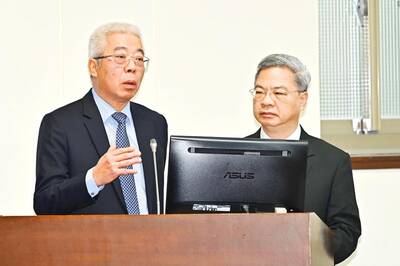
Taiwan has arranged for about 8 million barrels of crude oil, or about one-third of its monthly needs, to be shipped from the Red Sea this month to bypass the Strait of Hormuz and ease domestic supply pressures, CPC Corp, Taiwan (CPC, 台灣中油) said yesterday. The state-run oil company has worked with Middle Eastern suppliers to secure routes other than the Strait of Hormuz, through which about 20 percent of the world’s oil and liquefied natural gas typically passes, CPC chairman Fang Jeng-zen (方振仁) said at a meeting of the legislature’s Economics Committee in Taipei. Suppliers in Saudi Arabia have indicated they
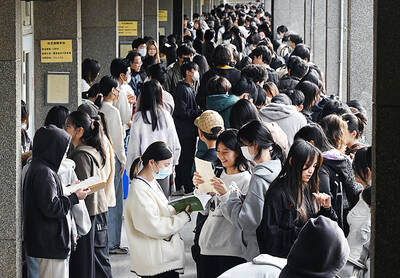
A global survey showed that 60 percent of Taiwanese had attained higher education, second only to Canada, the Ministry of the Interior said. Taiwan easily surpassed the global average of 43 percent and ranked ahead of major economies, including Japan, South Korea and the US, data from the Organisation for Economic Co-operation and Development (OECD) for 2024 showed. Taiwan has a high literacy rate, data released by the ministry showed. As of the end of last year, Taiwan had 20.617 million people aged 15 or older, accounting for 88.5 percent of the total population, with a literacy rate of 99.4 percent, the data
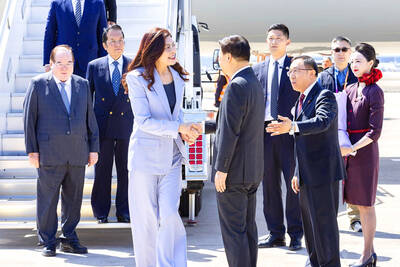
CCP ‘PAWN’? Beijing could use the KMT chairwoman’s visit to signal to the world that many people in Taiwan support the ‘one China’ principle, an academic said Chinese Nationalist Party (KMT) Chairwoman Cheng Li-wun (鄭麗文) yesterday arrived in China for a “peace” mission and potential meeting with Chinese President Xi Jinping (習近平), while a Taiwanese minister detailed the number of Chinese warships currently deployed around the nation. Cheng is visiting at a time of increased Chinese military pressure on Taiwan, as the opposition-dominated Legislative Yuan stalls a government plan for US$40 billion in extra defense spending. Speaking to reporters before going to the airport, Cheng said she was going on a “historic journey for peace,” but added that some people felt uneasy about her trip. “If you truly love Taiwan,

NEW LOW: The council in 2024 based predictions on a pessimistic estimate for the nation’s total fertility rate of 0.84, but last year that rate was 0.69, 17 percent lower An expected National Development Council (NDC) report expects the nation’s population to drop below 12 million by 2065, with the old-age dependency ratio to top 100 percent sooner than 2070, sources said yesterday. The council is slated to release its latest population projections in August, using an ultra-low fertility model, the sources said. The previous report projected that Taiwan’s population would fall to 14.37 million by 2070, but based on a new estimate of the total fertility rate (TFR) — the average number of children born to a woman over her lifetime — the population is expected to reach 12 million by


 RSS
RSS