


The Special Investigation Division (SID) is to be formally abolished and its responsibilities transferred back to prosecutors, the Legislative Yuan said yesterday.
The SID’s dissolution will take effect on Jan. 1, Democratic Progressive Party (DPP) Legislator Yu Mei-nu (尤美女) said.
The SID was created amid expectations that the government would be able to rein in corrupt civil servants, but in 2013, then-prosecutor-general Huang Shih-ming (黃世銘) illegally wiretapped a lawmaker, Yu said, adding that the SID has since become a judiciary organ not to combat crime, but to persecute people.
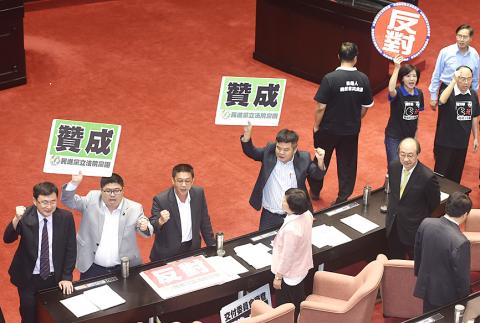
Photo: Liao Chen-huei, Taipei Times
The legislature has abolished the SID because it had become uncontrollable, Yu said.
Chinese Nationalist Party (KMT) Legislator Lin Te-fu (林德福) said that the dissolution of a judiciary organ tasked with investigating corruption by high-ranking officials seems to send the message that the DPP is willing to tolerate such acts.
The SID should continue to exist, as normal prosecutors might not have the initiative to prosecute cases against high-ranking government officials, the KMT legislative caucus said, adding that the division would also have more time, as investigating such cases was its sole duty.
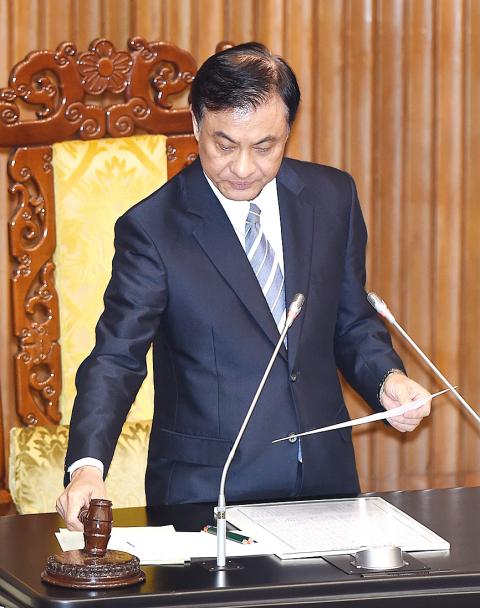
Photo: Liao Chen-huei, Taipei Times
Lin also questioned amendments to Article 63 of the Organic Act for Courts (法院組織法), which formed the legal basis for the SID, and said that the amendments could not prevent politics interfering in the judiciary.
As the amended article exempts prosecutors from the constraints of Article 62, which states that prosecutors are to perform duties in their jurisdictions, if they are appointed to head investigations by the prosecutor-general, the Taiwan High Court or the attorney general of the Taiwan High Prosecutors’ Office, the prosecutor-general’s power as the top-ranking entity among the three leaves a loophole for political intervention, Lin said.
In other news, the Legislative Yuan passed an amendment to Article 27 of the Civil Servants Election and Recall Act (公職人員選舉罷免法) barring elected officials who step down or candidates whose nominations are invalidated by a court due to bribery from running in by-elections.
Additional reporting by CNA

PROVOCATIVE: Chinese Deputy Ambassador to the UN Sun Lei accused Japan of sending military vessels to deliberately provoke tensions in the Taiwan Strait China denounced remarks by Japan and the EU about the South China Sea at a UN Security Council meeting on Monday, and accused Tokyo of provocative behavior in the Taiwan Strait and planning military expansion. Ayano Kunimitsu, a Japanese vice foreign minister, told the Council meeting on maritime security that Tokyo was seriously concerned about the situation in the East China and South China seas, and reiterated Japan’s opposition to any attempt to change the “status quo” by force, and obstruction of freedom of navigation and overflight. Stavros Lambrinidis, head of the EU delegation to the UN, also highlighted South China Sea
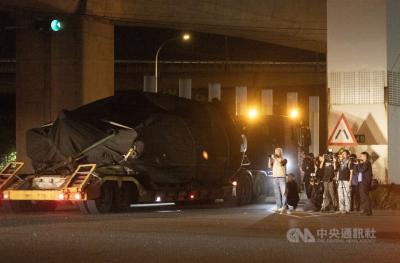
The final batch of 28 M1A2T Abrams tanks purchased from the US arrived at Taipei Port last night and were transported to the Armor Training Command in Hsinchu County’s Hukou Township (湖口), completing the military’s multi-year procurement of 108 of the tanks. Starting at 12:10am today, reporters observed more than a dozen civilian flatbed trailers departing from Taipei Port, each carrying an M1A2T tank covered with black waterproof tarps. Escorted by military vehicles, the convoy traveled via the West Coast Expressway to the Armor Training Command, with police implementing traffic control. The army operates about 1,000 tanks, including CM-11 Brave Tiger
Taiwan Semiconductor Manufacturing Co (TSMC, 台積電), the world’s largest contract chipmaker, said it expects its 2-nanometer (2nm) chip capacity to grow at a compound annual rate of 70 percent from this year to 2028. The projection comes as five fabs begin volume production of 2-nanometer chips this year — two in Hsinchu and three in Kaohsiung — TSMC senior vice president and deputy cochief operating officer Cliff Hou (侯永清) said at the company’s annual technology symposium in Silicon Valley, California, last week. Output in the first year of 2-nanometer production, which began in the fourth quarter of last year, is expected to
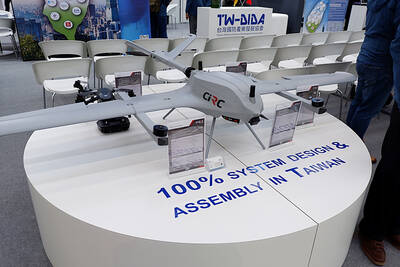
Taiwan’s drone exports surged past US$100 million in the first quarter, exceeding last year’s full-year total, with the Czech Republic emerging as the largest buyer, the Ministry of Economic Affairs said. Exports of complete drones reached US$115.85 million in the period, about 1.2 times the total recorded for all of last year, the ministry said in a report. Exports to the Czech Republic accounted for about US$100 million, far outpacing other markets. Poland, last year’s top destination, recorded about US$11.75 million in the first quarter. Taiwan’s drone exports have expanded rapidly in the past few years, with last year’s total


 RSS
RSS