


A change of government in the US will not affect Washington’s commitment to Taiwan, while Taiwan is likely to benefit from a US Republican administration in securing arms deals, diplomatic and defense officials said yesterday.
US administrations have consistently shaped Taiwan-US relations according to the Taiwan Relations Act and the “six assurances,” and US president-elect Donald Trump’s administration is not expected to deviate from that pattern, Minister of Foreign Affairs David Lee (李大維) said during a meeting of the Legislative Yuan’s Foreign Affairs and National Defense Committee.
The US Republican Party incorporated the “six assurances” and the sale of defensive arms to Taiwan into the party platform in July, which the Trump campaign recognized, so a friendly US administration and deeper bilateral military relations could reasonably be expected, Lee said.
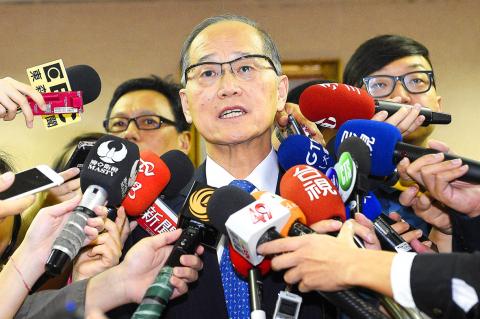
Photo: Chen Chih-chu, Taipei Times
Last year, Taiwan was the US’ ninth-largest trade partner, seventh-largest destination for US agricultural exports, 19th-largest source of international visitors and seventh-largest source of international students, and has proven itself to be a solid partner to the US, Lee said.
“[Taiwan’s] importance does not alter with a change of government in the US, which is why I have stressed that Taiwan is an asset for the US, rather than a liability,” he said.
Lee said the government has had good communication with Trump and his team, adding that it did not bet on US elections, as Taiwan could not afford to risk US support.
The Trans-Pacific Partnership (TPP) might no longer be an issue for a Trump administration, although Taiwan will continue to seek participation in the second round of negotiations likely to be led by Japan, Lee said in response to a question by Chinese Nationalist Party (KMT) Legislator Lu Yu-ling (呂玉玲) on whether Taiwan’s chances of joining the trade bloc were dimmed.
While development of the TPP has been suspended, Taiwan will continue to seek regional economic integration and free-trade agreements on an individual basis, Deputy Minister of Economic Affairs Wang Mei-hua (王美花) said.
While likely to be less effective than a US-led trade bloc, a Japan-led TPP would still be an economic containment of China, of which Taiwan should be a part to improve national security, National Security Bureau Deputy Director Chou Mei-wu (周美伍) said.
Citing its experience in securing arms sales from the Republican administrations of former US presidents George H.W. Bush and George W. Bush, the Ministry of National Defense said it is optimistic about possible arms deals with Trump’s administration, Deputy Minister of National Defense Bo Hong-hui (柏鴻輝) said.
The US presidential transition will not affect existing arms sales and deliveries, and the ministry is in talks with Washington to acquire M1A1 Abrams tanks, Bo said.
When asked by KMT Legislator Johnny Chiang (江啟臣) whether the prospect of the US expanding arms sales to Taiwan would run contrary to the government’s plan to develop an indigenous defense industry, Bo said that the government’s policy and budget plans to build a self-sufficient military would remain the same, regardless of the scale of US arms sales.
Lee said he was happy about Republican National Committee Chairman Reince Priebus being named as the next White House chief of staff, as Priebus is familiar with Taiwan-US relations and friendly to Taiwan.
Separately yesterday, Democratic Progressive Party (DPP) spokesman David Huang (黃適卓) said the DPP has close ties with Priebus, who met with President Tsai Ing-wen (蔡英文) in Taiwan last year to exchange thoughts on Taiwan’s presidential and legislative elections, Taiwan-US relations, economic development, long-term care and youth employment.
Priebus’ visit is proof that the DPP has paid close attention to developing bilateral relations and building ties with both major US parties, Huang said, rejecting allegations that the DPP had bet on US Democratic presidential candidate Hillary Rodham Clinton to carry the election.
Priebus has visited Taiwan twice and personally welcomed a Taiwanese delegation to the Republican National Convention in July, an unusually friendly gesture that resulted from the efforts of Taiwanese officials in the US, DPP Deputy Secretary-General Lee Chun-yi (李俊毅) said. The delegation sought Trump’s support for Taiwan when meeting with Priebus, who had “very positive” responses to requests, he added.
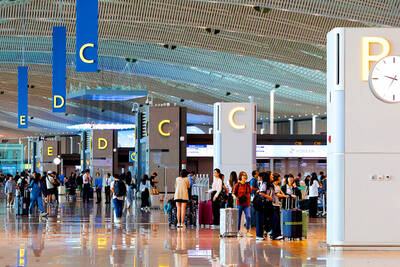
South Korea has adjusted its electronic arrival card system to no longer list Taiwan as a part of China, a move that the Ministry of Foreign Affairs said would help facilitate exchanges between the two sides. South Korea previously listed “Taiwan” as “Taiwan (China)” in the drop-down menus of its online arrival card system, where people had to fill out where they came from and their next destination. The ministry had requested South Korea make a revision and said it would change South Korea’s name on Taiwan’s online immigration system from “Republic of Korea” to “Korea (South),” should the issue not be

Tainan, Taipei and New Taipei City recorded the highest fines nationwide for illegal accommodations in the first quarter of this year, with fines issued in the three cities each exceeding NT$7 million (US$220,639), Tourism Administration data showed. Among them, Taipei had the highest number of illegal short-term rental units, with 410. There were 3,280 legally registered hotels nationwide in the first quarter, down by 14 properties, or 0.43 percent, from a year earlier, likely indicating operators exiting the market, the agency said. However, the number of unregistered properties rose to 1,174, including 314 illegal hotels and 860 illegal short-term rental
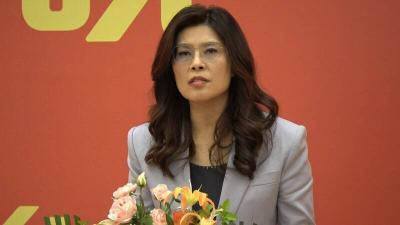
Both sides of the Taiwan Strait share a political foundation based on the “1992 consensus” and opposition to Taiwanese independence, Chinese Nationalist Party (KMT) Chairwoman Cheng Li-wun (鄭麗文) today said during her meeting with Chinese President Xi Jinping (習近平). Both sides of the Strait should plan and build institutionalized and sustainable mechanisms for dialogue and cooperation based on that foundation to make peaceful development across the Strait irreversible, she said. Peace is a shared moral value across the Strait, and both sides should move beyond political confrontation to seek institutionalized solutions to prevent war, she said. Mutually beneficial cross-strait relations are what the
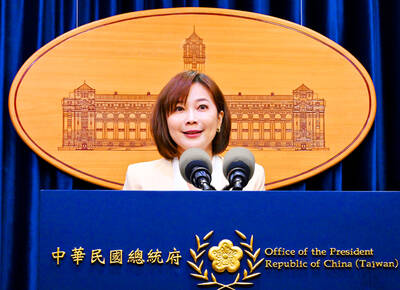
ECONOMIC COERCION: Such actions are often inconsistently applied, sometimes resumed, and sometimes just halted, the Presidential Office spokeswoman said The government backs healthy and orderly cross-strait exchanges, but such arrangements should not be made with political conditions attached and never be used as leverage for political maneuvering or partisan agendas, Presidential Office spokeswoman Karen Kuo (郭雅慧) said yesterday. Kuo made the remarks after China earlier in the day announced 10 new “incentive measures” for Taiwan, following a landmark meeting between Chinese President Xi Jinping (習近平) and Chinese Nationalist Party (KMT) Chairwoman Cheng Li-wun (鄭麗文) in Beijing on Friday. The measures, unveiled by China’s Xinhua news agency, include plans to resume individual travel by residents of Shanghai and China’s Fujian


 RSS
RSS