


This year’s Cross-strait Peaceful Development Forum between the Chinese Nationalist Party (KMT) and the Chinese Communist Party (CCP) has created a new political outlook, as the two sides have initiated cross-strait political communications, one of the forum’s organizers said as the event concluded in Beijing yesterday.
In his remarks at the two-day forum’s closing ceremony, KMT-sponsored National Policy Foundation vice executive director Sun Yang-ming (孫揚明) said the most important tasks ahead are furthering the so-called “1992 consensus,” exploring the possibility of ending cross-strait hostilities with a peace accord and institutionalizing cross-strait peace.
“Discussions of such issues rely on a forum like this, as they can be explored through various kinds of communications, which in turn holds the promise of a stable future and a peaceful environment for people on both sides of the Taiwan Strait,” Sun said.
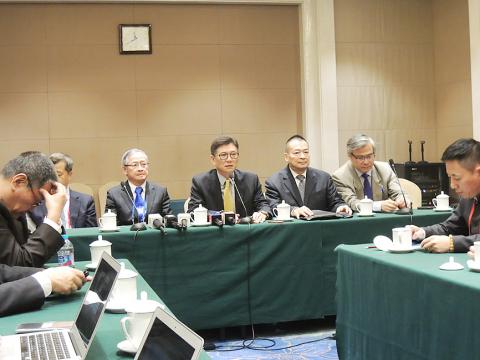
Photo: Shih Hsiao-kuang, Taipei Times
Differences in opinion are inevitable at the start of political communication, Sun said, urging people to open their minds to different views to facilitate discussions and help all parties understand other ideas.
Sun added that cross-strait political communication is not only necessary, but an unavoidable trend.
The annual forum — the name of which was changed from the “Cross-strait Economic, Trade and Cultural forum” to the “Cross-strait Peaceful Development Forum” this year — began after then-KMT chairman Lien Chan (連戰) visited China in 2005.
This year’s forum featured a political panel for the first time to discuss mutual trust and amicable interactions across the Taiwan Strait.
After the forum, the KMT think tank held a press conference in Beijing to expound on the idea of establishing a cross-strait military mutual trust mechanism, which was touched upon at the meeting.
“After discussing the issue, participants agreed that it should first be explored from an academic perspective,” said former KMT legislator Lin Yu-fang (林郁方), the convener of the think tank’s national security division.
With regard to KMT Chairwoman Hung Hsiu-chu’s (洪秀柱) proposal that a cross-strait peace accord be inked during her visit to China, Lin said participants’ views on the issue varied, but they generally supported the idea of a peace accord, as the current situation across the Taiwan Strait is a “mixture of peace and belligerence.”
Asked whether now would be an opportune time for both sides to enter the “political deep-water zone,” Sun said that even Straits Exchange Foundation Chairman Tien Hung-mao (田弘茂) has acknowledged that cross-strait ties would only get worse in the future.
“Such a situation has sparked grave concern and brought a high level of uncertainty to the future of Taiwanese. It is the No. 1 killer of economic development,” Sun said, adding that the KMT’s plan is to communicate its ideas with Beijing.

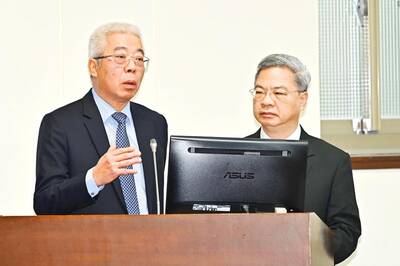
Taiwan has arranged for about 8 million barrels of crude oil, or about one-third of its monthly needs, to be shipped from the Red Sea this month to bypass the Strait of Hormuz and ease domestic supply pressures, CPC Corp, Taiwan (CPC, 台灣中油) said yesterday. The state-run oil company has worked with Middle Eastern suppliers to secure routes other than the Strait of Hormuz, through which about 20 percent of the world’s oil and liquefied natural gas typically passes, CPC chairman Fang Jeng-zen (方振仁) said at a meeting of the legislature’s Economics Committee in Taipei. Suppliers in Saudi Arabia have indicated they

South Korea has adjusted its electronic arrival card system to no longer list Taiwan as a part of China, a move that the Ministry of Foreign Affairs said would help facilitate exchanges between the two sides. South Korea previously listed “Taiwan” as “Taiwan (China)” in the drop-down menus of its online arrival card system, where people had to fill out where they came from and their next destination. The ministry had requested South Korea make a revision and said it would change South Korea’s name on Taiwan’s online immigration system from “Republic of Korea” to “Korea (South),” should the issue not be

Tainan, Taipei and New Taipei City recorded the highest fines nationwide for illegal accommodations in the first quarter of this year, with fines issued in the three cities each exceeding NT$7 million (US$220,639), Tourism Administration data showed. Among them, Taipei had the highest number of illegal short-term rental units, with 410. There were 3,280 legally registered hotels nationwide in the first quarter, down by 14 properties, or 0.43 percent, from a year earlier, likely indicating operators exiting the market, the agency said. However, the number of unregistered properties rose to 1,174, including 314 illegal hotels and 860 illegal short-term rental

AIR ALERT: China’s reservation of airspace over the Yellow Sea and East China Sea could be an attempt to test the US’ response ahead of a Trump-Xi meeting, the NSB head said China’s attempts to infiltrate Taiwan are systematic, planned and targeted, with activity shifting from recruiting mid-level military officers to rank-and-file enlisted personnel, National Security Bureau (NSB) Director-General Tsai Ming-yen (蔡明彥) said yesterday. The Chinese Communist Party’s (CCP) integrates national security, intelligence operations and “united front” efforts into a dense network to conduct intelligence gathering and espionage in Taiwan, Tsai said at a meeting of the legislature’s Foreign Affairs and National Defense Committee. It uses specific networks to screen targets through exchange activities and recruiting local collaborators to establish intelligence-gathering organizations, he said. China is also shifting who it targets to lower-ranking military personnel,


 RSS
RSS