


The Chung-Hua Institution for Economic Research (CIER, 中華經濟研究院) yesterday raised its forecast for this year’s GDP growth from 0.84 percent it projected in July to 1.03 percent, citing stronger-than-expected growth momentum in the first half, which might continue through the rest of the year.
However, experts warned that the modest upward revision is no cause for relief or excitement, as the nation leans on exports by a few technology sectors, while Chinese rivals are catching up.
“Even if GDP growth exceeds the 1 percent mark, it remains fragile,” Department of Statistics Director-General Yeh Maan-tzwu (葉滿足) told a panel discussion after the Taipei-based think tank delivered its quarterly growth update.
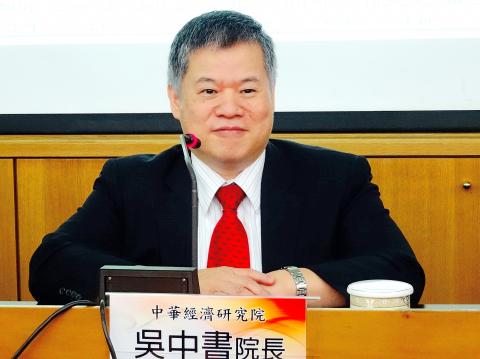
Photo: Wang Meng-lun, Taipei Times
The economy might have grown 1.15 percent last quarter and 2.46 percent this quarter after expanding a mild 0.21 percent in the first six months, CIER researcher Peng Su-ling (彭素玲) said.
Exports — including goods and services — might make no contribution to economic growth this year, but that is still better than a previously forecast drag, Peng said, adding that external demand remains soft, although it is improving.
The 1.03 percent growth estimate is close to the 1.06 percent growth prediction by the Directorate-General of Budget, Accounting and Statistics (DGBAS) in August.
However, it still lags behind the average growth rate of 3 percent in recent years, Yeh said.
Industrial overconcentration in the electronics sector is deepening, Yeh said, adding that semiconductor manufacturers are singlehandedly driving exports and increasing capital spending.
Taiwanese chipmakers have achieved a decent increase in business this year, even though their global peers have been taking a hit from the global slowdown, Taiwan Semiconductor Industry Association (台灣半導體協會) director-general Nicky Lu (盧超群) said.
However, Yeh raised concerns over the sustainability of the uneven growth, as China, the No. 1 destination for Taiwanese exports, is grooming its own semiconductor firms, which could grow to be formidable rivals.
A paradigm shift is also taking place from an emphasis on hardware investment to software development, which is unfavorable for local manufacturers, as many supply components for global technology brands, Yeh said.
Academia Sinica economics researcher Kamhon Kan (簡錦漢) shared some of Yeh’s concerns, saying that industrial overconcentration is not an issue as long as Taiwanese firms can maintain their leadership status.
However, Beijing has unveiled a timetable to cut its dependence on exports, and Taiwan would suffer the most due to its substantial trade ties with China, Kan said.
CIER’s growth forecast of 1.81 percent for next year might prove overly optimistic, Kan added.

SILENCING CRITICS: In addition to blocking Taiwan, China aimed to prevent rights activists from speaking out against authoritarian states, a Cabinet department said The Ministry of Foreign Affairs (MOFA) yesterday condemned transnational repression by Beijing after RightsCon, a major digital human rights conference scheduled to be held in Zambia this week, was abruptly canceled due to Chinese pressure over Taiwanese participation. This year’s RightsCon, the world’s largest conference discussing issues “at the intersection of human rights and technology,” was scheduled to take place from tomorrow to Friday in Lusaka, and expected to draw 2,600 in-person attendees from 150 countries, along with 1,100 online participants. However, organizers were forced to cancel the event due to behind-the-scenes pressure from China, the ministry said, expressing its “strongest condemnation”
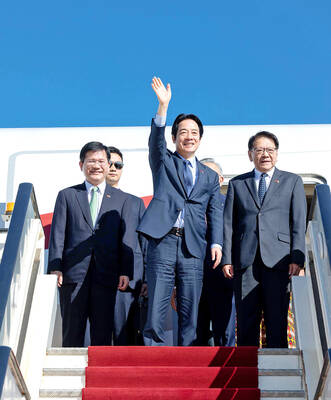
DELAYED BUT DETERMINED: The president’s visit highlights Taiwan’s right to international engagement amid regional pressure from China President Willaim Lai (賴清德) yesterday arrived in Eswatini, more than a week after his planned visit to Taiwan’s sole African ally was suspended because of revoked overflight permits. “The visit, originally scheduled for April 22, was postponed due to unforeseen external factors,” Lai wrote on social media. “After several days of careful arrangements by our diplomatic and national security teams, we successfully arrived today.” Lai said he looked forward to further deepening Taiwan-Eswatini relations through closer cooperation in the economy, agriculture, culture and education, as well as advancing the nation’s international partnerships. The president was initially scheduled to arrive in time to celebrate
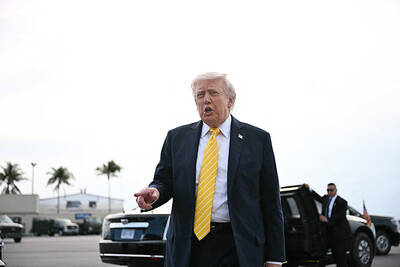
Iran’s Islamic Revolutionary Guard Corp (IRGC) yesterday said the US faced a choice between an “impossible” military operation or a “bad deal” with Tehran, after US President Donald Trump disparaged Iran’s latest peace proposal. Negotiations between the two countries have been deadlocked since a ceasefire came into effect on April 8, with only one round of direct peace talks held so far. Iran’s Tasnim and Fars news agencies reported that Tehran had submitted a 14-point proposal to mediator Pakistan, but Trump was quick to cast doubt on it. “I will soon be reviewing the plan that Iran has just sent to us, but

A group affiliated with indicted Chinese immigrant Xu Chunying (徐春鶯) is to be dissolved for monitoring Chinese immigrants in Taiwan, a source said yesterday. Xu, the secretary-general of the Cross-Strait Marriage and Family Service Alliance, was indicted on March 24 on charges of violating the Anti-Infiltration Act (反滲透法). The alliance “illegally monitored" Chinese immigrants living in Taiwan on behalf of the Chinese Communist Party (CCP) and the Ministry of the Interior is expected to dissolve the organization in the coming days under provisions of the Civil Associations Act (人民團體法), the source said. Xu, who married a Taiwanese in 1993 and became a Republic


 RSS
RSS