


Aborigines yesterday protested against the host of the Double Ten National Day ceremony using a ridiculous phrase to introduce the nation’s 16 recognized Aboriginal tribes, saying it was demeaning and made Aborigines the butt of a joke.
Host Ho Wei-lun (何偉綸) said “ Shao Tai tai da ka, A sa bu lu ge, bei xia de pao zou la” (邵太太打卡,阿薩不魯哥,被嚇得跑走啦). The term "A sa bu lu ge" means “ill-behaved” in Hoklo (commonly known as Taiwanese).
Aboriginal groups said the incident showed the government was not serious about its commitment to lift the oppression of Aborigines.
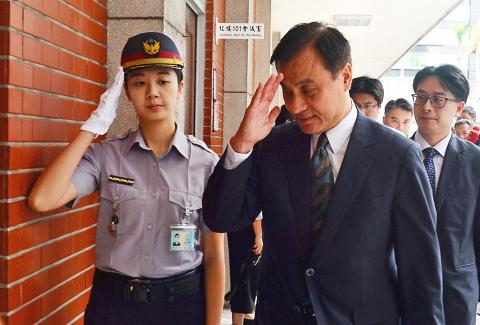
Photo: CNA
Chinese Nationalist Party (KMT) Legislator Sufin Siluko, who is an Amis, said the act was disrespectful and went against the olive branch President Tsai Ing-wen (蔡英文) extended toward Aborigines when she made a formal apology to them on behalf of the government in August.
Sufin Siluko said he was “very unhappy” to hear about the incident, especially given the Democratic Progressive Party’s (DPP) continuous reiteration that it wants to implement transitional justice for Aborigines.
The Tsai administration should seek to “transition” itself to justice and remove the ethnic Han chauvinism that is ubiquitous in government, he said, adding that only then will the government finally have respect for Aborigines.
Legislative Speaker Su Jia-chyuan (蘇嘉全) said that no event should ever turn ethnicity into a joke and he would be making a formal apology to all Aborigines on behalf of the government and would be asking the National Day Preparation Committee to make a formal apology as well.
As legislative speaker, Su was in charge of the organizing committee.
The committee said it came up with the phrase to highlight Taiwan’s acceptance of multiple ethnicities and wanted the public to be aware that Aboriginal culture is unique and treasured in Taiwan, adding it had not meant disrespect by what it thought was an opportunity for creative teaching.
The committee offered its apologies and said it would ensure that there would not be a repeat of the incident.
Premier Lin Chuan (林全) yesterday afternoon told lawmakers that that he had not noticed the phrase during the ceremony because the event was very noisy.
Lin made the comment in response to KMT Legislator Chien Tung-ming (簡東明), who had asked him if he agreed with the phrase.
Lin said that at the time he did not understand the meaning of the phrase and only realized that it was very disrespectful toward Aborigines after the incident was reported by the media.
That such a phrase would be used on such a solemn occasion as the National Day ceremony was inappropriate, Lin said.
Asked how the government should change after several incidents of mishandling commentary about Aborigines, Lin said the government should change its attitude and try to learn about different cultures.
Additional reporting by CNA

A signaling system malfunction disrupted high-speed rail (HSR) services beginning at 8am today, with trains temporarily reduced to three northbound and three southbound trains per hour as authorities conduct inspections. The malfunction occurred on a section of track in Miaoli County during pre-operation checks early this morning, forcing northbound and southbound trains to use a single track, the HSR operator said. The regular schedule has been replaced with three hourly trains offering only nonreserved seating in each direction, stopping at every station, it said, adding that business class cars would still have reserved seating. Departures from terminal stations are scheduled at the top

‘NO SECURITY RISK’: The Railway Bureau reassured the public that the technicians’ activities were limited to technical guidance and did not involve sensitive systems The Railway Bureau yesterday said it had invited eight Chinese technicians to assist with an airport MRT construction project. The bureau issued the confirmation after an Internet user said Chinese nationals had entered the construction zone of Taiwan Taoyuan International Airport’s Terminal 3 project. They asked why “individuals from an enemy state” were allowed access to such a major national infrastructure project, which raised serious concerns over Taiwan’s industrial safety, sensitive systems and information security. The bureau’s Northern Region Engineering Branch Office said subcontractor Taiwan Handle Industrial Co (台灣手把工業) of the Taoyuan airport MRT’s “Contract No. CU05 Project A14 Station Civil, MEP &
Taiwan is still in the process of assessing the possibility of recruiting workers from Eswatini, the Ministry of Foreign Affairs said yesterday, adding that its goal is to help Eswatini upgrade its vocational training centers. If there are plans to recruit workers from Eswatini, safeguarding national security, protecting public health and ensuring the employment rights of Taiwanese would be prerequisites, Department of West Asian and African Affairs Director-General Yen Chia-liang (顏嘉良) told a news conference. Key considerations would also include filling labor shortages in specific industries, and fostering bilateral professional and technical exchanges, he said. Yen was asked about the progress of labor

A US uncrewed surface vessel (USV) encountered multiple Chinese warships during an autonomous transit of the Taiwan Strait, US defense company Seasats said in a statement on Wednesday. Seasats announced that a Lightfish USV had completed the first autonomous transit of the Taiwan Strait. Over five days, the USV traversed the entire length of the Strait while constantly monitoring surface vessel traffic, the company said. The Lightfish encountered multiple Chinese warships, one of which was a Chinese People’s Liberation Army Navy (PLAN) Type 056 corvette, it said. The Chinese vessels were operating “well within Taiwan’s exclusive economic zone without transmitting their identity via the


 RSS
RSS