


President Tsai Ing-wen (蔡英文) yesterday reiterated her pledges to maintain cross-strait peace and Taiwan’s democratic system as she prepared to deliver her first Double Ten National Day speech today that is expected to be closely watched by China.
Tsai made the remarks in a speech at an event organized by the Overseas Compatriots Affairs Commission at the Taipei Arena yesterday afternoon. The event was attended by Taiwanese expats, as well as Presidential Office Secretary-General Lin Bih-jaw (林碧炤) and Legislative Speaker Su Jia-chyuan (蘇嘉全).
“More than four months have passed since we last met on the day of my inauguration in May. During this period, not one day has gone by that I have not remembered my promises to you, which are to take care of Taiwan and make it better,” Tsai said.
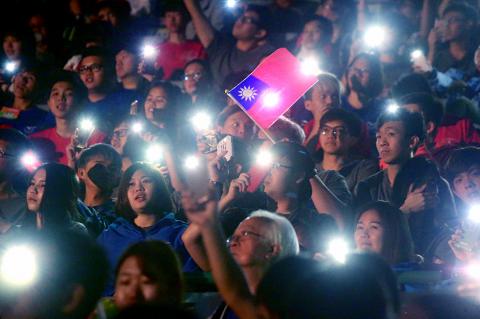
Photo: CNA
Tsai said that since taking office, her administration has encountered numerous challenges, some of which were unexpected, while others are structural problems that have accumulated over time.
Saying that achieving regional peace requires a concerted effort among all concerned parties, Tsai said she is aware of the significant public attention paid to cross-strait development and that her government would keep its promises.
“We are determined to create a consistent, sustainable and predictable cross-strait relationship, as well as to maintain peace across the Taiwan Strait and Taiwan’s democratic ‘status quo,’” Tsai said.
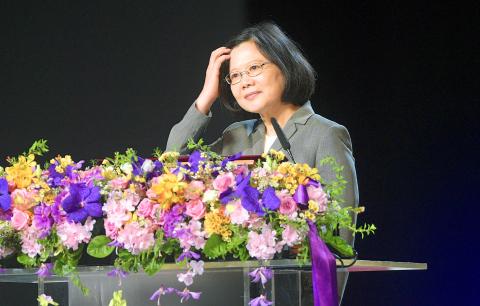
Photo: CNA
She said her principles in dealing with cross-strait ties include maintaining her promises and goodwill, never succumbing to pressure and refusing to revert to the old path of confrontation.
Both sides of the Taiwan Strait should sit down and seek to solve problems through dialogue as soon as possible, Tsai said.
Tsai’s remarks came amid speculation by political analysts that cross-strait relations could further deteriorate should the president’s Double Ten National Speech fail to satisfy Beijing.
China has imposed a series of punitive measures against the Tsai administration due to its refusal to acknowledge the so-called “1992 consensus,” including suspending official cross-strait communication mechanisms, further squeezing Taiwan’s international space and reducing the number of Chinese tourists to Taiwan.
The “1992 consensus” refers to a tacit understanding between the Chinese Nationalist Party (KMT) and Beijing that both sides of the Taiwan Strait acknowledge there is “one China,” with each side having its own interpretation of what “China” means. Former Mainland Affairs Council chairman Su Chi (蘇起) said in 2006 that he had made up the term in 2000.
A source familiar with Tsai’s Double Ten National Day speech, who spoke on condition of anonymity, said her address would not focus too much on cross-strait issues, but rather on the president’s domestic policies, such as promoting reforms in the pension, social housing and long-term care systems, as well as transitional justice.
The source said Tsai would pledge to continue her government’s efforts to expand Taiwan’s participation in international organizations and redefine Taiwan’s role in the Asia-Pacific region.
In relation to cross-strait issues, Tsai would maintain the stance she set in her inauguration speech and table a “new four noes” principle, the source said.
Presidential Office spokesman Alex Huang (黃重諺) said the theme of Tsai’s Double Ten National Day speech is “striding forward with a firm step and building a greater nation through reforms.”
Huang said the speech consists of three aspects: the government’s policy direction and blueprint for the nation, achievements in the government’s efforts to improve Taiwan’s international participation and reiteration of the government’s stance on cross-strait ties.
Additional reporting by Chun Li-hua

‘NO SECURITY RISK’: The Railway Bureau reassured the public that the technicians’ activities were limited to technical guidance and did not involve sensitive systems The Railway Bureau yesterday said it had invited eight Chinese technicians to assist with an airport MRT construction project. The bureau issued the confirmation after an Internet user said Chinese nationals had entered the construction zone of Taiwan Taoyuan International Airport’s Terminal 3 project. They asked why “individuals from an enemy state” were allowed access to such a major national infrastructure project, which raised serious concerns over Taiwan’s industrial safety, sensitive systems and information security. The bureau’s Northern Region Engineering Branch Office said subcontractor Taiwan Handle Industrial Co (台灣手把工業) of the Taoyuan airport MRT’s “Contract No. CU05 Project A14 Station Civil, MEP &

A US uncrewed surface vessel (USV) encountered multiple Chinese warships during an autonomous transit of the Taiwan Strait, US defense company Seasats said in a statement on Wednesday. Seasats announced that a Lightfish USV had completed the first autonomous transit of the Taiwan Strait. Over five days, the USV traversed the entire length of the Strait while constantly monitoring surface vessel traffic, the company said. The Lightfish encountered multiple Chinese warships, one of which was a Chinese People’s Liberation Army Navy (PLAN) Type 056 corvette, it said. The Chinese vessels were operating “well within Taiwan’s exclusive economic zone without transmitting their identity via the
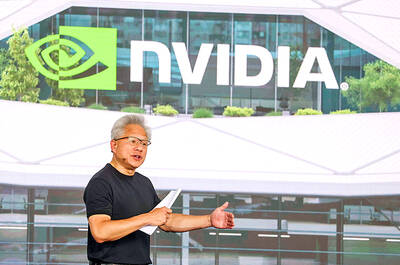
‘BOOMING’: ’ The number of partners we have here is incredible. You can see from their stock prices. They’re doing so well, they’re so happy,’ Jensen Huang said Nvidia Corp’s spending in Taiwan has ballooned to about US$150 billion a year, 10 times the US$10 billion to US$15 billion the company spent five years ago, Nvidia chief executive officer Jensen Huang (黃仁勳) said yesterday, suggesting Taiwan’s strategic importance in the global artificial intelligence (AI) supply chain. “Taiwan is the epicenter of the AI revolution. This is where the chips come, packaging comes. This is where the systems are made. This is where AI supercomputers were created,” Huang said at a meeting for the company’s employees in Beitou-Shilin Technology Park (北投士林科技園區) in Taipei, the planned site of Nvidia’s Taipei headquarters. “Taiwan
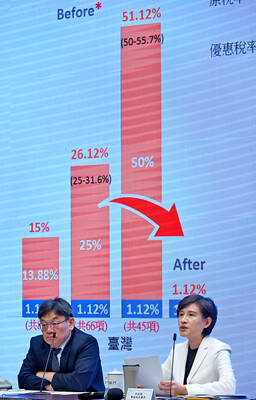
GREATER REACH? Auto parts and wood products would face tariffs of up to 15%, matching those targeting the EU, Japan and South Korea, Vice Premier said The US has announced that preferential tariff treatment for Taiwan’s non-semiconductor Section 232 goods would take effect retroactively from May 1, the Executive Yuan said yesterday. The US government yesterday posted a notice on the Federal Register’s public inspection Web site previewing tariff concessions for Taiwan under a memorandum of understanding (MOU) on Taiwan-US investment after two months of negotiations. The MOU signed on Jan. 15 stipulated three major preferential tariff arrangements: a 15 percent “reciprocal” tariff rate for Taiwan without stacking most-favored nation (MFN) rates; preferential Section 232 treatment for semiconductors and related products; and preferential Section 232 treatment for non-semiconductor


 RSS
RSS