


The Taipei District Court yesterday set bail for XPEC Entertainment Inc (樂陞科技) chairman Aaron Hsu (許金龍) after prosecutors sought court approval to detain him over alleged irregularities in a botched investment from a Japanese suitor, which caused massive losses for investors.
In late May, Bai Chi Gan Tou Digital Entertainment Co (百尺竿頭) announced it would acquire 38 million XPEC shares, or 25.17 percent of the company, at NT$128 per share, an almost 22 percent premium over the gaming software developer’s share price at the time, saying Bai Chi Gan Tou was upbeat about the Taiwanese firm’s prospects.
The acquisition was valued at NT$4.86 billion (US$155.1 million at current exchange rates) at the time.
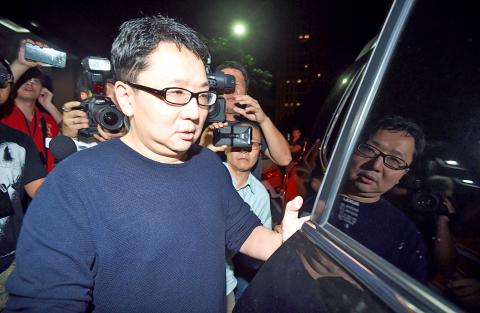
Photo: Chien Jung-fong, Taipei Times
The offer prompted investors to buy XPEC shares with the expectation that Bai Chi Gan Tou would buy their XPEC holdings.
In June, XPEC’s share price surpassed NT$110.
However, reports emerged on Aug. 19 that Bai Chi Gan Tou would delay the acquisition, which pushed XPEC shares lower. Late last month, the Japanese firm requested an extension of a deadline for making a payment on the acquisition, and on Aug. 30 it announced it was walking away from the deal, resulting in a settlement default.
The default led to XPEC’s shares dropping to as low as NT$70.2 on the over-the-counter market on Aug. 31.
Those who purchased XPEC shares after the tender offer was announced sustained significant losses. The aborted acquisition saw XPEC’s market capitalization shed NT$10 billion.
It was the first settlement default of a tender offer in Taiwan’s equity market, which caught many investors and market analysts off guard. It prompted prosecutors and the Financial Supervisory Commission (FSC) to launch investigations into the case.
After questioning Hsu, prosecutors filed an application with the court at 6:50am yesterday for permission to detain him, accusing him of breaching the Securities and Exchange Act (證券交易法).
The court later set bail at NT$10 million.
Prosecutors asked the court to bar Hsu from meeting with anyone, apart from his lawyers.
Prosecutors this week also summoned for questioning others connected to XPEC, including media celebrity and former lawmaker Sisy Chen (陳文茜) and former Taipei deputy mayor Lee Yong-ping (李永萍).
Chen resigned as an independent director of XPEC after the failed tender offer surfaced, while Lee remains an independent director of the gaming company.
Former minister of economic affairs Yiin Chii-ming (尹啟銘), another independent director of XPEC, was also summoned, but did not attend, as he was overseas.
Prosecutors said Yiin would be summoned again when he returns to Taiwan.
Prosecutors on Friday conducted a raid of XPEC’s headquarters, Bai Chi Gan Tou’s Taipei office, as well as offices of CTBC Bank Co (中國信託銀行), CTBC Securities Co (中信證) and Concord Securities Co (康和證券), which were involved in the tender offer.
Local media yesterday reported that prosecutors suspect Chinese funds of being behind the failed tender offer.
Media reports cited prosecutors as saying that Bai Chi Gan Tou could be a paper company, which has business ties with the Chinese gaming market, adding that it was possible that Chinese investors had tried to manipulate the deal.
Before the offer proposed by Bai Chi Gan Tou, XPEC issued three tranches of convertible bonds worth NT$2 billion in March.
The FSC said it suspects that the bond sales could involve insider trading and share price manipulation and has reported its suspicions to prosecutors.

PROVOCATIVE: Chinese Deputy Ambassador to the UN Sun Lei accused Japan of sending military vessels to deliberately provoke tensions in the Taiwan Strait China denounced remarks by Japan and the EU about the South China Sea at a UN Security Council meeting on Monday, and accused Tokyo of provocative behavior in the Taiwan Strait and planning military expansion. Ayano Kunimitsu, a Japanese vice foreign minister, told the Council meeting on maritime security that Tokyo was seriously concerned about the situation in the East China and South China seas, and reiterated Japan’s opposition to any attempt to change the “status quo” by force, and obstruction of freedom of navigation and overflight. Stavros Lambrinidis, head of the EU delegation to the UN, also highlighted South China Sea

The final batch of 28 M1A2T Abrams tanks purchased from the US arrived at Taipei Port last night and were transported to the Armor Training Command in Hsinchu County’s Hukou Township (湖口), completing the military’s multi-year procurement of 108 of the tanks. Starting at 12:10am today, reporters observed more than a dozen civilian flatbed trailers departing from Taipei Port, each carrying an M1A2T tank covered with black waterproof tarps. Escorted by military vehicles, the convoy traveled via the West Coast Expressway to the Armor Training Command, with police implementing traffic control. The army operates about 1,000 tanks, including CM-11 Brave Tiger

China on Wednesday teased in a video an aircraft carrier that could be its fourth, and the first using nuclear power, while making an allusion to Taiwan and vowing to further build up its islands, as it looks to boost maritime power, secure resources and bolster territorial claims. The video, issued on the eve of the 77th founding anniversary of the Chinese People’s Liberation Army Navy, featured fictional officers with names that are homophones of three commissioned aircraft carriers, the Liaoning (遼寧), Shandong (山東) and Fujian (福建). Titled Into the Deep, it showed a 19-year-old named “Hejian” (何劍) joining the group, sparking
Taiwan Semiconductor Manufacturing Co (TSMC, 台積電), the world’s largest contract chipmaker, said it expects its 2-nanometer (2nm) chip capacity to grow at a compound annual rate of 70 percent from this year to 2028. The projection comes as five fabs begin volume production of 2-nanometer chips this year — two in Hsinchu and three in Kaohsiung — TSMC senior vice president and deputy cochief operating officer Cliff Hou (侯永清) said at the company’s annual technology symposium in Silicon Valley, California, last week. Output in the first year of 2-nanometer production, which began in the fourth quarter of last year, is expected to


 RSS
RSS