


Thousands of retired and active civil servants, public-school teachers and military personnel took to the streets in Taipei yesterday, demanding that the government abstain from targeting them in planned pension reforms.
In the first massive demonstration since President Tsai Ing-wen (蔡英文) took office in May, protesters spilled from Ketagalan Boulevard onto Zhongshan S Road and several other roads blocks away, with the Taipei Police Department estimating that about 117,000 attended, while organizers claimed there were more than 250,000 participants.
The size of the crowd was swelled by an official mobilization by the Chinese Nationalist Party (KMT), with KMT Chairwoman Hung Hsiu-chu (洪秀柱) pledging to “stand with” the protesters.
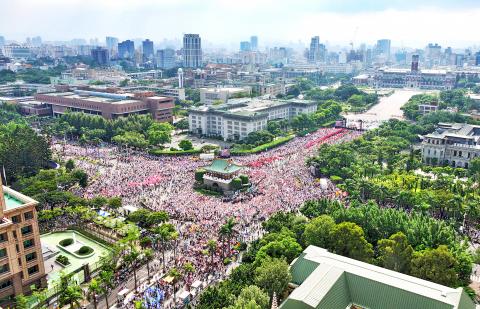
Photo: Lo Pei-der, Taipei Times
While Hung did not take to the stage, she greeted the leaders of one line of former military personnel with flowers and flags, with participants having photographs taken with her.
The KMT also set up several “gas stations” — a play on the Mandarin phrase “add oil,” an expression of encouragement — along march routes, handing out water and Republic of China (ROC) flags.
“Reform absolutely should not be carried out by putting labels on people or pitting generations against each other,” she said, adding that her party had pushed for pension reforms under former president Ma Ying-jeou (馬英九) while the DPP had stalled the efforts in the legislature.
Former premier Hau Pei-tsun (郝柏村) marched in his capacity as a former army general, while several KMT legislators and city councilors also took part.
The demonstration began yesterday afternoon with retired military personnel gathering outside Daan Forest Park (大安森林公園) and National Chiang Kai-shek Memorial Hall before marching to the rally site on Ketagalan Boulevard in front of the Presidential Office Building, walking in formation, waving large ROC flags and singing military anthems.
Retired civil servants, police officers and firefighters gathered at the 228 Peace Memorial Park before walking to Ketagalan Boulevard, while retired public-school teachers converged at National Chiang Kai-shek Memorial Hall’s Liberty Square.
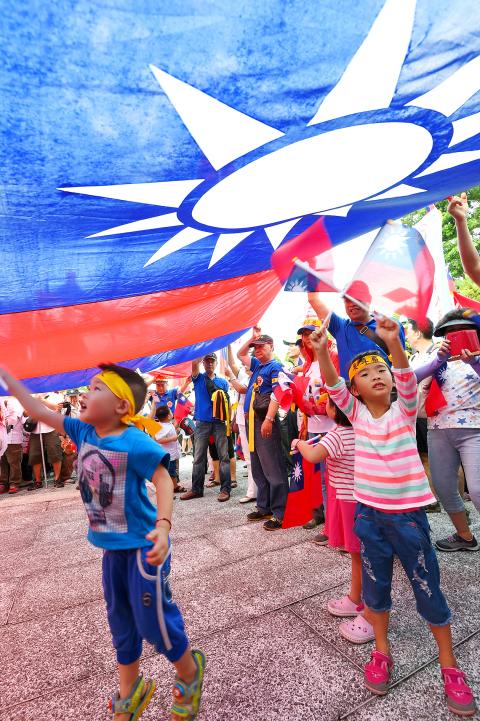
Photo: Chang Chia-ming, Taipei Times
Protesters shouted slogans opposing “stigmatization” and demanding “dignity,” with the Alliance for Monitoring Pension Reform — which organized the march — calling for fiscal reforms and fund management improvements to offset some of the need for cuts, while also demanding that any changes to benefits and contribution formulas not be applied retroactively.
Tsai has asked the Presidential Office’s National Pension Reform Committee to draft a consensus pension reform plan, with Minister Without Portfolio Lin Wan-i (林萬億), the deputy convener and executive director of the committee, pledging to resign if a plan is not drafted and submitted to the Legislative Yuan by May next year.
Some protesters expressed distrust of Tsai’s push for reforms.
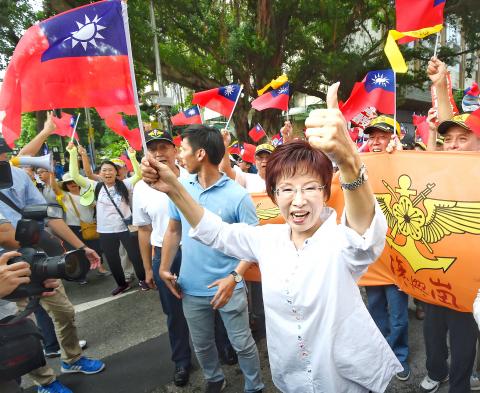
Photo: Fang Pin-chao, Taipei Times
“We are afraid of pension reform, because the Democratic Progressive Party (DPP) is now in full control,” said a woman surnamed Chan (詹), who said she is a former civil servant living in Taichung. “Without the KMT’s participation, there is no way to know what the final plan will look like beforehand. Waiting until a plan is announced would be too late. We have to step forward now before anything is finalized.”
Chan said that the government’s focus on discussions over relative “replacement ratios” between salaries and pensions for public and private-sector employees was unreasonable because of the different nature of the systems.
“We had to go through testing before being hired and that door is always open,” she said. “So if you think we have better treatment, you can always take the test yourself.”
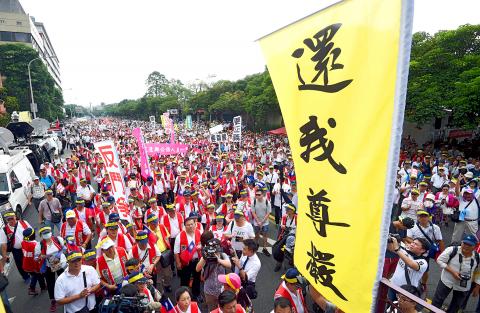
Photo: Lo Pei-der, Taipei Times
“We feel that fiscal reform should be comprehensive and not just targeted at us,” said Kuo Wen-ching (郭文進), a retired soldier, who called for the government to raise taxes on corporations instead of trying to “hunt down” former government employees.
He also rejected remarks by Tsai on Friday that former military personnel had “special circumstances” that warranted their being treated differently as part of pension reform, accusing her of trying to divide former government employees while remaining “coy” about the nature of cuts.
According to the committee, there are 13 pension programs in effect in Taiwan.
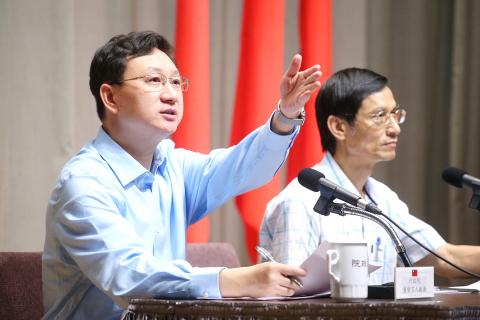
Photo: CNA
The average monthly pension is NT$49,379 for military personnel, NT$56,383 for civil servants, NT$68,025 for public-school teachers, NT$17,223 for private-school teachers, NT$16,179 for employees covered by labor insurance, NT$7,256 for farmers and NT$3,628 for workers covered by general public insurance, it said.
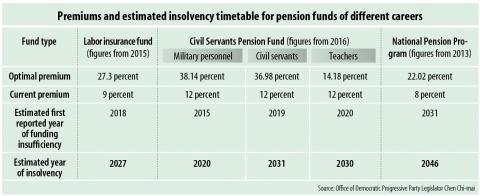
Low contributions coupled with the nation’s aging population have put most of the funds on course for bankruptcy within two decades, with Minister of Civil Service Chou Hung-hsien (周弘憲) last week saying that pension contributions by civil servants, military personnel and teachers would have to be tripled for the funds to be sustainable over the next 50 years at current payment levels.
At a news conference at the Executive Yuan later yesterday, Lin said the committee would convene pension reforms meetings next month and in November across the nation before a national conference in January or February next year.
Additional reporting by CNA

MAKING WAVES: China’s maritime militia could become a nontraditional threat in war, clogging up shipping lanes to prevent US or Japanese intervention, a report said About 1,900 Chinese ships flying flags of convenience and fishing vessels that participated in China’s military exercises around Taiwan last month and in January have been listed for monitoring, Coast Guard Administration (CGA) Deputy Director-General Hsieh Ching-chin (謝慶欽) said yesterday. Following amendments to the Commercial Port Act (商港法) and the Law of Ships (船舶法) last month, the CGA can designate possible berthing areas or deny ports of call for vessels suspected of loitering around areas where undersea cables can be accessed, Oceans Affairs Council Minister Kuan Bi-ling (管碧玲) said. The list of suspected ships, originally 300, had risen to about 1,900 as
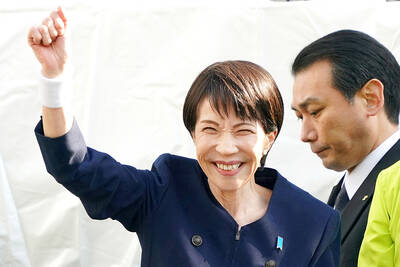
Japan’s strategic alliance with the US would collapse if Tokyo were to turn away from a conflict in Taiwan, Japanese Prime Minister Sanae Takaichi said yesterday, but distanced herself from previous comments that suggested a possible military response in such an event. Takaichi expressed her latest views on a nationally broadcast TV program late on Monday, where an opposition party leader criticized her for igniting tensions with China with the earlier remarks. Ties between Japan and China have sunk to the worst level in years after Takaichi said in November that a hypothetical Chinese attack on Taiwan could bring about a Japanese

Right-wing political scientist Laura Fernandez on Sunday won Costa Rica’s presidential election by a landslide, after promising to crack down on rising violence linked to the cocaine trade. Fernandez’s nearest rival, economist Alvaro Ramos, conceded defeat as results showed the ruling party far exceeding the threshold of 40 percent needed to avoid a runoff. With 94 percent of polling stations counted, the political heir of outgoing Costa Rican President Rodrigo Chaves had captured 48.3 percent of the vote compared with Ramos’ 33.4 percent, the Supreme Electoral Tribunal said. As soon as the first results were announced, members of Fernandez’s Sovereign People’s Party
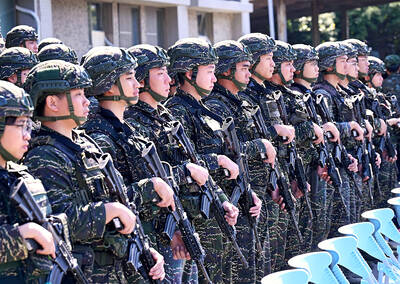
MORE RESPONSIBILITY: Draftees would be expected to fight alongside professional soldiers, likely requiring the transformation of some training brigades into combat units The armed forces are to start incorporating new conscripts into combined arms brigades this year to enhance combat readiness, the Executive Yuan’s latest policy report said. The new policy would affect Taiwanese men entering the military for their compulsory service, which was extended to one year under reforms by then-president Tsai Ing-wen (蔡英文) in 2022. The conscripts would be trained to operate machine guns, uncrewed aerial vehicles, anti-tank guided missile launchers and Stinger air defense systems, the report said, adding that the basic training would be lengthened to eight weeks. After basic training, conscripts would be sorted into infantry battalions that would take


 RSS
RSS