


Taiwan’s top-ranked female singles tennis player, Hsieh Su-wei (謝淑薇), has formally withdrawn from the Rio de Janeiro Olympics, a Chinese Taipei Olympic Committee (CTOC) official confirmed yesterday, after weeks of conflict between the athlete, the CTOC and Chinese Taipei Tennis Association.
Steven Chen (陳士魁), vice president of the CTOC and head of the Taiwanese delegation at the Rio Olympics, said Hsieh formally submitted an application with the CTOC to withdraw from the Games.
Shortly after receiving the application, the CTOC informed the International Tennis Federation of Hsieh’s decision, Chen said.
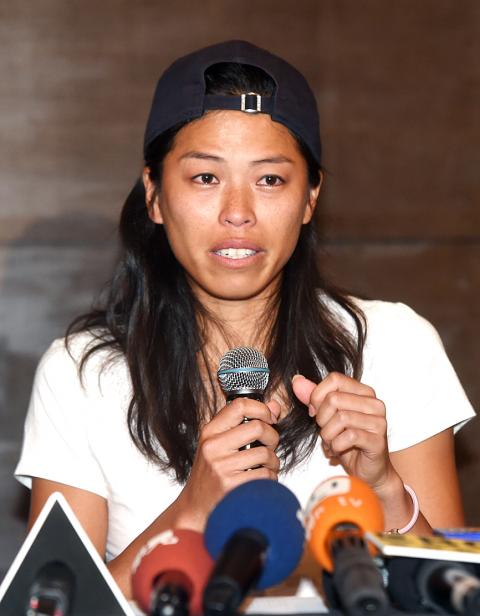
Photo: Chien Jung-fong, Taipei Times
The updated schedule on the Olympics Web site shows that Hsieh’s slot in the first round of the women’s singles competition has been filled by Czech player Lucie Hradecka, who is to play against Denmark’s Caroline Wozniacki.
Hsieh and Chuang Chia-jung (莊佳容) have also been removed from the first round of women’s doubles. They have been replaced by Belgians Yanina Wickmayer and Kirsten Flipkens, who are to play Kazakhstanis Yaroslava Shvedova and Galina Voskoboeva.
The Cabinet yesterday said that it respects Hsieh’s decision.
Hsieh on Thursday last week announced that she will retire from playing tennis for Taiwan and will not accept a call-up from the national team following a meeting with CTOC vice chairman Tsai Szu-chueh (蔡賜爵) in Rio de Janeiro on Wednesday, in which Tsai reportedly pounded a table and yelled at Hsieh after hearing her complaints of unfair treatment by the association.
Tsai said he admonished Hsieh because she said she is a professional tennis player and plays only for her fans.
Hsieh’s father said his daughter asked to withdraw from the Games due to an injury.
Sports Administration section head Lee Yu-jui (李昱叡) said that although Hsieh requested to withdraw from the Games due to an injury, it does not guarantee that she will not be fined.
The Taiwanese delegation in Rio de Janeiro will be notified of the CTOC’s decision, he said.
While Hsieh’s decision to withdraw from the Games drew support from her fans, a university administrator said that it was neither the time nor the way to fight for her own interests.
National Taiwan Sport University chief secretary Li Tzai-li (李再立) wrote on Facebook that people should not let their emotions get the better of them and should let athletes demonstrate their excellence and passion in sports.
“What is the reasonable amount of government subsidy that should be given to an athlete, when you have so many athletes and limited resources? How are you going to allocate the funding so that everyone agrees that the amount given to them is at least acceptable?” Li asked, adding that his assumption is that everyone is dissatisfied with the amount of subsidies that they receive.
Li said that the funding for athletes comes from taxpayers’ money, which is used to take care of athletes, artists and everyone else.
He asked if Hsieh was willing to pay higher taxes so that the expenditures could be covered.
“[Hsieh] calls herself a ‘professional athlete,’ but she asks for government funding. In that case, can she keep all the prize money to herself? Do other nations have similar procedures?” Li asked.
Li said the sports community has problems that need to be addressed, but added that he does not think the situation is dark and incorrigible.
He said he doubts if Hsieh’s words and deeds can make the community change for the better.
Hsieh should work with the community for much-needed change, Li said.
“I support her fighting for herself, but … the road she took will not make people think of her as someone with a bigger picture in mind, but as an emotional and calculating person who has not become righteous by simply pointing at others’ mistakes,” he added.
Additional reporting by CNA

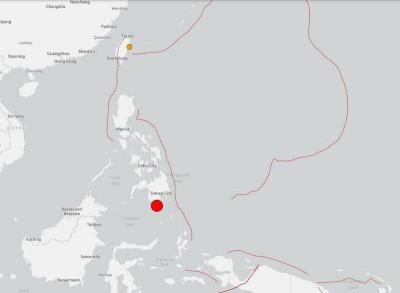
A magnitude 7.8 earthquake struck off the southern coast of Mindanao in the Philippines at 7:38am today, prompting the US Tsunami Warning System to issue an alert for neighboring countries, including Taiwan. The system issued a purple alert indicating a "tsunami threat." The potential threat zone includes Taiwan, the Philippines, Papua New Guinea, Yap and Palau. Philippine authorities were assessing the damage from the quake, with the office of civil defense seeking to verifying initial reports that 15 people had been killed and 129 injured in the region, mostly from falling debris. Arlene Hollero, disaster chief of Maasim town in the Philippines' Sarangani Province,

RESILIENCE: Taiwan plays a key role in semiconductors, energy, information infrastructure and advanced manufacturing, AIT Director Raymond Greene said Taiwan’s continued investment in deterrence and resilience remains vital, especially in uncrewed systems and other emerging technologies, American Institute in Taiwan (AIT) Director Raymond Greene said yesterday. Greene made the remarks at the annual National Strategic Summit on Supply Chain Resilience held by the Research Institute for Democracy, Society and Emerging Technology (DSET), a government-backed think tank. As Taiwan last year became the US’ fourth-largest trading partner and supply chain security is becoming more important, cooperation in emerging technologies continues to deepen between the two countries, he said. The US is committed to accelerating innovation, building key infrastructure, strengthening cooperation

The National Chungshan Institute of Science and Technology yesterday showcased its locally developed variants of the Vision 60 robotic patrol dog, which it plans to deploy on the nation’s outlying territories in the South China Sea. The variants were produced under the Joint Lab project — created by the institute and domestic companies — and assembled with domestically produced motors, lenses and artificial intelligence (AI) systems alongside licensed tech from the US, Missile and Rocket Systems Research Division deputy director Jen Kuo-kang (任國光) told the media event at a military base in Taipei’s Dazhi (大直) area. Taiwan has built up its strengths

RIGHT DIRECTION: Taiwan’s efforts to prevent forced labor include a proposal to ‘fully prohibit’ employers from withholding workers’ documents, an official said Taiwan is to establish a mechanism to restrict imports of goods linked to forced labor, the Executive Yuan said yesterday, after the US proposed imposing additional tariffs on Taiwanese goods over labor concerns. “The Ministry of Labor and the Ministry of Economic Affairs are to establish an interministerial review procedure,” Executive Yuan spokesperson Michelle Lee (李慧芝) said at a news briefing in Taipei. “The government is to use the Foreign Trade Act [貿易法] as the legal basis to restrict imports of goods produced with forced labor” and bring its supply chain governance more in line with international standards on human rights, resilience


 RSS
RSS