

President Tsai Ing-wen’s (蔡英文) promise to deal with radioactive waste stored on Taitung County’s Orchid Island (Lanyu, 蘭嶼) is an empty one, because it fails to specify exact relocation measures and a timetable, Aborigines on the island said yesterday.
“The apology aside, Tsai did not make any specific promise to remove radioactive waste from the island. It was a pity. It was disappointing,” Orchid Island-based Tao Foundation chief executive Sinan Mavivo said.
“Tsai fudged the issue at a historic moment when she, as the head of state, delivered an apology [to Aborigines],” Mavivo said.
“Officials of previous administrations and even former presidents have delivered apologies, but none of them promised to remove nuclear waste by a specific date,” she said.
Tsai should personally lead Cabinet and Taiwan Power Co (台電) officials on a visit to the island and hold meetings with residents to discuss when and how the nuclear waste will be removed, which is the only way to achieve reconciliation and transitional justice, Mavivo said.
Tsai apologized for the government depositing low-level radioactive waste on the island in 1982 without the knowledge or consent of the Tao people, also known as the Yami.
Tsai said she would establish a task force to investigate the former administration’s decisionmaking process and submit a “truth report.”
However, former Tao Foundation president Siyaman Foangayan said Tsai’s statement was an attempt to postpone dealing with the nuclear waste issue.
“There is nothing to investigate about the nuclear waste issue. There is nothing concealed, as in White Terror-era persecution cases. Storing radioactive waste on the island is simply a misguided policy against a minority, a policy that serves to eliminate [the Tao] people,” Foangayan said.
“Without any specific promise, the apology is simply a feigned attempt at friendliness to justify the government’s rule, which is nothing different from what the former authoritarian regime did,” he said.
If the government is really sincere about dealing with the issue, it should establish a nuclear waste relocation committee as part of the Executive Yuan and the Democratic Progressive Party-dominated legislature should create a removal schedule and budget, as well as create a health evaluation and rehabilitation program, he said.
In a draft bill created by Orchid Island residents and legislators, which Mavivo gave to Tsai yesterday, residents demanded that the government draw up a compensation law.
The draft legislation asks the government to remove radioactive waste from the island within two years after the bill goes into effect and to allocate a NT$10 billion (US$316.1 million) budget to restore local ecology, local residents’ health, and social and economic development.

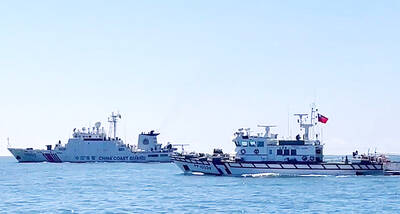
China deployed a record number of coast guard, scientific research and other ships near Taiwan’s waters last month, the Coast Guard Administration (CGA) said, as Beijing dials up pressure on Taipei. The coast guard warned of an increasingly severe situation, as analysts say the increased activity is part of China’s bid to map the region for submarine warfare. The number of Chinese ships detected around Taiwan proper soared to a record 244 last month — an average of nearly eight every day, official data showed. That compares with 55 ships detected in June and 30 in May, and 58 in July last year. In

The Hualien District Prosecutors’ Office yesterday launched an investigation following allegations by a former foreign correspondent in Taiwan of widespread vote-buying in Hualien County. In an interview with Formosa TV (FTV, 民視) aired on Saturday, former Financial Times Taiwan correspondent Kathrin Hille spoke about Taiwan’s democracy and said that she now lives in rural Hualien, where “all the votes are bought.” Neighbors would talk about who had come by and leave cash on the table showing “how much each vote was worth that year,” Hille said. The practice needs to be addressed, considering Taiwan has been a democracy for many
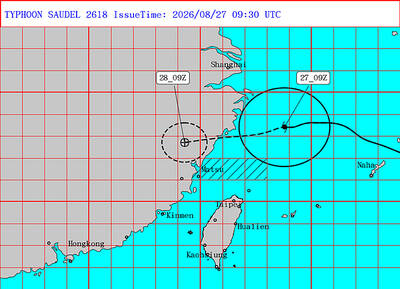
Taiwan is bracing for heavy rain in the south and rough seas around outlying Lienchiang County (Matsu), as Typhoon Saudel passes north toward eastern China, with forecasters yesterday warning of localized flooding over the next two days. Saudel is expected to pass closest to Taiwan today, when its outer rain bands are forecast to brush past Matsu, before making landfall at about noon in China’s Zhejiang Province and weakening significantly, the Central Weather Administration said. The storm’s outer bands, combined with strengthening southwesterly winds, are expected to bring heavy rain to southern and southeastern Taiwan today, it said. As the storm approaches Matsu,

LIMITED: The bill’s NT$40bn annual spending cap would prevent Taiwan from effectively building up its drone combat capabilities, National Defense Minister Wellington Koo said The legislature yesterday rejected the Executive Yuan’s NT$210 billion (US$6.62 billion) special budget proposal to buy military drones and instead passed its own plan, which earmarks NT$40 billion per year over six consecutive years. The Executive Yuan said its plan to buy about 210,000 drones by 2031 could not wait, as the wars in Ukraine and Iran showed the importance of uncrewed systems in modern warfare amid a rising threat from China. However, the Chinese Nationalist Party (KMT) and Taiwan People’s Party (TPP) used their opposition majority to pass a bill providing NT$240 billion through annual budgets over six years, with annual


 RSS
RSS