


The Chung-Hua Institution for Economic Research (CIER, 中華經濟研究院) yesterday slashed its forecast for this year’s GDP growth from 1.36 percent to 0.84 percent, as the global economy remains weak and unfavorable for exports and private investment.
The Taipei-based think tank expects exports to contract 0.14 percent this year, from its April forecast of a 0.6 percent increase, because it does not expect the anticipated improvement in the second half to be strong enough to offset the decline in the first half, CIER president Wu Chung-shu (吳中書) said.
Exports, including goods and services, might have recovered to positive territory with a 0.45 percent increase last quarter and might rise further by 1.26 percent this quarter and 1.62 percent next quarter from a year earlier, Wu said.
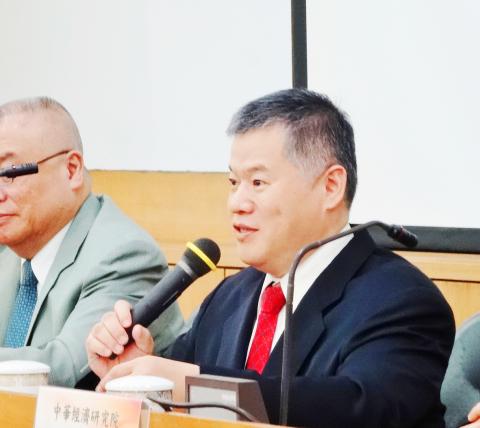
Photo: Wang Meng-lun, Taipei Times
The expected recovery is largely due to a low comparison base last year and will not be fast enough to offset a 4.06 percent fall in the first quarter, he said.
The lackluster outlook is due to stalling growth in advanced nations, while emerging markets struggle with a slowdown, Wu said.
The global scene suggests that the room for improvement in external demand is limited, despite the advent of the high sales season for technology products, Wu said.
Companies will be conservative about capital spending against the backdrop, the CIER said.
It trimmed its forecast for private investment from a 0.84 percent increase over last year to 0.5 percent.
Domestic demand is expected to underpin growth, not because of a shift in economic structure, but because external demand’s contribution is zero, said Lin Tzong-yau (林宗耀), director-general of the central bank’s Department of Economic Research.
Lin said he was concerned that private consumption and imports might be overestimated because they are heavily linked to exports.
Exports needs account for purchases of machineries and raw materials, and the dim business outlook might slow their consumption, Lin said.
In addition, most firms are unlikely to increase hiring or raise wages this year, limiting an improvement in private consumption, Lin said.
“The monetary easing by central banks worldwide shows the practice is limited [in success and effectiveness] and policymakers should consider fiscal loosening to stimulate growth,” Lin said.
The nation’s central bank has cut interest rates four times since September last year, but the output gap continues to widen.
The Brexit drama and sporadic terrorist attacks in Europe pose downside risks to the forecast, among other uncertainties, CIER researcher Peng Su-ling (彭素玲) said.
In addition, financial markets are likely to continue speculating on rate hikes by the US Federal Reserve, driving global funds around the world and creating asset bubbles as they move, Peng said.

SILENCING CRITICS: In addition to blocking Taiwan, China aimed to prevent rights activists from speaking out against authoritarian states, a Cabinet department said The Ministry of Foreign Affairs (MOFA) yesterday condemned transnational repression by Beijing after RightsCon, a major digital human rights conference scheduled to be held in Zambia this week, was abruptly canceled due to Chinese pressure over Taiwanese participation. This year’s RightsCon, the world’s largest conference discussing issues “at the intersection of human rights and technology,” was scheduled to take place from tomorrow to Friday in Lusaka, and expected to draw 2,600 in-person attendees from 150 countries, along with 1,100 online participants. However, organizers were forced to cancel the event due to behind-the-scenes pressure from China, the ministry said, expressing its “strongest condemnation”
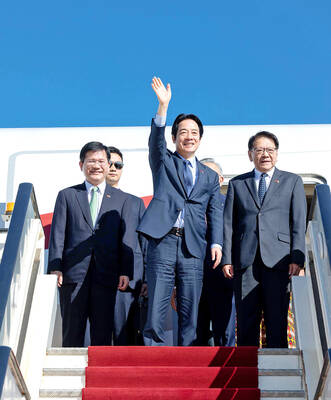
DELAYED BUT DETERMINED: The president’s visit highlights Taiwan’s right to international engagement amid regional pressure from China President Willaim Lai (賴清德) yesterday arrived in Eswatini, more than a week after his planned visit to Taiwan’s sole African ally was suspended because of revoked overflight permits. “The visit, originally scheduled for April 22, was postponed due to unforeseen external factors,” Lai wrote on social media. “After several days of careful arrangements by our diplomatic and national security teams, we successfully arrived today.” Lai said he looked forward to further deepening Taiwan-Eswatini relations through closer cooperation in the economy, agriculture, culture and education, as well as advancing the nation’s international partnerships. The president was initially scheduled to arrive in time to celebrate
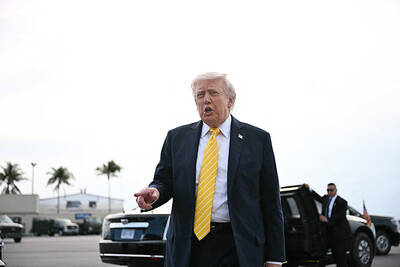
Iran’s Islamic Revolutionary Guard Corp (IRGC) yesterday said the US faced a choice between an “impossible” military operation or a “bad deal” with Tehran, after US President Donald Trump disparaged Iran’s latest peace proposal. Negotiations between the two countries have been deadlocked since a ceasefire came into effect on April 8, with only one round of direct peace talks held so far. Iran’s Tasnim and Fars news agencies reported that Tehran had submitted a 14-point proposal to mediator Pakistan, but Trump was quick to cast doubt on it. “I will soon be reviewing the plan that Iran has just sent to us, but

A group affiliated with indicted Chinese immigrant Xu Chunying (徐春鶯) is to be dissolved for monitoring Chinese immigrants in Taiwan, a source said yesterday. Xu, the secretary-general of the Cross-Strait Marriage and Family Service Alliance, was indicted on March 24 on charges of violating the Anti-Infiltration Act (反滲透法). The alliance “illegally monitored" Chinese immigrants living in Taiwan on behalf of the Chinese Communist Party (CCP) and the Ministry of the Interior is expected to dissolve the organization in the coming days under provisions of the Civil Associations Act (人民團體法), the source said. Xu, who married a Taiwanese in 1993 and became a Republic


 RSS
RSS