


A fire tore through a bus carrying an airport-bound Chinese tour group on National Freeway No. 2 yesterday afternoon, killing all 26 people onboard. The cause of the fire is under investigation.
The 24-member tour group from Dalian in Liaoning Province included 15 women, six men and three youngsters, the youngest of whom was 11, the Tourism Bureau said, while the other two fatalities were the bus driver, Su Wen-cheng (蘇文成), and a guide surnamed Cheng (鄭).
The group had arrived in Taiwan on Tuesday last week and were scheduled to return home yesterday afternoon on a flight from Taiwan Taoyuan International Airport, the bureau said.
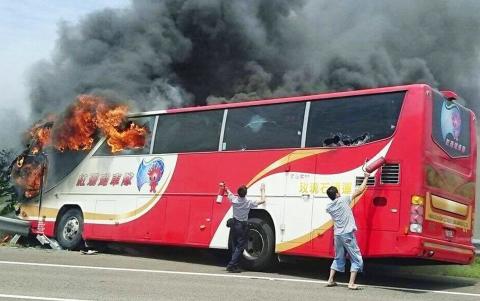
Photo: AP / Yan Cheng / Scoop Commune
The National Highway Police Bureau said the bus appeared to have veered out of control after catching fire and then hit the guard rails on the outer lane of the freeway’s westbound lanes.
Police bureau footage shows smoke emerging from the roof of the bus as the driver drove along the inner lane of the freeway.
The bus then hit a traffic island separating the freeway’s westbound lane and eastbound lanes before running into the guard rail along the outer lane.
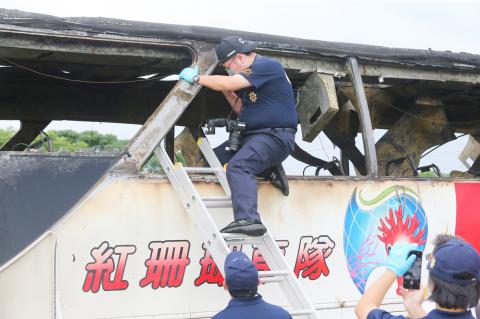
Photo: CNA
The drivers of other vehicles pulled over and attempted to put out the flames with fire extinguishers, but the fire had grown too large for them to put out, the Central News Agency reported.
Thirteen firefighting vehicles and 30 firefighters were sent to the scene, but the bus was an inferno by the time they arrived.
“There was not enough time for them to escape,” Taoyuan Fire Department chief Lai Chi-chong (賴志忠) told reporters.
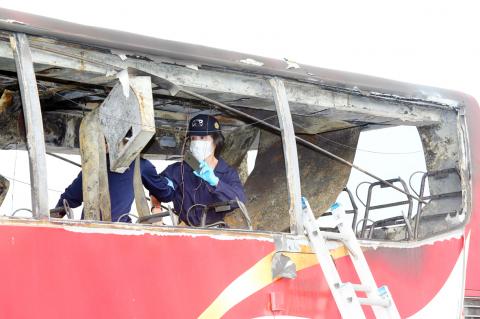
Photo: CNA
Firefighters and accident investigators who examined the charred remains of the bus said the passengers appeared to have tried to move to the back of the bus so they could leave through the emergency exit on the right side of the vehicle.
The Directorate-General of Highways (DGH) said that the bus’ main door and its emergency exit appeared to have been blocked by the guard rail, which probably explained why the doors were not opened.
The Chinese-language Liberty Times (the sister newspaper of the Taipei Times) quoted an unnamed eyewitness as saying passengers were pounding on the bus windows for help as the driver swerved sharply before the crash.
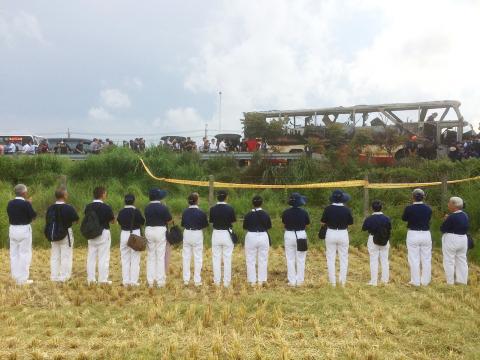
Photo courtesy of the Buddhist Compassion Relief Tzu Chi Foundation
DGH records show that the bus left its manufacturer in May 2010 and passed every required inspection at the vehicle supervision office.
The records also show that Su obtained his license to drive large passenger vehicles in 1996 and had no record of driving while intoxicated.
The tour bus company that owned the bus has four others of the same model and the DGH said it has asked the firm to suspend use of the four immediately.
The agency said those four buses, along with similar models owned by other tour bus firms, would be recalled and be inspected by technical specialists from the manufacturer.
Passenger buses must be equipped with at least three emergency hammers to break the windows and have two fire extinguishers, the DGH said, and buses with a capacity for 32 to 47 passengers must also have five emergency exits.
DGH records show that there have been 37 bus fires since 2006, but yesterday’s was the first one in which the vehicle was completely destroyed and where there were so many casualties.
The Tourism Bureau said the Chinese travel agency that put together the tour group and the Taiwanese travel agency that arranged the tour had bought insurance policies for each member of the group, while the bus company also has insurance covering its passengers.
There have been a total of 98 accidents involving Chinese tourists since 2008, in which 90 people were killed and 390 injured.
Of those accidents, 38 involved tour buses, accounting for 25 deaths and 273 injuries.
Yesterday’s fire was the deadliest incident involving Chinese tourists since a tour bus crash in 2010 killed 19.
Additional reporting by CNA and AP

PROVOCATIVE: Chinese Deputy Ambassador to the UN Sun Lei accused Japan of sending military vessels to deliberately provoke tensions in the Taiwan Strait China denounced remarks by Japan and the EU about the South China Sea at a UN Security Council meeting on Monday, and accused Tokyo of provocative behavior in the Taiwan Strait and planning military expansion. Ayano Kunimitsu, a Japanese vice foreign minister, told the Council meeting on maritime security that Tokyo was seriously concerned about the situation in the East China and South China seas, and reiterated Japan’s opposition to any attempt to change the “status quo” by force, and obstruction of freedom of navigation and overflight. Stavros Lambrinidis, head of the EU delegation to the UN, also highlighted South China Sea
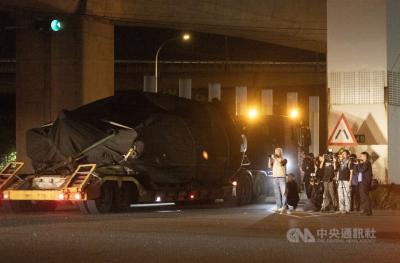
The final batch of 28 M1A2T Abrams tanks purchased from the US arrived at Taipei Port last night and were transported to the Armor Training Command in Hsinchu County’s Hukou Township (湖口), completing the military’s multi-year procurement of 108 of the tanks. Starting at 12:10am today, reporters observed more than a dozen civilian flatbed trailers departing from Taipei Port, each carrying an M1A2T tank covered with black waterproof tarps. Escorted by military vehicles, the convoy traveled via the West Coast Expressway to the Armor Training Command, with police implementing traffic control. The army operates about 1,000 tanks, including CM-11 Brave Tiger

Taiwan Semiconductor Manufacturing Co (TSMC, 台積電), the world’s largest contract chipmaker, said it expects its 2-nanometer (2nm) chip capacity to grow at a compound annual rate of 70 percent from this year to 2028. The projection comes as five fabs begin volume production of 2-nanometer chips this year — two in Hsinchu and three in Kaohsiung — TSMC senior vice president and deputy cochief operating officer Cliff Hou (侯永清) said at the company’s annual technology symposium in Silicon Valley, California, last week. Output in the first year of 2-nanometer production, which began in the fourth quarter of last year, is expected to
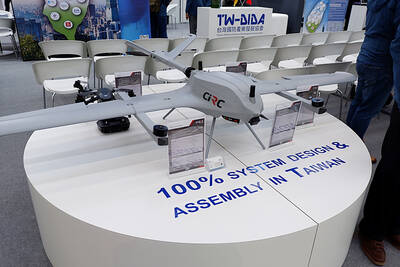
Taiwan’s drone exports surged past US$100 million in the first quarter, exceeding last year’s full-year total, with the Czech Republic emerging as the largest buyer, the Ministry of Economic Affairs said. Exports of complete drones reached US$115.85 million in the period, about 1.2 times the total recorded for all of last year, the ministry said in a report. Exports to the Czech Republic accounted for about US$100 million, far outpacing other markets. Poland, last year’s top destination, recorded about US$11.75 million in the first quarter. Taiwan’s drone exports have expanded rapidly in the past few years, with last year’s total


 RSS
RSS