


The Chinese Nationalist Party (KMT) caucus yesterday morning disrupted a presentation Premier Lin Chuan (林全) was giving to the legislature, while outside the Legislative Yuan, a rally supposedly led by pig farmers, fishermen and KMT supporters protested against US pork imports containing ractopamine and “the neglect” of fishermen’s rights.
KMT lawmakers chanting slogans and holding up placards reading: “[If] US pork is imported, [then] Lin Chuan steps down,” “US pork is laced with drugs, Taiwan does not want it” and “Green U-turns have fooled the whole of Taiwan,” put three models of green pigs on the front lectern — a mocking allusion to President Tsai Ing-wen’s (蔡英文) “three little pigs” fundraising effort during her election campaign.
The chaos prompted Legislative Speaker Su Jia-chyuan (蘇嘉全) to call a break after a few minutes, with the premier also leaving the main chamber and going to a back room, which moved KMT lawmakers to shout: “Runaway premier.”
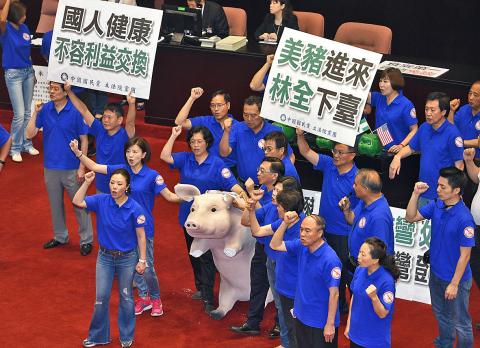
Photo: Lo Pei-der, Taipei Times
The lawmakers held up enlarged copies of a “pledge letter,” which they called on the premier to sign to promise not to allow the import of US pork or the import of products from the five Japanese prefectures that were affected by radioactive fallout from the Fukushima Dai-ichi nuclear power plant disaster in March 2011. They also called on Lin to ensure Taiwanese fishermen’s rights are protected in disputed waters near the Okinotori atoll in the Pacific Ocean.
While the crowd outside the Legislative Yuan dispersed at about noon, KMT lawmakers gathered in the front of the main chamber to again call out slogans before the legislative speaker reappeared and announced a formal break, saying that the floor meeting would resume at 2:30pm.
Following the recess announcement, Democratic Progressive Party (DPP) caucus whip Ker Chien-ming (柯建銘) said that the DPP had never asked KMT premiers to sign “pledge letters” even during its fiercest protests.
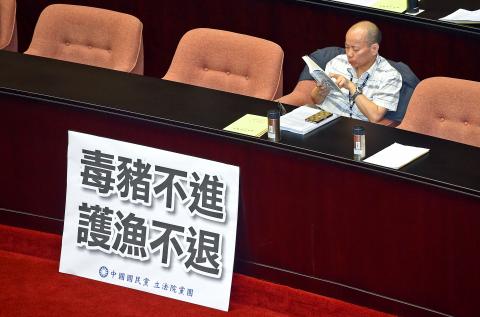
Photo: Lo Pei-der, Taipei Times
He told reporters that during negotiations, the KMT caucus asked for protesters from outside the Legislative Yuan to be allowed to stage a sit-in inside the legislative compound, which Ker said “was impossible.”
The meeting resumed at 2:30pm, but KMT lawmakers’ obstructed the proceedings again, as they continued to occupy podiums and chant slogans, asking the premier to “promise before stepping onto the podium.”
The legislative speaker therefore again called for a break for lawmakers to “calm down.”
Lin also left the floor chamber after the announcement was made.
When fielding questions from reporters before entering the chamber in the afternoon, Lin said that the Executive Yuan would communicate with the legislature to make sure that the public feels “secure” about the government’s policies.
The DPP caucus said at an afternoon news conference in the afternoon that the KMT was occupying podiums over a “pseudo issue,” because there was no negotiation ongoing between the government and the US about the import of US pork.
The government has been in power for a little more than 10 days and the KMT has already started to obstruct it, DPP Legislator Hsu Kuo-yung (徐國勇) said, adding that the KMT did not even know how to be “a loyal opposition party.”
The KMT caucus said that their issues were “real” as they concerned the public’s rights and health and therefore required the premier’s open promise.
Su and Lin returned to the legislative floor at 5:45pm, with the KMT lawmakers still boycotting, and processed — amid the KMT lawmakers’ chanting of slogans — a motion proposed by the New Power Party caucus to prolong the meeting to midnight, which was voted down by DPP legislators. Su announced the adjournment of the floor meeting at about 6pm, which ended the KMT caucus’ day-long demonstration.
Taiwan Semiconductor Manufacturing Co (TSMC, 台積電), the world’s largest foundry service provider, yesterday said that global semiconductor revenue is projected to hit US$1.5 trillion in 2030, after the figure exceeds US$1 trillion this year, as artificial intelligence (AI) demand boosts consumption of token and compute power. “We are still at the beginning of the AI revolution, but we already see a significant impact across the whole semiconductor ecosystem,” TSMC deputy cochief operating officer Kevin Zhang (張曉強) said at the company’s annual technology symposium in Hsinchu City. “It is fair to say that in the past decade, smartphones and other mobile devices were
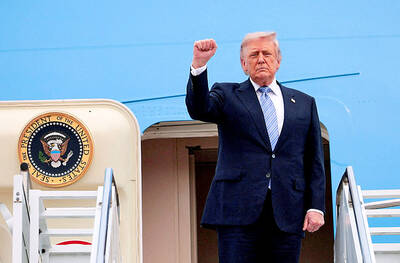
US-CHINA SUMMIT: MOFA welcomed US reassurance of no change in its Taiwan policy; Trump said he did not comment when Xi talked of opposing independence US President Donald Trump yesterday said he has not made a decision on whether to move forward with a major arms package for Taiwan after hearing concerns about it from Chinese President Xi Jinping (習近平). Trump’s comments on Taiwan came as he flew back to Washington after wrapping up critical talks in which both leaders said important progress was made in stabilizing US-China relations even as deep differences persist between the world’s two biggest powers on Iran and Taiwan. “I will make a determination,” Trump said, adding: “I’ll be making decisions. But, you know, I think the last thing we need right
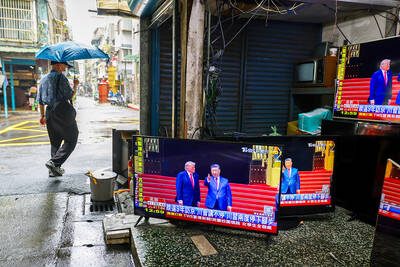
TAIWAN ISSUE: US treasury secretary Scott Bessent said on the first day of meetings that ‘it wouldn’t be a US-China summit without the Taiwan issue coming up’ There were no surprises on the first day of the summit between US President Donald Trump and Chinese President Xi Jinping (習近平), the Mainland Affairs Council (MAC) said yesterday, as the government reiterated that cross-strait stability is crucial to the Asia-Pacific region, as well as the world. As the two presidents met for a highly anticipated summit yesterday, Chinese state media reported that Xi warned Trump that missteps regarding Taiwan could push their two countries into “conflict.” Trump arrived in China with accolades for his host, calling Xi a “great leader” and “friend,” and extending an invitation to visit the White House
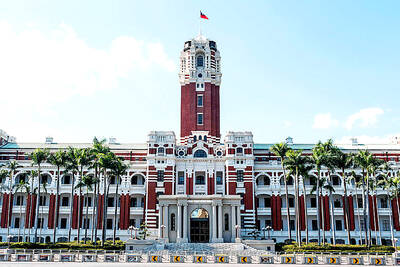
SECURITY: Taipei presses the US for arms supplies, saying the arms sales are not only a reflection of the US security commitment to Taiwan but also serve as a mutual deterrent against regional threats Taiwan is committed to preserving the cross-strait “status quo” and contributing to regional peace and stability, the Presidential Office said yesterday. “It is an undeniable fact that the Republic of China is a sovereign and independent democratic nation,” Presidential Office spokeswoman Karen Kuo (郭雅慧) reiterated, adding that Beijing has no right to claim sovereignty over Taiwan. The statements came after US President Donald Trump warned against Taiwanese independence. Trump wrapped up a state visit to Beijing on Friday, during which Chinese President Xi Jinping (習近平) had pressed him not to support Taiwan. Taiwan depends heavily on US security backing to deter China from carrying


 RSS
RSS