


Lawyers Huang Ti-ying (黃帝穎) and Cheng Wen-lung (鄭文龍) yesterday panned the Taipei District Prosecutors’ Office for rejecting a request by several civic groups to prohibit President Ma Ying-jeou (馬英九) from leaving the country amid allegations of abuse of power and corruption.
Huang, along with the Taiwan Association of University Professors, the Taiwan Forever group and the Northern Taiwan Society, on April 26 lodged a formal complaint with the Taipei office against Ma.
They accused Ma of profiting the Farglory Group (遠雄集團) in the scandal-dogged Taipei Dome project during his term as Taipei mayor and instigating former prosecutor-general Huang Shih-ming (黃世銘) in 2013 to leak details in a controversial wiretapping investigation of former legislative speaker Wang Jin-pyng (王金平), while questioning reports of unexplained increases in his personal wealth while in office.

Photo: Chiang Chih-hsiung, Taipei Times
The groups asked the office to ban Ma, who is to step down on Friday next week, from leaving the country to secure potential evidence.
However, the office turned down the request, saying that Huang Ti-ying and the civic groups were not a “legal entity” as defined in Article 219, Clause 1, Item 1 of the Code of Criminal Procedure.
Huang Ti-ying blasted the office’s decision, saying it was “politically motivated.”
He said the complaint the groups filed served as a “notice” to prosecutors that Ma might be linked to prosecutors’ investigations into the Taipei Dome and Huang Shih-ming cases.
“Following the precedent set by the office during its investigation into former president Chen Shui-bian’s (陳水扁) case, prosecutors should know that Ma, who has a green card and two daughters who have US citizenships, and, as president, is familiar with possible channels of escape, could cause significant delays to the prosecution were he allowed to leave the country,” Huang Ti-ying said.
Ma has said he has not renewed his green card, which has therefore been nullified.
He questioned the timing of the prosecutors’ response, “coming eight days before Ma leaves the Presidential Office,” and said that prosecutors should look after the interests of the “victim in this case, which is the whole nation.”
Cheng said the office’s decision contravened normal procedures.
The complaint was a notice to prosecutors and the office should prepare to undertake a possible investigation instead of rejecting the request at this point.
“The rejection has made us question the office’s motives. It also goes to show that although Ma is stepping down [as president], he still has tight control over the nation’s prosecutorial and investigation system,” Cheng said.
Ma has accrued quite a number of cases during his time as Taipei mayor and two terms as president, and has clearly been implicated in some cases, such as the ones involving the Taipei Dome and Huang Shih-ming, the lawyer added.

‘NO SECURITY RISK’: The Railway Bureau reassured the public that the technicians’ activities were limited to technical guidance and did not involve sensitive systems The Railway Bureau yesterday said it had invited eight Chinese technicians to assist with an airport MRT construction project. The bureau issued the confirmation after an Internet user said Chinese nationals had entered the construction zone of Taiwan Taoyuan International Airport’s Terminal 3 project. They asked why “individuals from an enemy state” were allowed access to such a major national infrastructure project, which raised serious concerns over Taiwan’s industrial safety, sensitive systems and information security. The bureau’s Northern Region Engineering Branch Office said subcontractor Taiwan Handle Industrial Co (台灣手把工業) of the Taoyuan airport MRT’s “Contract No. CU05 Project A14 Station Civil, MEP &

A US uncrewed surface vessel (USV) encountered multiple Chinese warships during an autonomous transit of the Taiwan Strait, US defense company Seasats said in a statement on Wednesday. Seasats announced that a Lightfish USV had completed the first autonomous transit of the Taiwan Strait. Over five days, the USV traversed the entire length of the Strait while constantly monitoring surface vessel traffic, the company said. The Lightfish encountered multiple Chinese warships, one of which was a Chinese People’s Liberation Army Navy (PLAN) Type 056 corvette, it said. The Chinese vessels were operating “well within Taiwan’s exclusive economic zone without transmitting their identity via the
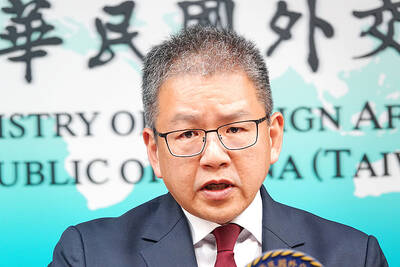
Taiwan is still in the process of assessing the possibility of recruiting workers from Eswatini, the Ministry of Foreign Affairs said yesterday, adding that its goal is to help Eswatini upgrade its vocational training centers. If there are plans to recruit workers from Eswatini, safeguarding national security, protecting public health and ensuring the employment rights of Taiwanese would be prerequisites, Department of West Asian and African Affairs Director-General Yen Chia-liang (顏嘉良) told a news conference. Key considerations would also include filling labor shortages in specific industries, and fostering bilateral professional and technical exchanges, he said. Yen was asked about the progress of labor
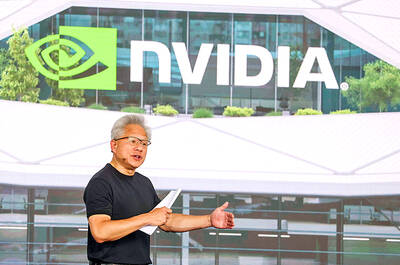
‘BOOMING’: ’ The number of partners we have here is incredible. You can see from their stock prices. They’re doing so well, they’re so happy,’ Jensen Huang said Nvidia Corp’s spending in Taiwan has ballooned to about US$150 billion a year, 10 times the US$10 billion to US$15 billion the company spent five years ago, Nvidia chief executive officer Jensen Huang (黃仁勳) said yesterday, suggesting Taiwan’s strategic importance in the global artificial intelligence (AI) supply chain. “Taiwan is the epicenter of the AI revolution. This is where the chips come, packaging comes. This is where the systems are made. This is where AI supercomputers were created,” Huang said at a meeting for the company’s employees in Beitou-Shilin Technology Park (北投士林科技園區) in Taipei, the planned site of Nvidia’s Taipei headquarters. “Taiwan


 RSS
RSS