


A Philippine diplomat yesterday said that any Chinese move to turn a disputed shoal — where the US Navy recently spotted a suspected Chinese survey ship — into an island would escalate the disputes in the South China Sea and asked Washington to convince Beijing not to take that “very provocative” step.
Philippine Ambassador to Washington Jose Cuisia Jr told a news conference in Manila that a senior US Navy official reported spotting a suspected Chinese survey ship in the Scarborough Shoal, which Taiwan also claims, a few weeks ago and expressed concern about its presence in the disputed offshore area.
The Scarborough Shoal is known in Taiwan and China as Huangyan Island (黃岩島).
China has said it has completed construction work to turn seven reefs into islands in the the South China Sea’s disputed Spratly Islands (Nansha Islands, 南沙群島), raising alarm in the region and sparking calls by Asian and Western governments for China to stop taking provocative action that might lead to confrontations. Beijing says it has sovereignty over the Spratlys, which Taiwan also claims and has the right to build there.
The US Navy sighting of the survey ship in Scarborough, a rich fishing area about 230km west of the Philippines, has reinforced suspicions that Beijing is eyeing the vast atoll as its next target in its island-making spree, Cuisia said.
“That I think will be very provocative if they will build on Scarborough Shoal,” Cuisia said, adding that such an action “will further escalate the tensions and the conflict.”
The Philippines is incapable of stopping China from constructing an island in the shoal, where Filipino fishermen have been barred by Chinese coast guard ships, Cuisia said.
“We hope that the US and other countries ... would convince China not to proceed with that,” he said.
Washington does not take sides in the disputes involving Taiwan, China, the Philippines and three other governments, but has declared that ensuring freedom of navigation and overflight in the busy waters is in its national interest.
Cuisia said he was involved in a US Department of State-brokered deal for China and the Philippines to withdraw their ships simultaneously from Scarborough to avoid a potential clash during a tense standoff in 2012.
China reneged on that deal by refusing to withdraw its ships after the Philippines did and now claims there was no such deal, he said.
“We were shortchanged,” Cuisia said.
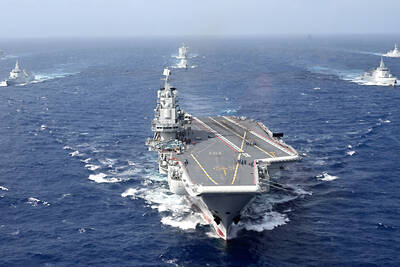
PROVOCATIVE: Chinese Deputy Ambassador to the UN Sun Lei accused Japan of sending military vessels to deliberately provoke tensions in the Taiwan Strait China denounced remarks by Japan and the EU about the South China Sea at a UN Security Council meeting on Monday, and accused Tokyo of provocative behavior in the Taiwan Strait and planning military expansion. Ayano Kunimitsu, a Japanese vice foreign minister, told the Council meeting on maritime security that Tokyo was seriously concerned about the situation in the East China and South China seas, and reiterated Japan’s opposition to any attempt to change the “status quo” by force, and obstruction of freedom of navigation and overflight. Stavros Lambrinidis, head of the EU delegation to the UN, also highlighted South China Sea
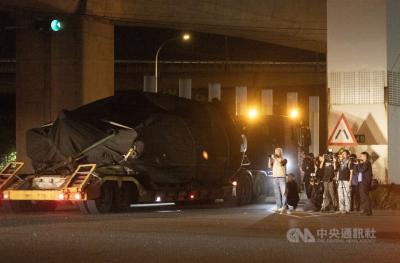
The final batch of 28 M1A2T Abrams tanks purchased from the US arrived at Taipei Port last night and were transported to the Armor Training Command in Hsinchu County’s Hukou Township (湖口), completing the military’s multi-year procurement of 108 of the tanks. Starting at 12:10am today, reporters observed more than a dozen civilian flatbed trailers departing from Taipei Port, each carrying an M1A2T tank covered with black waterproof tarps. Escorted by military vehicles, the convoy traveled via the West Coast Expressway to the Armor Training Command, with police implementing traffic control. The army operates about 1,000 tanks, including CM-11 Brave Tiger
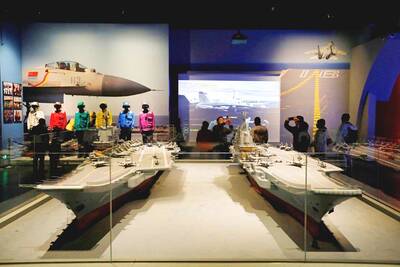
China on Wednesday teased in a video an aircraft carrier that could be its fourth, and the first using nuclear power, while making an allusion to Taiwan and vowing to further build up its islands, as it looks to boost maritime power, secure resources and bolster territorial claims. The video, issued on the eve of the 77th founding anniversary of the Chinese People’s Liberation Army Navy, featured fictional officers with names that are homophones of three commissioned aircraft carriers, the Liaoning (遼寧), Shandong (山東) and Fujian (福建). Titled Into the Deep, it showed a 19-year-old named “Hejian” (何劍) joining the group, sparking
BIG YEAR: The company said it would also release its A12 chip the same year to keep a ‘reliable stream of new silicon technologies’ flowing to its customers Taiwan Semiconductor Manufacturing Co (TSMC, 台積電) yesterday said its newest A13 chip is to enter volume production in 2029 as the chipmaker seeks to hold onto its tech leadership and demand for next-generation chips used in artificial intelligence (AI), high-performance-computing (HPC) and mobile applications. TSMC, the world’s biggest contract chipmaker, also unveiled its A12 chip at its annual technology symposium in Santa Clara, California. The A12 chip, which features TSMC’s super-power-rail technology to provide backside power delivery for AI and HPC applications, is also to enter volume production in 2029, a year after the scheduled release of the A14 chip. The technology moves


 RSS
RSS