


The Taipei District Court yesterday ruled that the Taipei City Government’s alleged forced hospitalization of a homeless man surnamed Ting (丁) on Thursday was flawed, demanding that Ting be discharged immediately from Taipei City Hospital’s Songde Branch.
It is unclear whether Ting had any intention of hurting himself or others at the time of his hospitalization, but Ting was hospitalized against his will and deprived of his personal freedom, which is a breach of the Mental Health Act (精神衛生法), the court said.
The Songde hospital on Friday night said that it had transported Ting back to his usual spot at National Chengchi University (NCCU) in a taxi out of respect for his request to be discharged made in a teleconference with the court earlier that afternoon.
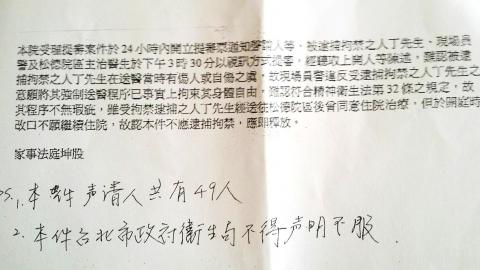
Photo: Hsiang Cheng-chen, Taipei Times
However, questions over the incident remained as statements by Taipei Mayor Ko Wen-je (柯文哲) and the Taipei Department of Health did not seem to match up, adding to the confusion over the incident.
According to a report by the Chinese-language Apple Daily, Ko on Friday said an informant reported Ting to the health department on Thursday. The informant was a classmate of Ting’s from elementary school, Ko said in the report.
“The informant said he [Ting] needed to be hospitalized because he appeared skinnier,” Ko was quoted as saying.
“Did you think the government had nothing better to do than patrol the NCCU campus all day?” he said.
“This was supposed to be a touching story and you reported it as if he had been forced,” Ko said.
However, a statement released by the health department on the same day said there was no informant and that it hospitalized Ting after a check on his wellbeing. The department said Ting was on a list of individuals it routinely checks on.
Footage recorded by a witness showed police on Thursday restraining Ting, who was clearly struggling, on a stretcher before taking him away in an ambulance.
Netizens upset with what they called a breach of human rights launched a Facebook campaign targeting Ko.
The campaign, titled: “Force Ko Wen-je to the hospital. Help Taipei write the most touching story,” was organized by a netizen using the name “Tamsui grandma.”
The Facebook group said that Ko might be mentally unstable, judging by his habits of scratching his head and using the phrase: “That is odd.”
Ko should resign if he loses weight, because it hampers one’s ability to walk on campus, let alone govern a city, the campaign said, in an apparent reference to a health department report that Ting had not eaten in days.
“Borough wardens should arrange more community events to lure the eccentric Ko from his home,” it said, adding that Ko should apologize to Ting and revise the city’s procedures.
Additional reporting by CNA

LEVERAGE: China did not ‘need to fire a shot’ to deny Taiwan airspace over Africa when it owns ‘half the continent’s debt,’ a US official said, calling it economic warfare The EU has raised concerns about overflight rights following the delay of President William Lai’s (賴清德) planned state visit to the Kingdom of Eswatini after three African nations denied overflight clearance for his charter at the last minute. Taiwanese allies Paraguay and Saint Kitts and Nevis, as well as several US lawmakers and the Inter-Parliamentary Alliance on China (IPAC) condemned China for allegedly pressuring the countries. Lai was scheduled to fly directly to Taiwan’s only African ally from yesterday to Sunday to celebrate the 40th anniversary of King Mswati III’s accession and his 58th birthday, but Seychelles, Mauritius and Madagascar suddenly revoked
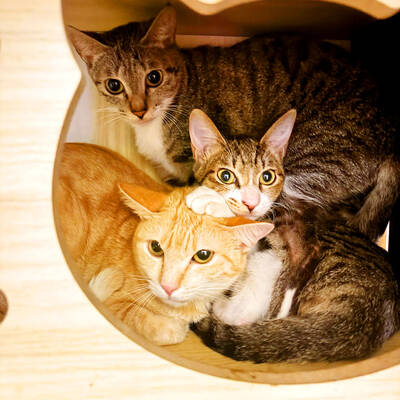
The number of pet cats in Taiwan surpassed that of pet dogs for the first time last year, reaching 1,742,033, a 32.8 percent increase from 2023, the Ministry of Agriculture said yesterday, citing a survey. By contrast, the number of pet dogs declined slightly by 1.2 percent over the same period to 1,462,528, the ministry said. Despite the shift, households with dogs still slightly outnumber those with cats by 1.2 percent. However, while the number of households with multiple dogs has remained relatively stable, households keeping more than two cats have increased, contributing to the overall rise in the feline population. The trend

China on Wednesday teased in a video an aircraft carrier that could be its fourth, and the first using nuclear power, while making an allusion to Taiwan and vowing to further build up its islands, as it looks to boost maritime power, secure resources and bolster territorial claims. The video, issued on the eve of the 77th founding anniversary of the Chinese People’s Liberation Army Navy, featured fictional officers with names that are homophones of three commissioned aircraft carriers, the Liaoning (遼寧), Shandong (山東) and Fujian (福建). Titled Into the Deep, it showed a 19-year-old named “Hejian” (何劍) joining the group, sparking

BIG YEAR: The company said it would also release its A12 chip the same year to keep a ‘reliable stream of new silicon technologies’ flowing to its customers Taiwan Semiconductor Manufacturing Co (TSMC, 台積電) yesterday said its newest A13 chip is to enter volume production in 2029 as the chipmaker seeks to hold onto its tech leadership and demand for next-generation chips used in artificial intelligence (AI), high-performance-computing (HPC) and mobile applications. TSMC, the world’s biggest contract chipmaker, also unveiled its A12 chip at its annual technology symposium in Santa Clara, California. The A12 chip, which features TSMC’s super-power-rail technology to provide backside power delivery for AI and HPC applications, is also to enter volume production in 2029, a year after the scheduled release of the A14 chip. The technology moves


 RSS
RSS