


Just hours after winning a board vote to take control of Japanese electronics maker Sharp Corp, Hon Hai Precision Industry Co (鴻海精密) said in a surprise reversal that it would postpone signing a definitive agreement because of “new material information.”
Under an agreement announced by Sharp, Hon Hai — the parent company of Foxconn Technology Group (富士康) — would get control over the company by spending ¥484.3 billion (US$4.3 billion) to buy additional shares. The Taiwanese company said it would not finalize a deal until the situation with the new information is resolved.
Hon Hai’s response cast uncertainty over a deal that Sharp had outlined in detail just hours before, and was seen as a sign of Japan’s growing openness to foreign acquisitions. The board of the century-old consumer electronics maker had to choose between Innovation Network Corp of Japan’s plan to restructure by spinning off businesses, or staying whole under a foreign parent.
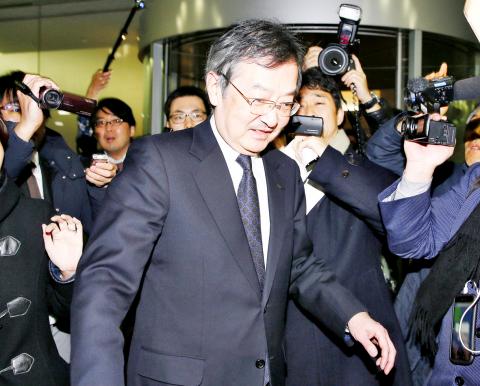
Photo: Kyodo News via AP
Hon Hai, the main assembler of Apple Inc’s iPhone, is aiming to take over one of the largest suppliers of screens for phones and tablets.
“That puts the entire deal in jeopardy,” Jefferies Group LLC analyst Atul Goyal wrote in a report.
Hon Hai put out a one-paragraph statement late yesterday after Sharp disclosed the agreement terms.
It read in its entirety: “We acknowledge receipt of a notice today from Sharp’s board choosing us as their preferred partner. After receiving new material information from Sharp yesterday morning, we have accordingly informed Sharp last night [before the board meeting on Wednesday] that we will have to postpone any signing of a definitive agreement until we have arrived at a satisfactory understanding and resolution of the situation.”
The new information is a list of about ¥350 billion of contingent liabilities at Sharp, the Wall Street Journal reported, citing unidentified people familiar with the matter.
Sharp had no immediate comment on Hon Hai’s statement.
“It’s odd that after chasing a company for four years you wouldn’t do your due diligence and find out about off-balance sheet contingent liabilities far ahead of striking a final agreement,” Sanford C Bernstein & Co analyst Alberto Moel said.
Under the announced deal, Foxconn would control 65.9 percent of Sharp after buying new shares at ¥118 apiece, or 32 percent less than Wednesday’s closing price.
Sharp shares fell 14 percent after details of the deal were announced, with the stock finishing at a nine-month low of ¥149 yen. Hon Hai’s shares closed 2.6 percent higher yesterday, before Sharp outlined details of its deal.
“It isn’t a victory for Sharp shareholders, and I’m not at all sure if this is a victory for Foxconn and its shareholders may see that money simply evaporate,” Goyal said by telephone.
Hon Hai chairman Terry Gou (郭台銘) is seeking to broaden Foxconn’s remit, transforming it into a company that also makes key electronics components and devices. Foxconn had proposed a total rescue plan worth about ¥660 billion, a person familiar said previously.
As part of the deal announced by Sharp, Foxconn would buy ¥100 billion of preferred shares owned by Mizuho Financial Group and Mitsubishi UFJ Financial Group, or half of each bank’s holdings. Mizuho ended 2.7 percent higher while MUFJ closed up 1.8 percent.
Sharp would remain an independent company and keep the brand under new ownership, it said in a statement.
The Japanese company, which pledged to maintain employment levels, would work with Foxconn on next-generation high-end flexible displays for smartphones and other devices.

‘NO SECURITY RISK’: The Railway Bureau reassured the public that the technicians’ activities were limited to technical guidance and did not involve sensitive systems The Railway Bureau yesterday said it had invited eight Chinese technicians to assist with an airport MRT construction project. The bureau issued the confirmation after an Internet user said Chinese nationals had entered the construction zone of Taiwan Taoyuan International Airport’s Terminal 3 project. They asked why “individuals from an enemy state” were allowed access to such a major national infrastructure project, which raised serious concerns over Taiwan’s industrial safety, sensitive systems and information security. The bureau’s Northern Region Engineering Branch Office said subcontractor Taiwan Handle Industrial Co (台灣手把工業) of the Taoyuan airport MRT’s “Contract No. CU05 Project A14 Station Civil, MEP &

A US uncrewed surface vessel (USV) encountered multiple Chinese warships during an autonomous transit of the Taiwan Strait, US defense company Seasats said in a statement on Wednesday. Seasats announced that a Lightfish USV had completed the first autonomous transit of the Taiwan Strait. Over five days, the USV traversed the entire length of the Strait while constantly monitoring surface vessel traffic, the company said. The Lightfish encountered multiple Chinese warships, one of which was a Chinese People’s Liberation Army Navy (PLAN) Type 056 corvette, it said. The Chinese vessels were operating “well within Taiwan’s exclusive economic zone without transmitting their identity via the
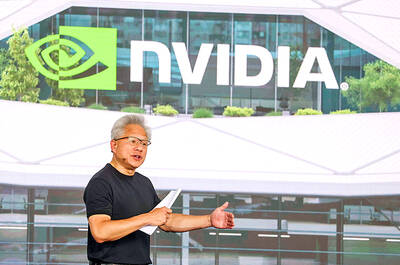
‘BOOMING’: ’ The number of partners we have here is incredible. You can see from their stock prices. They’re doing so well, they’re so happy,’ Jensen Huang said Nvidia Corp’s spending in Taiwan has ballooned to about US$150 billion a year, 10 times the US$10 billion to US$15 billion the company spent five years ago, Nvidia chief executive officer Jensen Huang (黃仁勳) said yesterday, suggesting Taiwan’s strategic importance in the global artificial intelligence (AI) supply chain. “Taiwan is the epicenter of the AI revolution. This is where the chips come, packaging comes. This is where the systems are made. This is where AI supercomputers were created,” Huang said at a meeting for the company’s employees in Beitou-Shilin Technology Park (北投士林科技園區) in Taipei, the planned site of Nvidia’s Taipei headquarters. “Taiwan
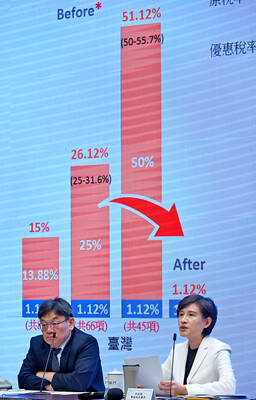
GREATER REACH? Auto parts and wood products would face tariffs of up to 15%, matching those targeting the EU, Japan and South Korea, Vice Premier said The US has announced that preferential tariff treatment for Taiwan’s non-semiconductor Section 232 goods would take effect retroactively from May 1, the Executive Yuan said yesterday. The US government yesterday posted a notice on the Federal Register’s public inspection Web site previewing tariff concessions for Taiwan under a memorandum of understanding (MOU) on Taiwan-US investment after two months of negotiations. The MOU signed on Jan. 15 stipulated three major preferential tariff arrangements: a 15 percent “reciprocal” tariff rate for Taiwan without stacking most-favored nation (MFN) rates; preferential Section 232 treatment for semiconductors and related products; and preferential Section 232 treatment for non-semiconductor


 RSS
RSS